
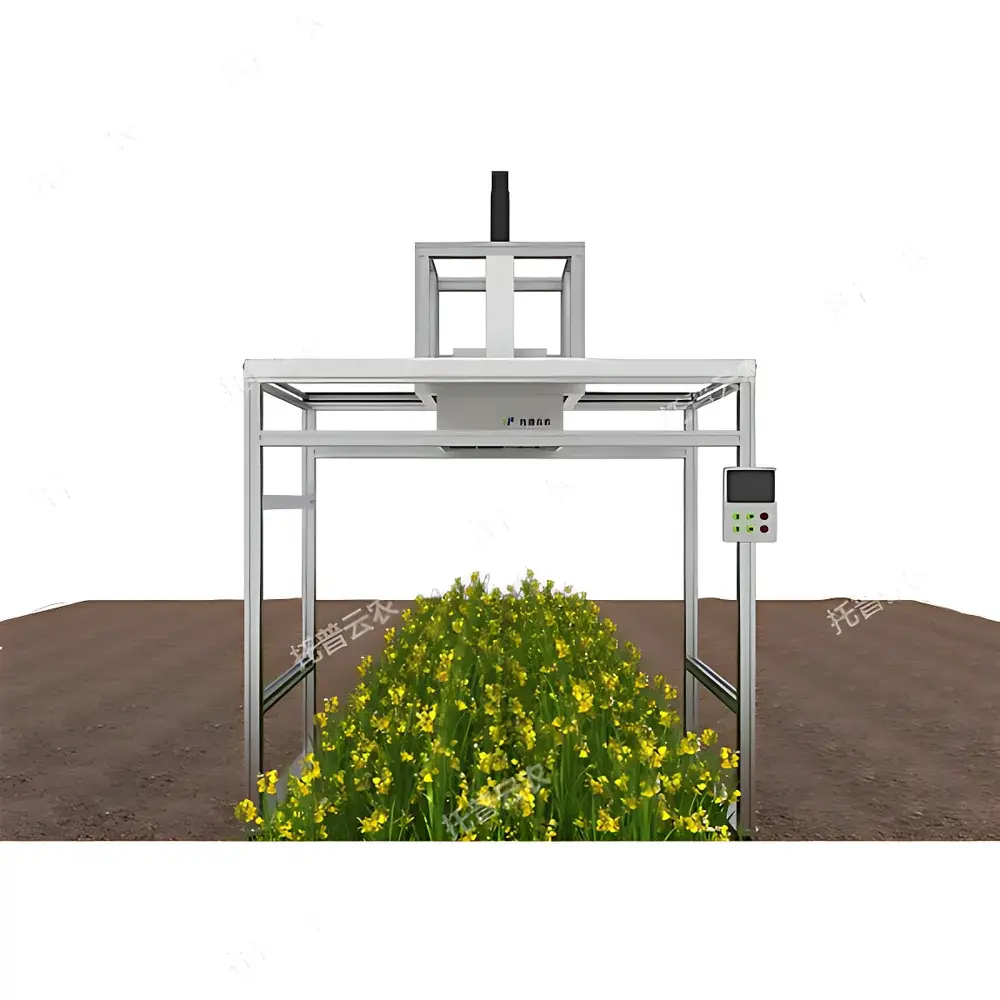
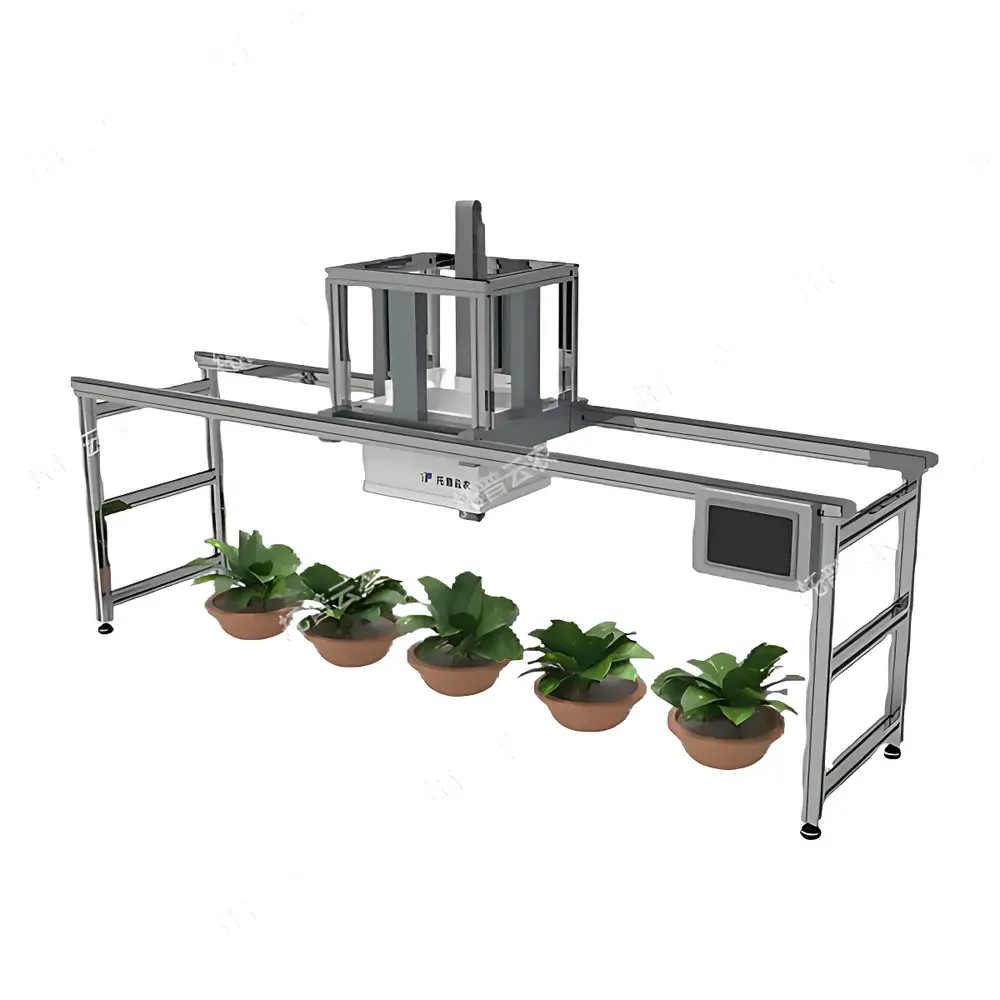
Top Cloud-agri TP-MPR-I3 Mobile Single-Axis Gantry Plant Phenotyping System
| Brand | Top Cloud-agri |
|---|---|
| Origin | Zhejiang, China |
| Manufacturer Type | Manufacturer |
| Region of Origin | Domestic (China) |
| Model | TP-MPR-I3 |
| Pricing | Upon Request |
Overview
The Top Cloud-agri TP-MPR-I3 Mobile Single-Axis Gantry Plant Phenotyping System is an engineered field-deployable platform designed for high-throughput, non-destructive phenotypic characterization of plants under controlled greenhouse, growth chamber, or open-field conditions. It operates on a motorized single-axis gantry architecture with programmable X- and Z-axis motion control, enabling precise positioning of multi-modal optical sensors above individual plants or plots without mechanical disturbance. The system implements a standardized imaging geometry—fixed working distance (850 mm), calibrated field-of-view (2540 × 900 mm), and repeatable sensor-to-plant alignment—to ensure spatial consistency and measurement reproducibility across time-series experiments. Its modular sensor integration framework supports synchronized acquisition from visible-light, hyperspectral, and thermal infrared modalities, enabling concurrent extraction of morphological, spectral, and physiological traits aligned to common georeferenced coordinates. This architecture meets the foundational requirements of quantitative plant phenomics: geometric stability, spectral fidelity, temporal repeatability, and environmental contextualization.
Key Features
- Programmable dual-axis (X/Z) gantry with precision stepper motor control, enabling automated sensor positioning and height-adaptive imaging for plants up to 1 m tall
- Modular optical payload bay accommodating interchangeable sensor units: 25 MP visible-light camera (5120 × 5120 pixels, 2.5 µm pixel pitch), push-broom hyperspectral imager (400–1000 nm, 224 bands, 5.5 nm spectral resolution), and uncooled microbolometer thermal camera (640 × 480 resolution, −40 to 150 °C range, ±2 °C absolute accuracy)
- Integrated environmental monitoring suite with calibrated sensors for ambient temperature, relative humidity, and photosynthetic photon flux density (PPFD), time-synchronized with image acquisition
- Embedded ROI-based analysis engine supporting both automatic segmentation and user-defined region selection for comparative spectral reflectance, thermal heterogeneity, and morphometric profiling
- Onboard preprocessing pipeline executing real-time radiometric calibration, geometric correction, and noise reduction prior to data storage
- Fail-safe mechanical design featuring limit switches, emergency stop circuitry, and fault logging compliant with IEC 61508 functional safety principles
Sample Compatibility & Compliance
The TP-MPR-I3 accommodates potted plants, seedling trays, and in-ground field plots with minimal setup adaptation. Its mobile chassis allows repositioning between experimental zones without structural anchoring, while the adjustable Z-axis ensures consistent imaging geometry across variable canopy heights. All optical modules adhere to ISO 17025 traceability guidelines where applicable: hyperspectral radiometric calibration is referenced to NIST-traceable standards; thermal camera calibration follows ASTM E1933-19 protocols for infrared thermography. Data acquisition workflows support GLP-compliant metadata tagging—including operator ID, timestamp, GPS-derived location (optional external module), and environmental context—and are compatible with 21 CFR Part 11 audit trail requirements when deployed with validated software configuration.
Software & Data Management
The proprietary TopPheno™ software provides unified control of hardware motion, sensor triggering, and synchronized data ingestion. It implements a hierarchical database schema with relational linking between raw images, derived phenotypic parameters, environmental logs, and experimental metadata. Analysis modules include: (i) visible-light morphology quantification (leaf area index, fractal dimension, convex hull metrics, senescence ratio); (ii) hyperspectral vegetation index computation (NDVI, GVI, PRI, MCARI, among 30+ indices); (iii) thermal canopy temperature statistics and drought stress index derivation; and (iv) time-series trend visualization using interactive line plots, heatmaps, and statistical overlay charts. Export formats include CSV, HDF5, and GeoTIFF; all datasets retain embedded EXIF and XMP metadata for FAIR (Findable, Accessible, Interoperable, Reusable) compliance. Local storage utilizes encrypted SQLite with optional network-attached storage (NAS) replication and incremental backup scheduling.
Applications
This system supports longitudinal studies in crop improvement programs, including genotype-by-environment interaction analysis, abiotic stress phenotyping (drought, heat, salinity), biotic stress response monitoring (pathogen progression, insect herbivory), nutrient use efficiency assessment, and developmental staging validation. It has been deployed in breeding trials for rice, wheat, maize, tomato, and Arabidopsis under both controlled-environment and semi-field conditions. The synchronized multi-sensor architecture enables cross-modal correlation—for example, linking NDVI decline with rising canopy temperature during water deficit, or correlating chlorophyll-a absorption features with visible-texture descriptors of leaf rolling. Its portability makes it suitable for distributed phenotyping networks where centralized imaging facilities are impractical.
FAQ
Can the system operate autonomously overnight in unattended greenhouse environments?
Yes—the gantry motion, sensor triggering, and environmental logging are fully scriptable via scheduled task sequences; power management includes low-power standby mode and battery-backed real-time clock synchronization.
Is hyperspectral data calibrated for absolute reflectance?
Yes—each acquisition session includes reference panel capture using a certified 99% reflectance Spectralon® target; raw cube data undergoes dark-current subtraction and illumination-normalized conversion to apparent reflectance.
How is thermal data georeferenced to visible/hyperspectral imagery?
All sensors share a common coordinate frame defined by the gantry’s kinematic model; sub-pixel registration is achieved through checkerboard-based homography estimation during system initialization.
Does the software support custom algorithm integration?
Yes—TopPheno™ exposes a Python API with documented hooks for user-defined feature extraction, machine learning inference, and third-party model deployment within the analysis pipeline.
What maintenance is required for long-term field deployment?
Annual recalibration of thermal and hyperspectral modules is recommended; optical windows require periodic cleaning with lens-grade solvent; gantry rails should be inspected quarterly for particulate accumulation in dusty environments.



