
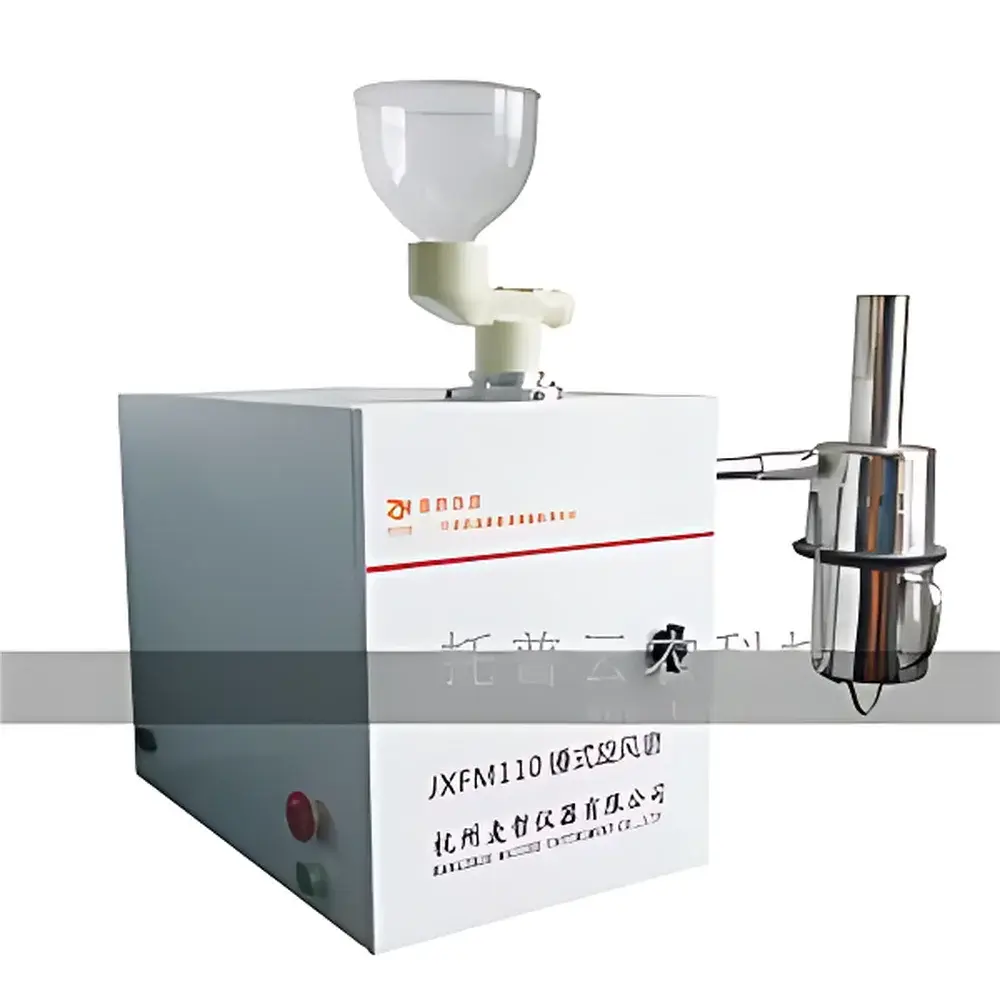
Top Cloud-agri JXFM110 Hammer Cyclone Mill
| Brand | Top Cloud-agri |
|---|---|
| Origin | Zhejiang, China |
| Manufacturer Type | Direct Manufacturer |
| Country of Origin | China |
| Model | JXFM110 |
| Price Range | USD 1,250 – 1,680 |
| Power Supply | AC 220 ±10 V, 50 Hz |
| Motor Power | 750 W |
| Grinding Chamber Diameter | 110 mm |
| Hammer Rotational Speed | 16,800 rpm |
| Sieve Aperture Options | 0.5 mm, 0.8 mm, 1.5 mm |
| Net Weight | 51 kg |
| Noise Level | <72 dB(A) |
| Thermal Protection | Built-in motor temperature cutoff switch (auto-restart upon cooling) |
| Feed Control | Compatible with optional automated feeder for high-moisture and hulled cereals |
| Sample Compatibility | Wheat, rice (paddy), corn, barley, oats, rye, sorghum, soybean meal |
Overview
The Top Cloud-agri JXFM110 Hammer Cyclone Mill is a precision laboratory grinding instrument engineered specifically for grain and oil analysis in food quality control and agricultural research laboratories. It operates on the principle of high-speed impact comminution combined with pneumatic cyclonic separation: sample material is introduced into the grinding chamber where it is subjected to repeated collisions with rotating tungsten-carbide-tipped hammers spinning at 16,800 rpm. The resulting fine particles are carried by centrifugal air flow through interchangeable stainless-steel sieve plates (0.5 mm, 0.8 mm, or 1.5 mm aperture), ensuring consistent particle size distribution essential for standardized physicochemical testing. Unlike conventional disc or roller mills, this design minimizes thermal degradation and particle agglomeration—critical when preparing samples for rheological, enzymatic, and spectroscopic assays requiring strict reproducibility.
Key Features
- High-efficiency impact grinding architecture delivering uniform sub-millimeter particle size distribution (e.g., ≥95% passing 0.42 mm for wheat flour preparation per CQ16 sieve standard)
- Integrated acoustic damping: interior chamber lined with certified sound-absorbing composite material achieving noise levels below 72 dB(A), compliant with ISO 7779 and OSHA 29 CFR 1910.95 workplace exposure limits
- Motor-integrated thermal protection circuitry automatically interrupts operation above preset threshold (typically 110°C); system resumes function only after passive cooling to ≤60°C—ensuring long-term motor reliability under continuous batch processing
- Modular feed interface supports retrofitting of programmable volumetric feeders, enabling precise control of feed rate for moisture-rich grains (e.g., paddy rice at 18–22% w.b.) and hulled cereals (e.g., oat groats), thereby reducing clogging and improving throughput consistency
- Tool-free sieve plate exchange mechanism allows rapid adaptation to analytical method requirements—including ASTM D7420-22 (for flour particle size profiling) and GB/T 5507–2019 (Chinese national standard for cereal grinding)
- Fail-safe interlock system: mill halts immediately if access door is opened during operation; emergency stop button conforms to IEC 60204-1 safety standards
Sample Compatibility & Compliance
The JXFM110 is validated for use with intact and milled cereal matrices including hard red winter wheat, brown rice, yellow dent corn, barley, rye, and full-fat soybean meal. Its grinding performance meets sieve retention specifications required by internationally recognized test methods: ≥90% passage through 0.50 mm (CQ14) for falling number analysis (ISO 3093:2022), ≥95% passage through 0.437 mm (CQ16) for gluten quantity/quality determination (ICC Standard Method No. 155), and ≥90% passage through 0.270 mm (CQ24) for viscosity testing of wheat flour slurries (AACC Method 22-05). The instrument is not intended for moisture content determination (per ISO 6540 or AOAC 950.46), as heat generation during milling may induce evaporative loss. All structural materials comply with FDA 21 CFR §177.2600 for food-contact surfaces.
Software & Data Management
While the JXFM110 is a standalone mechanical instrument without embedded digital controls, its operational parameters are fully traceable within laboratory information management systems (LIMS). Each unit ships with a calibration certificate documenting rotational speed verification (±20 rpm tolerance at 16,800 rpm), sieve plate dimensional metrology (certified via optical profilometry), and acoustic emission testing report. For GLP/GMP-regulated environments, users may integrate usage logs—including operator ID, sample ID, sieve specification, and run duration—into electronic notebooks compliant with 21 CFR Part 11 audit trail requirements. Firmware-upgradable optional feed controllers (sold separately) support RS-485 Modbus RTU communication for centralized process monitoring.
Applications
- Preparation of homogenized flour samples for Farinograph, Extensograph, and Mixolab analyses (AACC Methods 54-40A, 54-10, 54-60)
- Generation of standardized grist for falling number testing (ISO 3093, AACCI Method 56-81B)
- Production of representative subsamples for near-infrared (NIR) spectral calibration models targeting protein, moisture, starch, and ash content in cereals
- Routine grinding of rice bran and corn germ prior to solvent extraction for fatty acid value (FAV) determination (GB/T 15684–2015)
- Particle size reduction of whole grains for dough rheology studies evaluating starch gelatinization kinetics and gluten network development
FAQ
Can the JXFM110 be used for moisture analysis?
No. Due to frictional heating during high-speed hammer impact, the mill induces non-negligible water loss. Moisture determination must be performed on unground or cryo-ground material per ISO 6540 or AOAC 950.46.
What sieve aperture should be selected for falling number testing?
A 0.8 mm stainless-steel sieve (CQ14 equivalent) is recommended to achieve ≥90% passage of ground wheat, satisfying ISO 3093:2022 particle size requirements.
Is the mill compatible with GMP documentation workflows?
Yes—when paired with validated feed automation and LIMS integration, all critical operating parameters (speed, time, sieve ID) can be recorded with electronic signatures and audit trails meeting 21 CFR Part 11 expectations.
How often does the hammer assembly require replacement?
Under typical laboratory use (≤8 hrs/day, 5 days/week), tungsten-carbide hammer tips maintain dimensional integrity for ≥1,200 operating hours; wear verification is performed during semi-annual preventive maintenance using calibrated micrometers.
Does the instrument include CE or UL certification?
The JXFM110 carries CCC (China Compulsory Certification) and complies with IEC 61000-6-3 (EMC) and IEC 61000-6-2 (immunity) standards; UL/CE versions are available upon request with modified power supply and enclosure labeling.



