
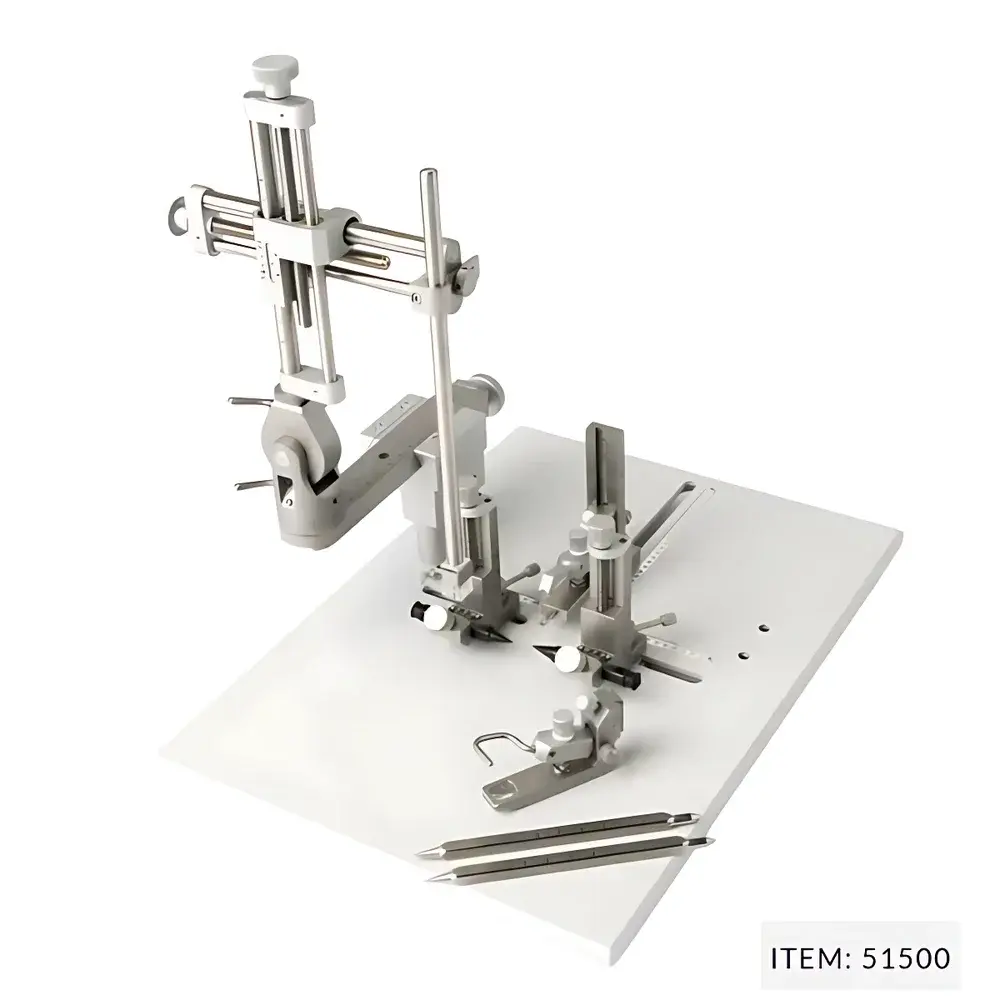
Stoelting Model 51500 New Standard Universal Stereotaxic Instrument
| Brand | Stoelting |
|---|---|
| Origin | USA |
| Model | 51500 |
| Type | Universal (Mouse & Rat) |
| Frame Design | U-Frame-Free Open-Architecture Base |
| Adjustment Axes | Three-Axis Manual Micrometer (X/Y/Z) |
| Ear Bar Configuration | Dual-Angle Rat Ear Bars (18° & 45°), Mouse-Specific Ear Pins & Nasal Adapter |
| Compliance | Designed for GLP-compliant preclinical neuroscience research |
Overview
The Stoelting Model 51500 New Standard Universal Stereotaxic Instrument is a precision-engineered, manually operated neurosurgical apparatus designed to enable accurate three-dimensional targeting of subcortical brain structures in both mice and rats without craniotomy or direct visual access. Based on the stereotactic coordinate system—referenced to standardized bregma–lambda landmarks and defined by orthogonal X (anterior–posterior), Y (medial–lateral), and Z (dorsal–ventral) axes—the instrument provides repeatable, millimeter-level spatial resolution essential for intracerebral injections, electrode implantation, lesioning, optogenetic fiber placement, and microdialysis probe guidance. Unlike legacy Lab Standard platforms, the 51500 integrates a re-engineered open-architecture base that eliminates the restrictive U-shaped frame, significantly expanding unobstructed working space above the animal’s skull. Its universal compatibility eliminates the need for adapter swaps between mouse and rat procedures—a critical advancement for high-throughput behavioral pharmacology, neurodegenerative disease modeling (e.g., Parkinson’s, Alzheimer’s), ischemic stroke, and neural stem cell transplantation studies.
Key Features
- Universal rodent compatibility: Single-base configuration supports both mice (via dedicated low-profile ear pins and nasal adapter) and rats (with dual-angle 18°/45° ear bars) without mechanical reconfiguration.
- Open-architectural base design: Removal of traditional U-frame maximizes vertical clearance and lateral access—facilitating simultaneous multi-probe insertion, surgical microscope integration, and intraoperative imaging alignment.
- Three-axis micrometer-driven positioning: High-resolution manual controls (X/Y/Z) with engraved scales and locking mechanisms ensure sub-millimeter reproducibility across repeated experiments.
- Rat-specific dual-angle ear bars: Independently adjustable 18° and 45° angles accommodate anatomical variation across rat strains (e.g., Sprague-Dawley vs. Long-Evans), improving skull stabilization and reducing torque-induced drift.
- Mouse-optimized fixation system: Precision-machined ear pins and a low-force nasal adapter minimize tissue compression while maintaining consistent head orientation relative to the stereotactic plane.
- Modular accessory interface: Standardized mounting points support third-party add-ons including hydraulic microdrives, LED-based optogenetic commutators, and real-time depth-sensing cannula guides.
Sample Compatibility & Compliance
The Model 51500 is validated for use with adult C57BL/6, BALB/c, CD-1, and ICR mice (18–30 g) and Sprague-Dawley, Wistar, and Long-Evans rats (200–500 g). All structural components meet ISO 13485–aligned manufacturing protocols for medical-grade laboratory instrumentation. While not a medical device per FDA 21 CFR Part 820, its mechanical repeatability and traceable calibration methodology support compliance with GLP (Good Laboratory Practice) documentation requirements for nonclinical laboratory studies (OECD 407, 422). The instrument’s design facilitates adherence to ARRIVE 2.0 guidelines for reporting animal research and aligns with institutional IACUC-approved surgical protocols requiring precise, minimally invasive intracranial targeting.
Software & Data Management
As a fully manual platform, the Model 51500 does not incorporate embedded electronics or proprietary software. However, it is interoperable with widely adopted neuroscience data acquisition ecosystems—including Spike2 (CED), NeuroPort (Blackrock Neurotech), and MATLAB-based custom stimulation/injection control scripts—via standard mechanical interface mounts. Digital calipers and external optical encoders (e.g., Mitutoyo Digimatic) may be affixed for audit-ready position logging. All adjustment values are mechanically inscribed and retain traceability without power dependency—ensuring full compliance with 21 CFR Part 11 requirements when paired with validated electronic lab notebook (ELN) systems for procedural documentation.
Applications
- Establishment and validation of neurodegenerative disease models (e.g., 6-OHDA lesions for Parkinson’s, Aβ/tau injection for Alzheimer’s).
- Targeted intracerebroventricular (ICV), intrastriatal, or hippocampal delivery of viral vectors, antisense oligonucleotides, or small-molecule therapeutics.
- Chronic electrode array implantation for in vivo electrophysiology (LFP, single-unit recording) and closed-loop neuromodulation.
- Image-guided stereotaxy workflows integrating MRI/CT-derived atlases with physical coordinate mapping.
- Preclinical evaluation of blood–brain barrier permeability enhancers via precise cortical or thalamic microinjection.
- Neurodevelopmental studies requiring bilateral, symmetric targeting across developmental timepoints (P7–P60).
FAQ
Is the Model 51500 compatible with stereotactic atlases such as Paxinos & Watson?
Yes—the instrument uses standardized bregma–lambda referencing and supports direct coordinate translation from Paxinos & Watson (7th ed.), Franklin & Paxinos (mouse), and Allen Brain Atlas digital coordinates.
Can I upgrade my existing Lab Standard base to the New Standard configuration?
No—New Standard components (base, ear bars, adapters) are not mechanically retrofittable onto Lab Standard frames due to fundamental differences in mounting geometry and load-bearing architecture.
What is the maximum weight capacity of the ear bar assembly?
The dual-angle rat ear bars are rated for static loads up to 750 g; mouse ear pins are optimized for ≤35 g head mass with <0.05 mm positional hysteresis after repeated clamping cycles.
Does Stoelting provide installation or protocol training?
Yes—Stoelting offers on-site or virtual technical training sessions covering coordinate referencing, strain-specific alignment, surgical workflow integration, and maintenance certification.
Are replacement parts and calibration tools available separately?
All consumables—including ear pins, nasal adapters, micrometer knobs, and leveling feet—are stocked globally and supplied with NIST-traceable dimensional verification certificates.



