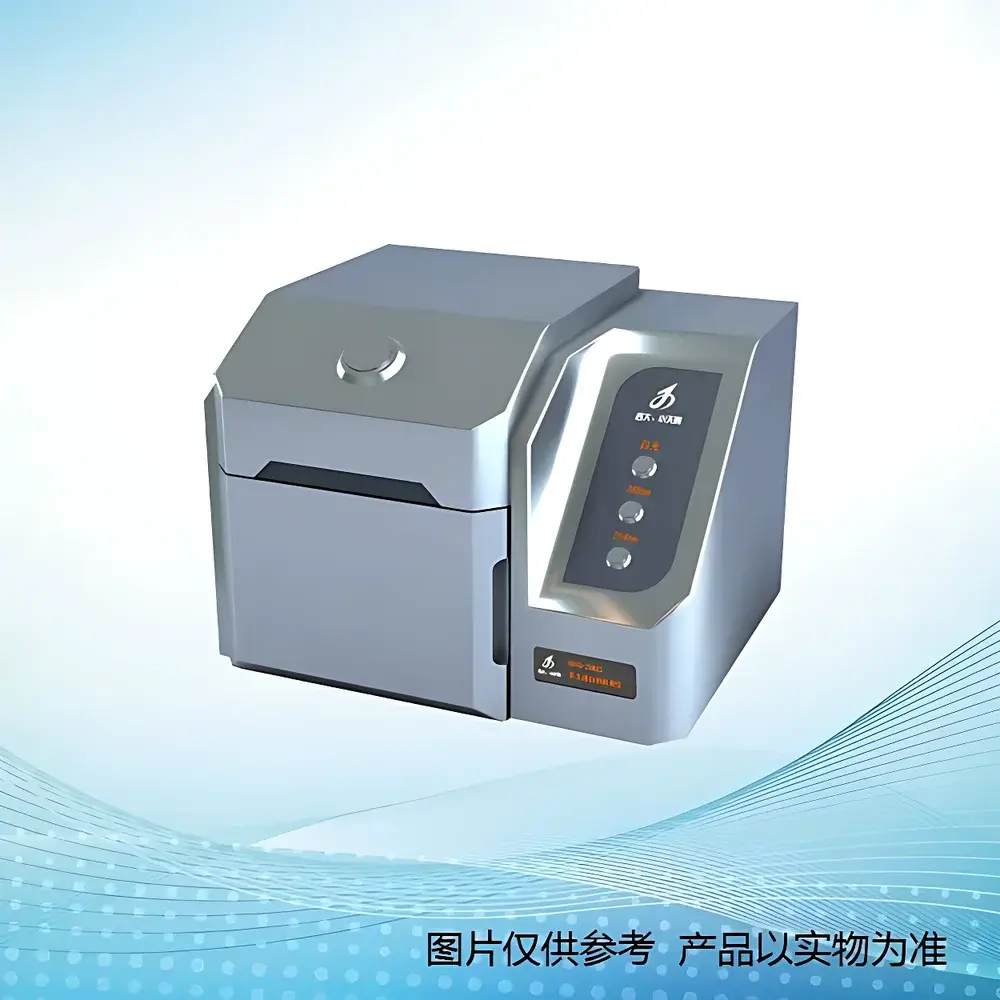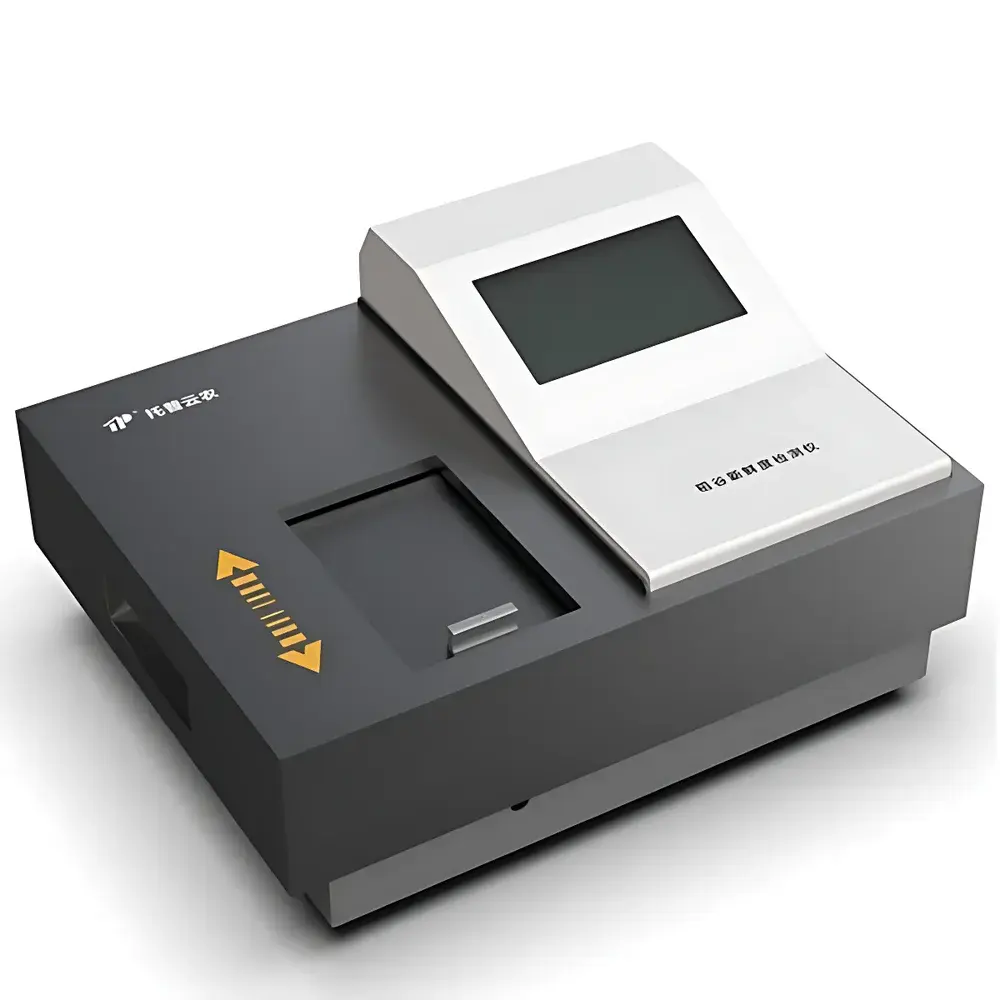
Top Cloud-agri TPDG-1 Rice Freshness Analyzer
| Brand | Top Cloud-agri |
|---|---|
| Origin | Zhejiang, China |
| Manufacturer Type | Direct Manufacturer |
| Country of Origin | China |
| Model | TPDG-1 |
| Price | Upon Request |
| Sample Weight | 1.00 ± 0.01 g |
| Test Time | < 60 s per sample |
| Output | Freshness Index (A) |
| Photometric Stability | ±0.1% T / 3 min |
| Photometric Repeatability | ±0.5% T |
| Display | 7-inch capacitive touchscreen LCD |
| Power Input | AC 80–240 V, 50–60 Hz |
| Operating Environment | 10–45 °C, 10–80% RH |
| Dimensions (L×W×H) | 475 × 370 × 240 mm |
| Net Weight | 14.1 kg |
| Data Storage Capacity | ≥100,000 records |
| Included Accessories | 10 × 100 mm × 16 mm cuvettes, 5 mL adjustable pipette, mortar set, 100-mesh sample sieve, 2 kits of proprietary reagents |
Overview
The Top Cloud-agri TPDG-1 Rice Freshness Analyzer is a dedicated photometric instrument engineered for the objective quantification of rice freshness—specifically for Oryza sativa subspecies japonica and indica. It operates on the principle of dual-wavelength spectrophotometric analysis of enzymatic oxidation products formed during post-harvest lipid degradation. As rice ages, endogenous lipases and lipoxygenases catalyze the hydrolysis and oxidation of unsaturated fatty acids in bran layers, generating aldehydes and ketones that react with proprietary chromogenic reagents to yield measurable absorbance shifts. The TPDG-1 calculates a dimensionless Freshness Index (A), calibrated against reference standards traceable to national grain quality protocols. This method aligns with empirical correlations established in Chinese National Standard GB/T 20569–2006 and supports routine assessment in environments where rapid, non-destructive, and operator-independent evaluation is required—including grain storage facilities, seed banks, milling plants, provincial grain inspection centers, and academic laboratories engaged in post-harvest physiology research.
Key Features
- Dual-wavelength photometric detection: Simultaneous measurement at two optimized wavelengths minimizes interference from turbidity, color variation, and matrix effects—achieving analytical repeatability within ±0.5% transmittance and long-term stability of ±0.1% T over 3 minutes.
- Integrated hardware-software workflow: Pre-calibrated optical path, temperature-compensated detector, and regulated power supply ensure consistent performance across variable mains voltage (80–240 V AC) and ambient conditions (10–45 °C, 10–80% RH).
- Intuitive human-machine interface: A 7-inch capacitive touchscreen provides direct navigation through calibration, sample registration, test execution, and result review—requiring no external PC or keyboard.
- Onboard data processing and reporting: Automatic calculation of Freshness Index (A) from raw absorbance ratios; results displayed numerically and graphically with timestamp, operator ID (optional), and sample ID.
- Thermal printing capability: Built-in thermal printer enables immediate hardcopy output compliant with internal QA documentation requirements—no third-party drivers or software dependencies.
- Validated reagent system: Proprietary, CE-marked reagent kits are pre-formulated for rice-specific lipid oxidation markers; each kit supports ≥100 determinations with documented shelf life and lot-specific calibration certificates.
Sample Compatibility & Compliance
The TPDG-1 is validated exclusively for milled or brown rice samples conforming to GB/T 5491–2023 (sampling procedures) and GB/T 5492–2023 (preparation of test samples). Samples must be homogenized using the included mortar set and sieved through a 100-mesh (150 µm) stainless steel screen to ensure particle size uniformity. The instrument accepts 1.00 ± 0.01 g subsamples placed in standardized 100 mm × 16 mm optical cuvettes. While not intended for paddy (unhulled) rice or parboiled varieties, it demonstrates high correlation (r² > 0.92) with accelerated aging studies per ISO 7301:2022 (rice — specification) Annex B. Data integrity meets GLP-aligned record-keeping practices: all measurements include embedded timestamps, user-assigned identifiers, and immutable audit trails stored locally in non-volatile memory. Firmware supports optional password-protected administrator mode for configuration control.
Software & Data Management
Data are stored internally in a relational SQLite database supporting ≥100,000 entries, each containing Freshness Index (A), raw absorbance values at both wavelengths, test duration, ambient temperature/humidity (if external sensor connected), and operator metadata. Users may browse, filter by date range or sample ID, export CSV files via USB 2.0 port, or delete individual records or full batches. No cloud connectivity or remote telemetry is implemented—ensuring full data sovereignty and compliance with institutional IT security policies. Calibration logs, reagent lot tracking, and maintenance history are retained separately and accessible only in admin mode. Exported datasets retain ISO 8601 timestamps and SI-unit annotations, facilitating integration into LIMS platforms or statistical analysis tools such as JMP or R.
Applications
- Grain storage management: Monitoring freshness decay kinetics during silo storage to inform rotation schedules and fumigation timing.
- Seed viability assessment: Correlating Freshness Index (A) with germination rate and seedling vigor in breeding programs.
- Quality assurance in milling: Verifying batch consistency prior to packaging and identifying early-stage rancidity before sensory detection.
- Regulatory compliance testing: Supporting submissions under China’s Grain Circulation Supervision Regulations and provincial food safety monitoring plans.
- Academic research: Investigating lipid oxidation pathways under controlled humidity/temperature stressors or antioxidant intervention trials.
FAQ
What sample preparation steps are mandatory prior to analysis?
Homogenization using the supplied mortar set followed by 100-mesh sieving is required to ensure representative particle size distribution and reproducible extraction kinetics.
Is the instrument suitable for brown rice or parboiled rice?
Yes, for brown rice—provided bran layer integrity is preserved during milling. Parboiled rice is not supported due to altered starch-lipid interactions affecting chromogen formation kinetics.
How often does the system require recalibration?
Factory calibration remains valid for 12 months under normal use; annual verification using NIST-traceable neutral density filters is recommended. User-initiated zero and span calibration is available before each testing session.
Can raw absorbance data be exported for secondary analysis?
Yes—CSV exports include both primary wavelength absorbances, calculated ratio, and derived Freshness Index (A), enabling independent algorithm validation or multivariate modeling.
Does the device comply with FDA 21 CFR Part 11 requirements?
It does not implement electronic signature or audit trail features required for Part 11 compliance; however, its local data logging architecture satisfies GLP documentation expectations for non-GMP research and internal QA use.