
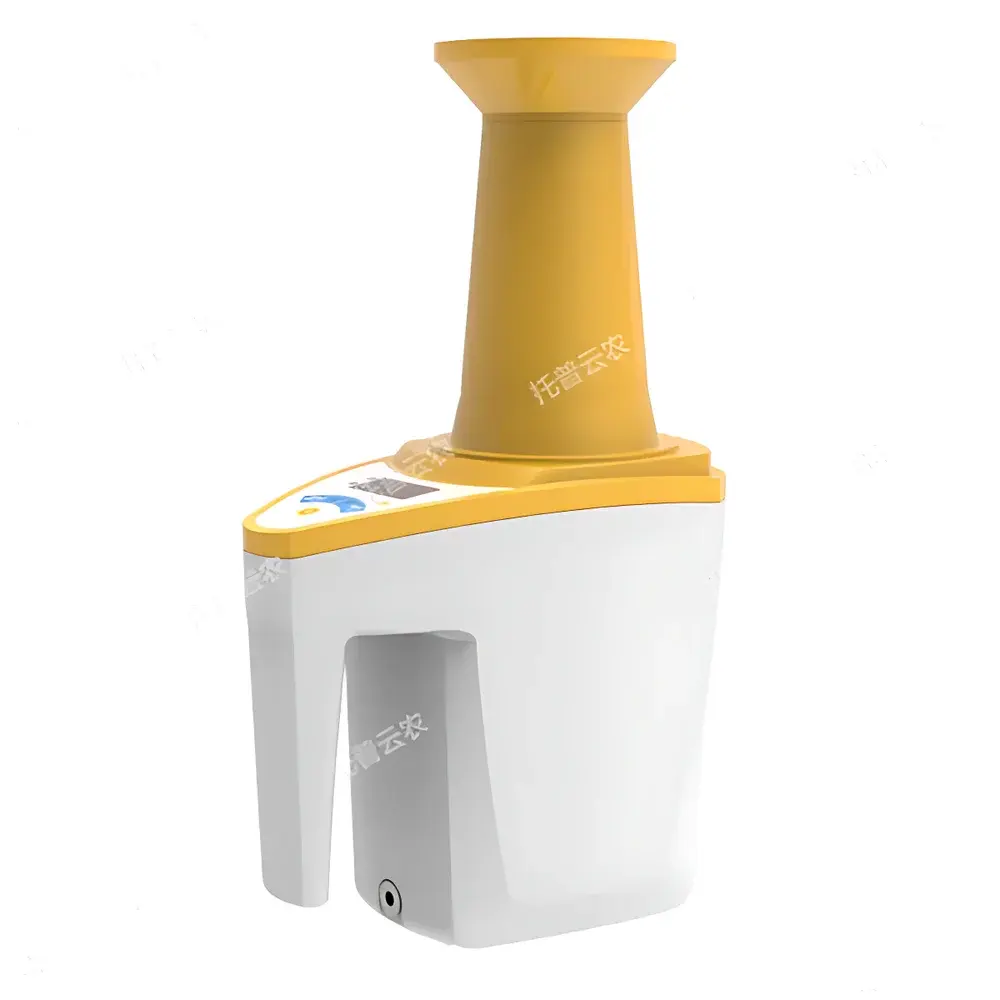
Top Cloud-agri LDS-1H/LDS-1S Grain Moisture Analyzer
| Brand | Top Cloud-agri |
|---|---|
| Origin | Zhejiang, China |
| Manufacturer Type | Direct Manufacturer |
| Country of Origin | China |
| Model | LDS-1H / LDS-1S |
| Measurement Range | 3–35% w.b. |
| Accuracy | ≤ ±0.5% (within primary moisture range) |
| Repeatability | ≤ 0.2% |
| Measurement Time | ≤ 10 s |
| Sample Weight | 150 g (fixed-weight mode, exceptions apply) |
| Temperature Compensation | Automatic |
| Operating Ambient | 0–40 °C |
| Net Weight | 860 g |
| Power Supply | 4 × AA alkaline batteries |
| Calibration | Floating three-point calibration (pre-loaded cultivar-specific curves for common grains and vegetable seeds) |
| Auto-shutdown | After 3 minutes of inactivity |
Overview
The Top Cloud-agri LDS-1H/LDS-1S Grain Moisture Analyzer is a portable, resistance-based moisture measurement instrument engineered for rapid, field-deployable quantification of water content in intact cereal grains and horticultural seeds. It operates on the principle of electrical conductivity correlation—where moisture-dependent ionic mobility alters bulk resistivity across a defined sample volume under controlled compression and electrode contact. This method conforms to empirical calibration frameworks widely accepted in agricultural quality control, including ISO 712:2017 (Cereals and cereal products — Determination of moisture content — Reference method) and ASTM D4940-22 (Standard Guide for Conductive Moisture Testing of Agricultural Commodities). Unlike loss-on-drying (LOD) methods requiring oven drying and gravimetric analysis, the LDS series delivers results in under 10 seconds without sample preparation, making it suitable for real-time process monitoring in grain receiving stations, seed conditioning lines, and QC laboratories where throughput and operator consistency are critical.
Key Features
- Integrated precision load cell with automatic tare and fixed-weight sampling (150 g standard), eliminating manual weighing errors;
- Real-time ambient temperature compensation algorithm, ensuring stable readings across operational environments from 0 °C to 40 °C;
- Dual-model architecture: LDS-1H optimized for high-density cereals (e.g., paddy rice, wheat, soybean, maize, barley, indica rice, milled rice); LDS-1S calibrated for low-mass vegetable seeds (e.g., tomato, eggplant, leek, radish, cowpea, pak choi);
- Floating three-point calibration system—users may adjust offset, slope, and curvature parameters per cultivar or lot, supporting traceable method validation;
- Battery-powered operation (4 × AA) with DC/AC adaptability; no external power source required for field use;
- Auto-power-off after 3 minutes of inactivity to preserve battery life; low-battery indicator and error-code diagnostics;
- Pre-loaded calibration curves for >25 common grain and seed varieties, enabling immediate deployment without initial setup.
Sample Compatibility & Compliance
The LDS-1H/LDS-1S supports non-destructive, single-batch moisture assessment of whole, unground kernels and seeds. It is validated for use with intact, clean, and dry-to-touch samples—excessive surface moisture, cracked hulls, or excessive chaff may affect repeatability. The instrument complies with national metrological verification requirements for agricultural moisture testers (JJG 891–2019, People’s Republic of China) and aligns with functional equivalency clauses in ISO 6540:2021 (Moisture determination in oilseeds — Rapid method using electrical resistance meters). While not certified for legal metrology or trade settlement, its ≤ ±0.5% accuracy and ≤ 0.2% repeatability meet internal QA thresholds for in-process release decisions under GLP-aligned laboratory practices.
Software & Data Management
The analyzer operates as a standalone embedded system with no proprietary software dependency. All calibration parameters, user-defined offsets, and measurement logs are stored in non-volatile memory. Data export is not supported via USB or Bluetooth; however, measurement values are displayed numerically with unit annotation (% w.b.) and accompanied by status flags (e.g., “CAL”, “TEMP”, “LOW BATT”). For regulated environments requiring audit trails, users may document readings manually or integrate into LIMS via secondary transcription. The floating calibration architecture permits full traceability: each measurement implicitly references the active curve ID, ambient temperature, and time stamp (real-time clock not included; timestamping requires external logging).
Applications
- Grain intake inspection at elevators and cooperatives to enforce contractual moisture limits (e.g., ≤14.5% for wheat, ≤13.5% for paddy);
- Seed lot certification prior to storage or sale, verifying compliance with ISTA moisture thresholds for viability preservation;
- In-line moisture verification during seed coating, priming, or pelleting processes;
- Research trials evaluating drought tolerance or post-harvest drying kinetics across genotypes;
- Extension service outreach—field technicians conducting on-farm grain quality assessments without access to central labs;
- Feed mill raw material screening to prevent mold risk associated with elevated moisture (>15% in corn).
FAQ
Does the LDS-1H/LDS-1S require grinding or milling before measurement?
No. It measures moisture in whole, intact kernels and seeds. Grinding is neither recommended nor necessary—and may compromise accuracy due to altered particle packing and surface area effects.
Can I validate the instrument against oven-dry reference values?
Yes. Cross-validation is encouraged per ISO 712:2017. Users should perform parallel measurements on homogenized subsamples—LDS reading vs. LOD result—and apply linear regression to refine calibration if systematic bias exceeds ±0.3%.
Is the device compliant with FDA 21 CFR Part 11 or EU Annex 11?
No. It lacks electronic signature capability, audit trail generation, or user access controls. It is intended for non-GxP environments or as a supplementary tool within broader GMP workflows where manual data entry is acceptable.
What maintenance is required?
Routine cleaning of electrode surfaces with lint-free cloth and isopropyl alcohol; annual verification of load cell linearity using certified test weights; no routine recalibration needed unless physical damage or long-term drift is observed.





