
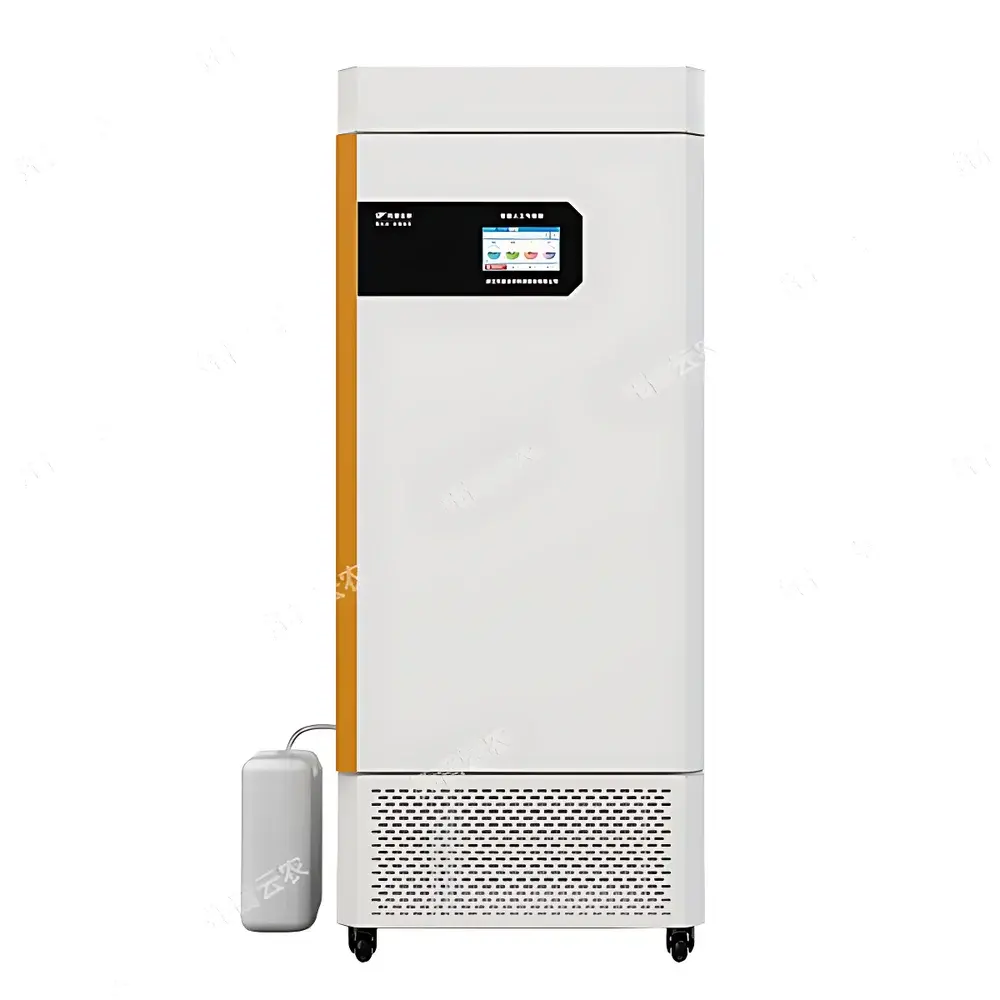
Top Cloud-agri TP-R1000C-JC High-Throughput Intelligent Seed Germination Analysis System
| Brand | Top Cloud-agri |
|---|---|
| Origin | Zhejiang, China |
| Manufacturer Type | Direct Manufacturer |
| Country of Origin | China |
| Model | TP-R1000C-JC |
| Chamber Volume | 1000 L |
| Temperature Range | 0–65 °C |
| Temp. Uniformity | ±0.3 °C (at 25.0 °C / 50% RH) |
| Humidity Range | 50–95% RH |
| Humidity Uniformity | ±3% RH (at 25.0 °C / 50% RH) |
| Illumination | 0–22,000 lx, continuously adjustable |
| Light Control | 0–100% stepless dimming |
| Imaging Sensor | 12 MP (4024 × 3036), low-light sensitivity ≤0.1 lux |
| Noise Level | ≥39 dB(A) |
| Power Supply | AC 220 V / 50 Hz, 16 A |
| Max. Power Consumption | 2500 W |
| Dimensions (W×D×H) | 1552 × 765 × 1940 mm |
| Internal Dimensions (W×D×H) | 1415 × 560 × 1165 mm |
| Interface Ports | 1 × CO₂ inlet, 1 × USB, 2 × fresh-air vents, 1 × Ethernet |
Overview
The Top Cloud-agri TP-R1000C-JC High-Throughput Intelligent Seed Germination Analysis System is a purpose-built artificial climate incubator engineered for standardized, reproducible, and quantifiable seed germination studies under controlled environmental conditions. It integrates precision climate regulation—spanning temperature, relative humidity, and spectrally neutral illumination—with synchronized visible-light imaging and AI-driven phenotypic analysis. Unlike conventional incubators limited to passive environmental maintenance, the TP-R1000C-JC implements active optical monitoring: an XY-programmable imaging carriage traverses the chamber interior at user-defined intervals, capturing high-resolution stills across all tray levels. These time-series images feed into an embedded computer vision pipeline trained to detect radicle emergence, coleoptile elongation, and cotyledon expansion—enabling automated, non-destructive germination scoring aligned with ISTA (International Seed Testing Association) and ISO 20723:2019 guidelines. The system operates as a closed-loop experimental platform: environmental parameters are logged at 1-minute resolution, image metadata are time-stamped and geotagged (via internal RTC), and analytical outputs—including germination percentage, mean germination time (MGT), and uniformity index—are exported in CSV/JSON format for downstream statistical validation.
Key Features
- Precision climate control with independent PID-regulated heating, refrigeration, humidification, and ventilation subsystems—ensuring ±0.3 °C temperature stability and ±3% RH consistency across the full 1000 L working volume.
- Full-spectrum white LED illumination (0–22,000 lx, 0–100% continuous dimming) calibrated to CIE standard illuminant D65, enabling photomorphogenic studies without spectral bias.
- Automated XY imaging carriage with stepper-motor actuation and anti-vibration suspension, supporting programmable acquisition frequencies from 1 image/hour to 1 image/minute per tray level.
- 12-megapixel CMOS sensor (4024 × 3036 px) with F1.8 aperture and on-chip near-infrared enhancement, delivering usable imagery under low-light conditions (≤0.1 lux) for nocturnal growth phase capture.
- 10-inch industrial-grade capacitive touchscreen (1024 × 600 px) with GLP-compliant audit trail: all parameter edits, program starts/stops, and alarm acknowledgments are timestamped and attributed to operator ID.
- Dual-layer thermal insulation using cyclopentane-blown polyurethane foam (R-value > 3.2 m²·K/W) and 6 mm tempered glass inner door—minimizing thermal bridging and enabling observation without chamber disturbance.
- Modular rack system with tool-free height adjustment (50 mm increments) and quick-connect LED panel mounts, accommodating seed trays (standard 510 × 290 mm), petri dishes, or hydroponic rafts.
Sample Compatibility & Compliance
The TP-R1000C-JC accommodates up to 48 standard seed trays (or equivalent surface area) distributed across six independently monitored shelf levels. Its open architecture supports diverse sample formats: paper towel rolls, agar plates, soil-filled pots, and aeroponic mist chambers—all without modification to airflow or light distribution. Environmental profiles comply with ASTM E1826-22 (Standard Practice for Laboratory Incubation of Seeds), ISTA Rules 2024 Section 5 (Germination Testing), and ISO 11237:2021 (Seed Quality Control). Data integrity meets FDA 21 CFR Part 11 requirements via electronic signatures, immutable audit logs, and role-based access control (RBAC) enforced through dual authentication (PIN + biometric-capable optional module). All firmware and analysis algorithms undergo annual verification against NIST-traceable reference standards for luminance (NIST SRM 2035), temperature (SPRT calibration), and humidity (chilled-mirror hygrometer).
Software & Data Management
The embedded Linux-based OS runs proprietary GerminVision™ software v3.2, featuring three-tiered data handling: (1) Real-time edge processing—germination events are detected locally using convolutional neural networks optimized for monocot/dicot morphological divergence; (2) Synchronized cloud sync—encrypted TLS 1.3 transmission to Top Cloud-agri’s ISO 27001-certified data center, where raw images, metadata, and analytics are stored for ≥10 years; (3) Cross-platform visualization—web dashboard (Chrome/Firefox/Safari) and WeChat Mini Program provide interactive germination curves, spatial heatmaps of germination synchrony, and batch comparison reports. Data export supports FAIR principles: files include embedded EXIF tags (GPS disabled by default), MIAME-compliant headers, and ontological annotations mapped to Plant Ontology (PO) and Trait Ontology (TO). OTA updates deliver algorithm refinements validated against public benchmark datasets (e.g., SeedGerm-2023).
Applications
- High-throughput screening of genetic germplasm libraries for germination vigor QTL mapping under abiotic stress gradients (e.g., osmotic, thermal, hypoxic).
- Regulatory seed certification workflows requiring ISTA-accredited germination counts, including dormant seed stratification protocols.
- Phytochemical elicitor studies evaluating gibberellin/abscisic acid dose-response relationships on radicle protrusion kinetics.
- Teaching laboratories conducting inquiry-based experiments on environmental cue integration (light quality × temperature × moisture).
- Pre-commercial variety trialing under simulated regional climate scenarios (e.g., RCP 4.5/8.5 projections downscaled to chamber setpoints).
- Microbiome–seed interaction assays combining germination phenotyping with concurrent 16S rRNA sequencing of rhizosphere isolates.
FAQ
Does the system support CO₂ enrichment for hypoxia or elevated-CO₂ germination studies?
Yes—the integrated CO₂ inlet port accepts regulated gas supply (0–2000 ppm range); concentration is monitored via NDIR sensor and maintained via proportional solenoid valve control.
Can third-party image analysis software be used with exported TIFF sequences?
All acquired images are saved in uncompressed 16-bit TIFF format with embedded ICC profiles and scale bars; compatibility is confirmed with Fiji/ImageJ, MATLAB Image Processing Toolbox, and Python OpenCV pipelines.
Is remote troubleshooting supported via secure vendor access?
Field engineers may initiate encrypted VNC sessions only after explicit user authorization and time-limited token generation—no persistent backdoor access is implemented.
How is calibration traceability documented for regulatory audits?
Each unit ships with a factory calibration certificate (ISO/IEC 17025 accredited lab), listing uncertainty budgets for all critical sensors and referencing NIST SRMs used during verification.
What is the maximum allowable load for the XY imaging rail without compromising positional accuracy?
The carriage maintains ±0.1 mm repeatability under static loads up to 8 kg; dynamic deflection remains within ±0.3 mm during continuous scanning at 200 mm/s traverse speed.




