
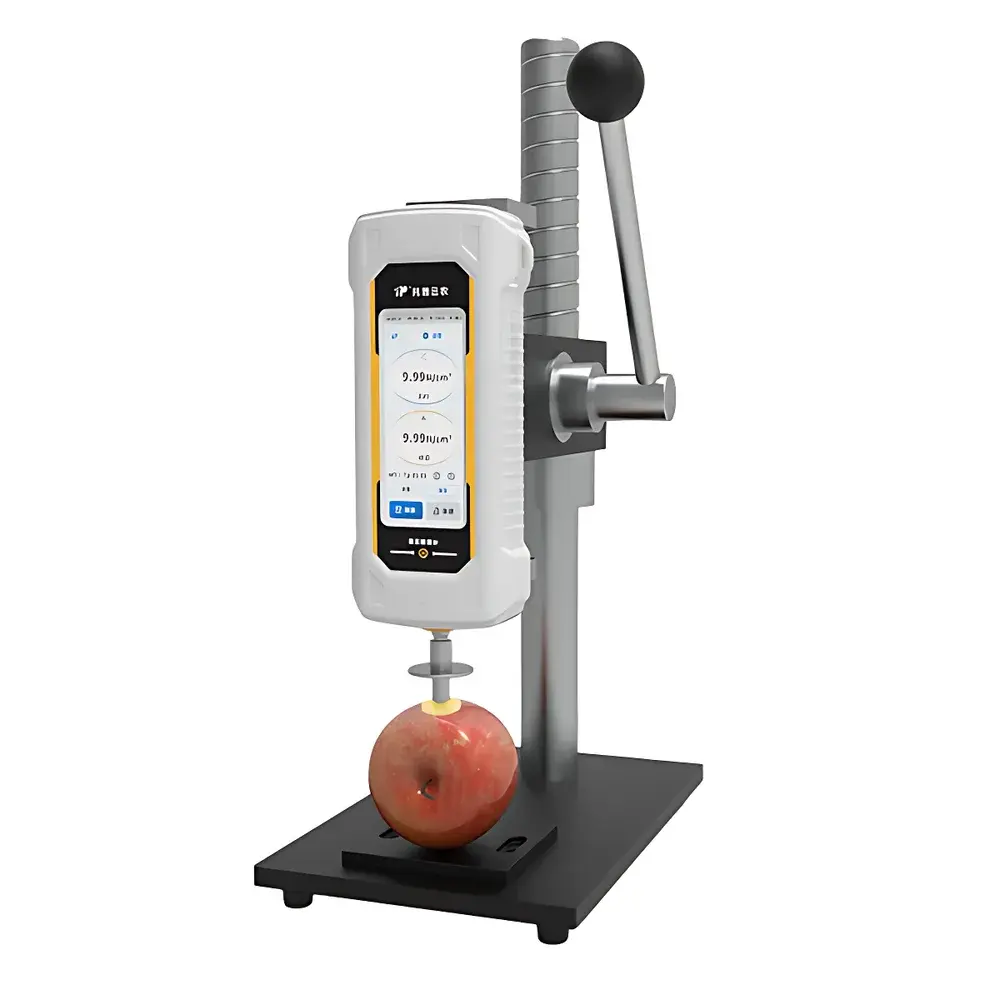
Top Cloud-agri TP-GY-4 Digital Fruit Hardness Tester
| Brand | Top Cloud-agri |
|---|---|
| Origin | Zhejiang, China |
| Manufacturer Type | Manufacturer |
| Country of Origin | Domestic (China) |
| Model | TP-GY-4 |
| Price | USD 520 (FOB) |
| Display Resolution | 0.01 N/cm² |
| Accuracy | ±0.1% FS |
| Probe Diameters | Φ3.5 mm / Φ7.9 mm / Φ11.1 mm |
| Max Load Capacity | 52 / 102 / 520 kg/cm² (per probe) |
| Penetration Depth | 10 mm |
| Operating Temperature | −10 °C to +60 °C |
| Relative Humidity | 0–80% RH |
| Weight | <500 g |
| Dimensions | 206 × 85 × 40 mm |
| Power Supply | Rechargeable Li-ion battery (12 h continuous operation) |
| Units | kg/cm², N/cm², lb/cm², kPa |
| Data Storage | >10,000 records |
Overview
The Top Cloud-agri TP-GY-4 Digital Fruit Hardness Tester is a handheld, portable mechanical penetrometer engineered for objective, non-destructive quantification of firmness in fresh horticultural produce. It operates on the standardized principle of controlled axial penetration: a calibrated probe is driven perpendicularly into the fruit or vegetable tissue at a defined rate and depth (10 mm), and the peak resistance force—measured via high-precision load and tilt sensors—is recorded as hardness. This methodology aligns with internationally recognized protocols such as ASTM F2523-20 (Standard Test Method for Measuring Firmness of Fresh Fruits and Vegetables Using a Penetrometer) and ISO 11348-1 (Fruit and vegetable products — Determination of firmness by penetrometry). Designed for field deployment and laboratory use alike, the instrument supports evidence-based decision-making across the postharvest chain—from harvest timing validation and cultivar comparison to cold storage optimization and shelf-life modeling.
Key Features
- Triple-probe configuration: Interchangeable stainless-steel probes (Φ3.5 mm, Φ7.9 mm, Φ11.1 mm) enable standardized measurement across diverse produce types—from soft berries and tomatoes to dense apples, pears, and root vegetables—minimizing surface deformation artifacts and ensuring compliance with crop-specific testing guidelines.
- Real-time peak-hold & dynamic trace: Simultaneous display of instantaneous force and maximum (peak) force during penetration; automatic retention of peak value upon probe retraction, eliminating operator-dependent interpretation errors.
- Multi-parameter data logging: Each measurement captures timestamp, GPS coordinates (via paired smartphone), sequence ID, probe ID, and environmental metadata; supports up to 200 test groups with 96 entries per group and total storage capacity exceeding 10,000 records.
- Unit flexibility & automatic calibration mapping: Seamless switching among kg/cm², N/cm², lb/cm², and kPa; firmware-integrated conversion logic adjusts reported values based on selected probe diameter, ensuring consistency with published reference tables (e.g., USDA Handbook No. 66).
- Field-optimized ergonomics: Lightweight (<500 g), ruggedized housing with IP54-rated ingress protection; reversible LCD display for flexible viewing angles; adjustable backlight and programmable auto-shutdown to conserve battery life.
- Wireless interoperability: Bluetooth 5.0 interface enables secure, low-latency transfer of structured CSV datasets to iOS/Android mobile applications, with optional cloud synchronization to research-grade platforms supporting audit trails and role-based access control.
Sample Compatibility & Compliance
The TP-GY-4 is validated for use with intact, unpeeled fruits and vegetables exhibiting surface integrity sufficient to support localized probe entry without slippage or crushing. Compatible specimens include but are not limited to: apples, pears, peaches, plums, mangoes, kiwifruit, tomatoes, cucumbers, carrots, potatoes, and eggplants. Measurements adhere to Good Laboratory Practice (GLP) requirements through embedded digital audit trails—including operator ID (if configured), timestamp, geolocation, and sensor calibration status. Data export formats comply with FDA 21 CFR Part 11 readiness when used in conjunction with validated third-party analysis software, facilitating traceability in quality assurance workflows under HACCP, ISO 22000, and BRCGS Food Safety standards.
Software & Data Management
Data acquisition and post-processing are supported via the proprietary Top Cloud-agri AgriTest Mobile App (iOS/Android), which provides real-time visualization, statistical summary (mean, SD, min/max per batch), trend charting, and customizable report generation (PDF/Excel). Raw datasets include full metadata headers compatible with LIMS integration. Cloud storage options support multi-user collaboration, version-controlled dataset archiving, and automated backup. All firmware updates are delivered over-the-air (OTA) with cryptographic signature verification to ensure system integrity and regulatory defensibility.
Applications
- Determining optimal harvest maturity indices for export-grade fruit
- Monitoring textural degradation during controlled-atmosphere storage trials
- Evaluating postharvest treatment efficacy (e.g., calcium dips, 1-MCP exposure)
- Supporting breeding programs through high-throughput phenotyping of firmness QTLs
- Validating packaging performance under simulated transport vibration profiles
- Generating input parameters for predictive models of enzymatic softening kinetics
- Conducting sensory correlation studies linking instrumental hardness to consumer texture perception
FAQ
What calibration standards are recommended for routine verification?
We recommend annual verification using NIST-traceable dead-weight test kits (e.g., Dillon or Mark-10 certified load cells) across the full range of each probe. Internal zero-point and span checks are accessible via service mode.
Is the device suitable for frozen or refrigerated samples?
Yes—operational down to −10 °C—but surface condensation must be removed prior to measurement to prevent probe slippage and erroneous low-force readings.
Can measurement data be exported in machine-readable format for statistical analysis?
Yes—CSV exports include column headers for time, probe ID, force value, unit, GPS, and group identifier; fully compatible with R, Python (pandas), JMP, and SPSS.
Does the instrument meet GLP or GMP documentation requirements?
The device itself is not GLP-certified, but its data structure, audit trail capabilities, and secure export functionality enable compliant usage within GLP/GMP environments when deployed with validated procedures and trained personnel.
How is probe wear managed over extended field use?
Probes are precision-ground stainless steel with Rockwell C60+ hardness; wear is monitored via periodic diameter verification using digital micrometers. Replacement probes are supplied with individual calibration certificates.





