
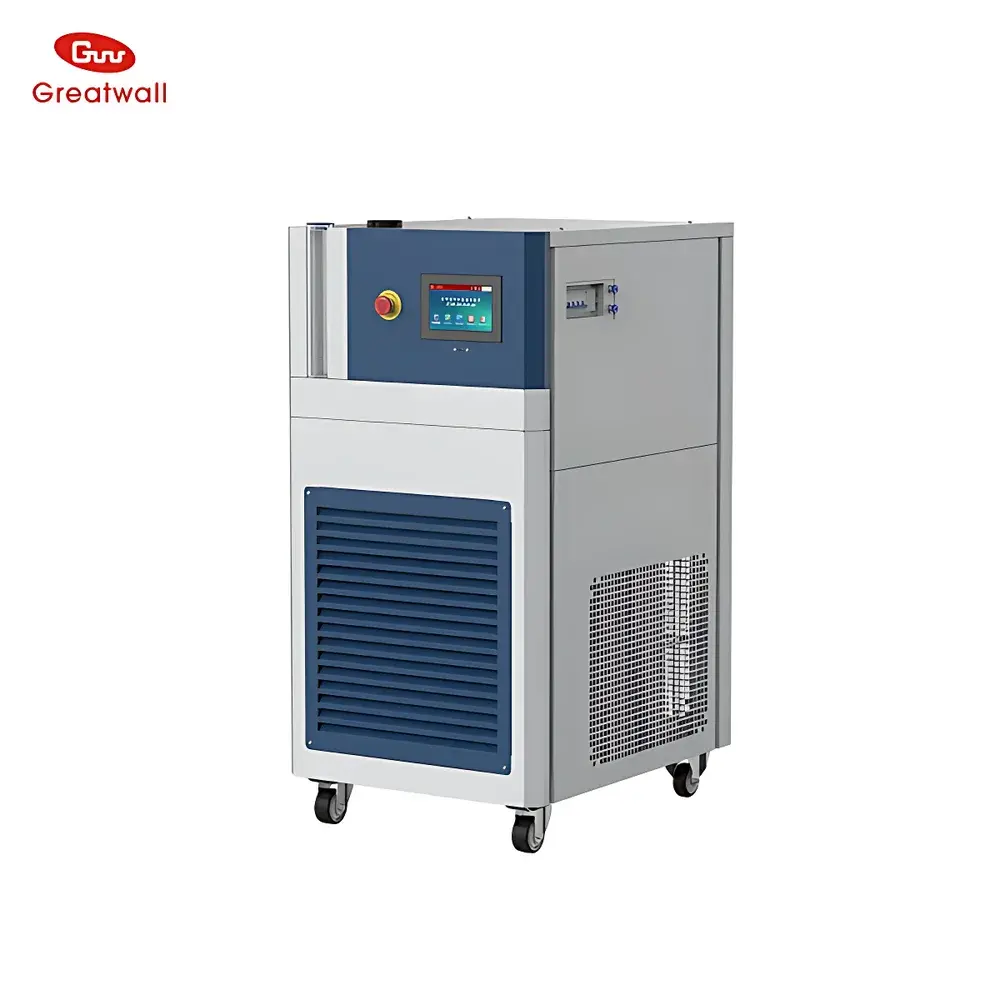
Great Wall ZTM Series Closed-Loop Refrigerated & Heated Circulation System
| Brand | The Great Wall |
|---|---|
| Origin | Henan, China |
| Manufacturer Type | Direct Manufacturer |
| Product Category | Domestic |
| Model | ZTM Series |
| Instrument Type | Vertical |
| Temperature Stability | ±0.5 °C |
| Setpoint Accuracy | ±0.5 °C |
| Operating Temperature Range | −30 °C to 200 °C |
| Heating Power | 3 kW |
| Bath Volume | 3 L |
| External Dimensions (W×D×H) | 554 mm × 796 mm × 1050 mm |
| Net Weight | 170 kg |
| Circulating Medium | Water |
Overview
The Great Wall ZTM Series Closed-Loop Refrigerated & Heated Circulation System is an integrated thermal management platform engineered for precise, bidirectional temperature control of external laboratory equipment—such as glass jacketed reactors, rotary evaporators, calorimeters, and synthesis modules. Unlike conventional single-function chillers or heaters, the ZTM system employs a dual-mode thermodynamic architecture that enables seamless transition between heating and cooling within a single fluid circuit, eliminating the need for external switching valves or secondary loops. Its operational principle relies on a closed-loop circulation of water-based heat transfer fluid, regulated via coordinated modulation of a high-efficiency refrigeration cycle and a calibrated resistive heating subsystem. The system achieves stable setpoint maintenance across its full −30 °C to 200 °C range without pressurization, supporting both rapid cooldown from elevated temperatures and sustained low-temperature operation under ambient conditions. Designed for integration into GLP-compliant laboratories, the ZTM series meets fundamental mechanical and electrical safety requirements per IEC 61010-1 and incorporates fail-safe thermal isolation between fluid paths and control electronics.
Key Features
- Integrated refrigeration-heating architecture with independent compressor and immersion heater control logic
- TaiKang hermetic piston compressor delivering high volumetric efficiency and extended service life under cyclic load conditions
- Plate-type heat exchanger rated for −160 °C to 200 °C, constructed from stainless steel plates with low fouling coefficient and compact footprint (20–30% weight vs. shell-and-tube equivalents)
- Danfoss thermostatic expansion valve with field-replaceable cartridge design—no system evacuation required during maintenance
- Pre-cooling module using forced-air finned heat exchanger to decouple high-temperature discharge from compressor inlet, reducing thermal stress and improving compressor longevity
- 304 stainless steel circulation piping with integrated anti-siphon check valves and built-in expansion tank equipped with level indicator
- 5.7-inch TFT color touchscreen interface supporting both constant-setpoint and multi-segment programmable temperature profiles (up to 120 programs × 100 segments each)
- Real-time temperature curve logging with automatic plot generation and RS485 MODBUS RTU communication for SCADA or LIMS integration
Sample Compatibility & Compliance
The ZTM system is compatible with standard laboratory vessels requiring external thermal coupling—including jacketed reactors (≤5 L), rotary evaporators (≤5 L capacity), and analytical sample cells with external cooling jackets. Its water-based circulation medium ensures chemical compatibility with common solvents (e.g., ethanol, acetone, ethylene glycol/water blends) when used within specified concentration limits. The unit conforms to basic electromagnetic compatibility (EMC) requirements per EN 61326-1 and carries CE marking for use in EU-regulated environments. While not certified to ISO/IEC 17025 or FDA 21 CFR Part 11 out-of-the-box, its programmable logging, audit trail-capable event history, and password-protected parameter modification support validation pathways for GMP/GLP workflows when deployed with documented IQ/OQ protocols.
Software & Data Management
Control firmware supports two primary operating modes: Constant Temperature Mode for steady-state applications and Programmed Ramp Mode for time-temperature profiles requiring defined heating/cooling rates and dwell periods. All temperature setpoints, ramp rates, and hold durations are stored in non-volatile memory with timestamped change logs. Data export is available via USB port in CSV format, including real-time bath temperature, external sensor input (if connected), power consumption status, and alarm history. The MODBUS RTU interface allows bidirectional communication with PLCs or centralized lab automation systems for remote start/stop, setpoint override, and fault reporting—enabling alignment with enterprise-level data integrity frameworks when paired with validated middleware.
Applications
- Temperature-controlled synthesis in glass-jacketed reactors requiring exothermic reaction quenching or cryogenic initiation
- Condenser cooling and bath temperature stabilization for rotary evaporation under vacuum
- Calibration of temperature-sensitive detectors (e.g., IR cells, photodiodes) across extended thermal ranges
- Material testing setups involving thermal cycling of polymers, composites, or phase-change materials
- Stability studies in pharmaceutical development where controlled thermal stress profiles simulate storage or transport conditions
- Support for calorimetric measurements requiring precise thermal equilibration prior to enthalpy determination
FAQ
Can this system operate continuously at −30 °C using only water as the circulating medium?
Water freezes at 0 °C under standard pressure; therefore, continuous operation below 0 °C requires a suitable antifreeze mixture (e.g., 30–40% propylene glycol in deionized water). Pure water is recommended only for applications between 5 °C and 95 °C.
Is external dry air or nitrogen purging required for low-temperature operation?
No. The system’s sealed circulation loop and integrated expansion tank eliminate moisture ingress risk. However, maintaining ambient humidity below 60% RH in the installation environment is advised to prevent condensation on external fittings during deep-cooling cycles.
What maintenance intervals are recommended for the refrigeration circuit?
Compressor oil inspection every 2,000 operating hours; refrigerant charge verification and filter-drier replacement every 5,000 hours or biannually—whichever occurs first. Visual inspection of coolant clarity and pH should occur quarterly when using aqueous glycol solutions.
Does the system support external PT100 or thermocouple feedback for cascade control?
Yes. A dedicated analog input channel accepts 0–10 V or 4–20 mA signals from third-party temperature sensors, enabling process temperature feedback control independent of internal bath sensing.



