
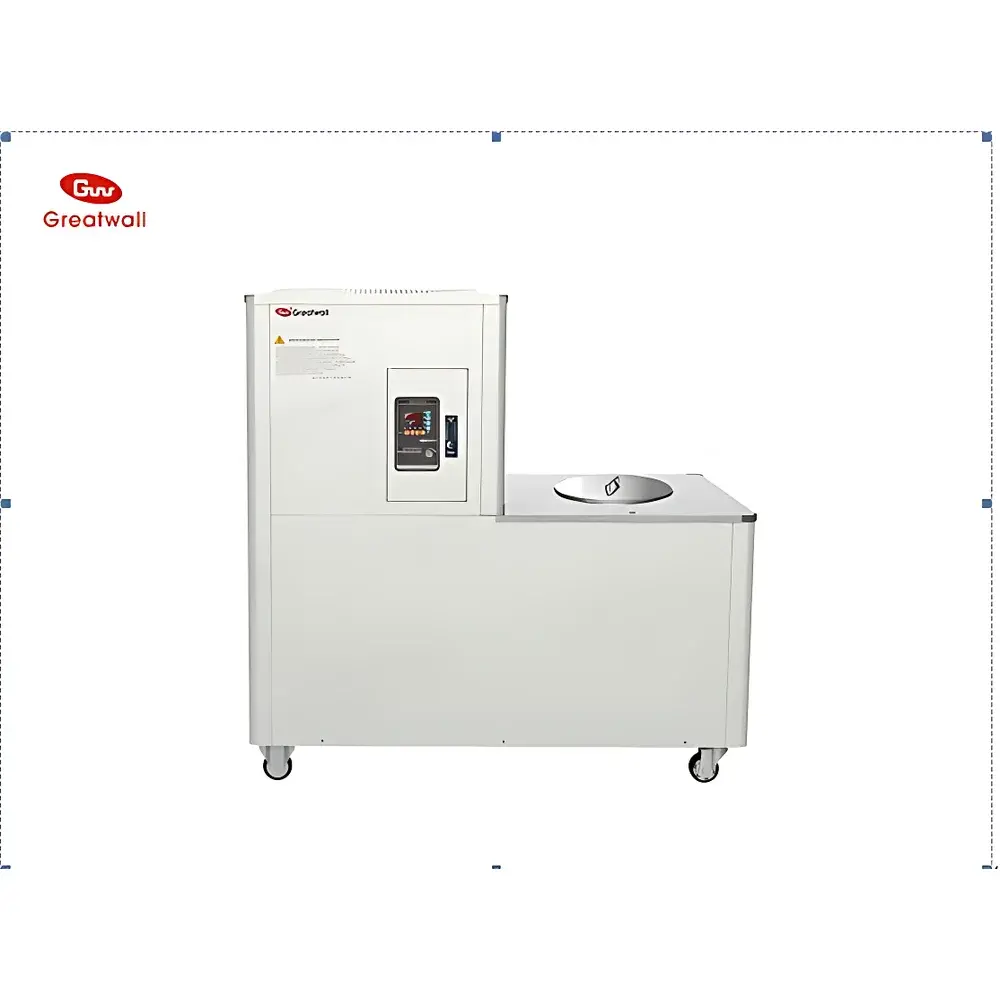
Great Wall DHJF-1030 Ultra-Low-Temperature Circulating Cooling Bath
| Brand | The Great Wall |
|---|---|
| Origin | Henan, China |
| Manufacturer Type | Direct Manufacturer |
| Model | DHJF-1030 |
| Cooling Capacity | 620 W at −60 °C, 480 W at −80 °C, 200 W at −100 °C |
| Temperature Range | −100 °C to −60 °C |
| Temperature Stability | ±2 °C |
| Bath Volume | 30 L |
| Pump Flow Rate | 20 L/min |
| Max. Circulation Pressure | 0.4 bar |
| Power Input | 4000 W (3-phase, 380 V, 50 Hz) |
| Display Resolution | 0.1 °C |
| Evaporator Type | Immersed Helical Coil |
| Compressor | Panasonic Hermetic Scroll Compressor |
| Refrigerant | Mixed Cryogenic Refrigerant Blend |
| Safety Protections | Phase Sequence Monitoring, Overcurrent, Overtemperature, Delayed Start, Thermal Cut-off |
| Ambient Operating Conditions | 5–35 °C, ≤70% RH |
| External Port | 1/2″ NPT |
| Bath Opening Diameter | 320 mm |
| Bath Dimensions (Ø × H) | 400 × 235 mm |
| Max. Flask Capacity | 10,000 mL |
| Bath Material | AISI 304 Stainless Steel |
| Footprint (W × D × H) | 1160 × 800 × 1310 mm |
| Net Weight | 180 kg |
| Warning | External circulation must be disabled when bath temperature < −90 °C |
Overview
The Great Wall DHJF-1030 Ultra-Low-Temperature Circulating Cooling Bath is an engineered thermal management system designed for sustained operation in the cryogenic range of −100 °C to −60 °C. It integrates a single-stage compression cascade refrigeration architecture with proprietary series-connected heat exchangers—enabling multi-stage cooling performance without mechanical complexity or multiple compressors. At its core, the unit employs a hermetically sealed Panasonic scroll compressor, optimized for low-temperature reliability and equipped with integrated thermal overload protection. Heat rejection occurs via an air-cooled finned-tube condenser constructed from oxygen-free copper tubing with enhanced surface geometry and proprietary tube-to-fin expansion technology—ensuring high heat transfer coefficients and long-term corrosion resistance under continuous duty. The evaporator is a helical coil design fully immersed in the 30 L stainless steel (AISI 304) reservoir; this configuration prevents mechanical stress during cryogen-induced fluid solidification and eliminates risk of coil rupture upon localized freezing. The system uses a custom-blended mixed refrigerant formulation compatible with ultra-low-temperature thermodynamic cycles and compliant with current global ozone depletion potential (ODP) and global warming potential (GWP) regulatory frameworks.
Key Features
- Single-compressor cascade refrigeration architecture delivering stable −100 °C operation using series-connected heat exchangers—minimizing weld joints and maximizing structural integrity
- Panasonic hermetic scroll compressor with flexible orbiting mechanism, internal thermal cut-off, and extended service life under cyclic cryogenic loads
- AISI 304 stainless steel bath tank with 320 mm diameter opening and 10,000 mL flask compatibility—optimized for large-scale reaction vessels and jacketed reactors
- High-flow, low-temperature-rated shielded centrifugal pump (100 W, 20 L/min, 0.4 bar max pressure) with 304 stainless steel wetted parts and non-cavitating impeller geometry
- Digital PID controller with 0.1 °C resolution, real-time temperature logging capability, and intuitive membrane keypad interface
- Comprehensive safety suite: phase sequence detection, overcurrent tripping, compressor discharge temperature monitoring, delayed restart logic, and automatic circulation interlock below −90 °C
Sample Compatibility & Compliance
The DHJF-1030 is intended for use with low-viscosity, non-reactive heat transfer fluids suitable for sub-zero operation—including ethylene glycol/water mixtures, silicone oils, and specialized cryogenic baths (e.g., MP-100). It supports immersion of standard laboratory glassware (up to 10 L), double-jacketed reactors, and external heat exchangers via standardized 1/2″ NPT ports. All electrical components conform to IEC 61000-6-3 (EMC emission limits) and IEC 61000-6-2 (immunity requirements). Mechanical design complies with ISO 12100:2010 (risk assessment principles) and incorporates fail-safe shutdown protocols aligned with GLP and GMP environmental control guidelines. While not certified to UL or CE for direct medical device integration, the system meets essential safety and performance criteria for industrial R&D laboratories operating under ISO/IEC 17025-accredited quality systems.
Software & Data Management
The embedded controller provides local data acquisition with timestamped temperature readings stored in non-volatile memory (10,000-point capacity). Optional RS485 Modbus RTU output enables integration into centralized lab monitoring platforms (e.g., LabVIEW, Ignition SCADA, or DeltaV DCS) for remote setpoint adjustment, alarm notification, and audit-trail generation. Data export is supported via USB flash drive in CSV format, facilitating traceability for method validation and regulatory review. The firmware implements basic event logging—including compressor runtime, fault codes, and safety interlock activations—with retention aligned with FDA 21 CFR Part 11 principles (user-accessible logs, time-stamped entries, no manual edit capability). No cloud connectivity or proprietary software installation is required for core functionality.
Applications
This system serves as a stable thermal sink for low-temperature synthetic chemistry—including Grignard reactions, organolithium additions, and cryo-photolysis studies requiring precise thermal control between −60 °C and −100 °C. It is routinely deployed in polymerization kinetics investigations where exothermic initiation must be suppressed, and in analytical sample preparation workflows involving cryo-concentration or cold-trap interfacing. Its high-flow, low-pressure circulation capability supports external jacketed crystallizers, falling-film evaporators, and custom-built vacuum manifolds. In materials science labs, it enables controlled thermal cycling of superconducting precursors and low-Tc semiconductor substrates prior to deposition. The bath’s mechanical robustness and thermal repeatability make it suitable for long-duration stability testing per ICH Q1A(R2) guidelines.
FAQ
What is the minimum allowable ambient temperature for continuous operation?
The unit requires ambient conditions between 5 °C and 35 °C; operation below 5 °C may impair condenser efficiency and trigger premature high-pressure cutouts.
Can the DHJF-1030 be used with liquid nitrogen or dry ice as auxiliary coolants?
No—this is a mechanically refrigerated system only. Introduction of cryogens risks thermal shock, seal failure, and refrigerant contamination.
Is external circulation permitted at −95 °C?
No. The controller automatically disables pump output when bath temperature falls below −90 °C to prevent flow-induced thermal stress on frozen fluid columns.
What maintenance intervals are recommended for the scroll compressor?
Panasonic recommends inspection every 2,000 hours of cumulative runtime; oil analysis and valve plate integrity checks should accompany scheduled refrigerant leak verification.
Does the system support programmable ramp-and-soak temperature profiles?
No—the DHJF-1030 operates in fixed-setpoint mode only. For dynamic thermal profiling, integration with an external PLC or programmable thermostat is required via analog voltage input (0–10 VDC).



