
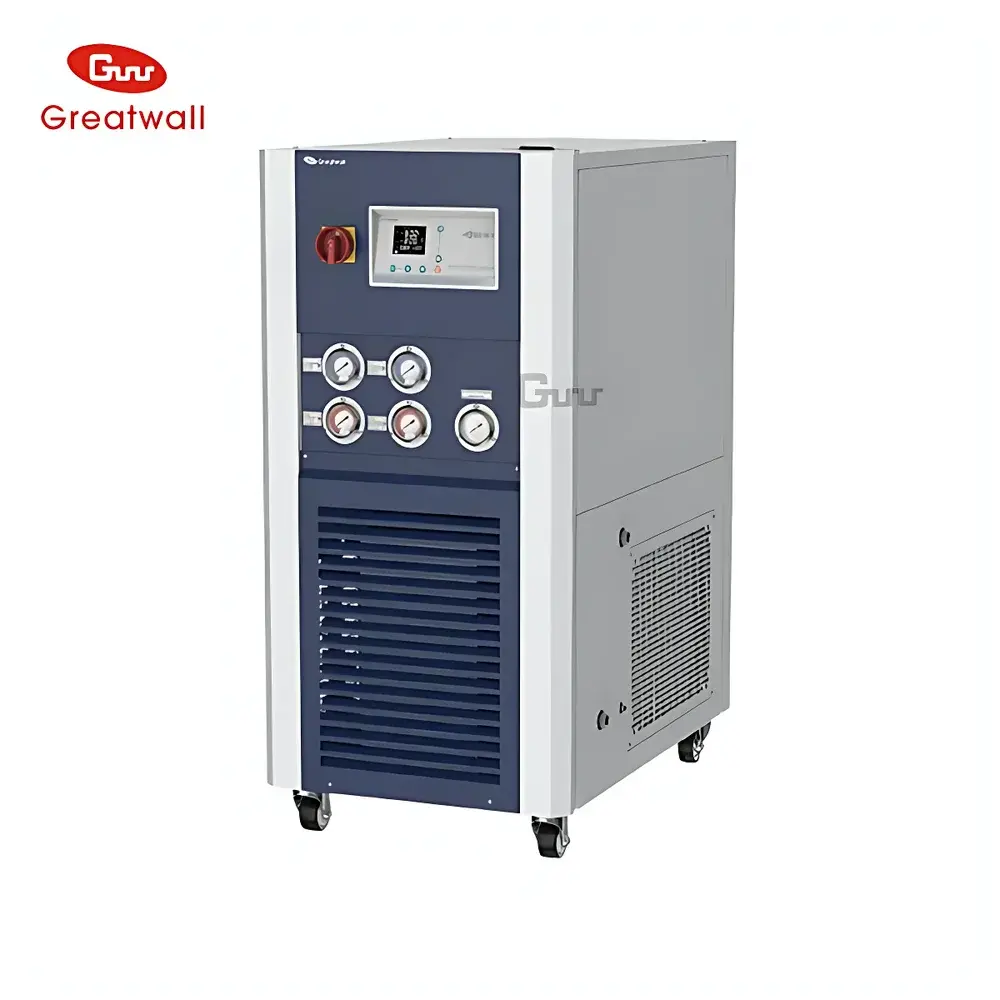
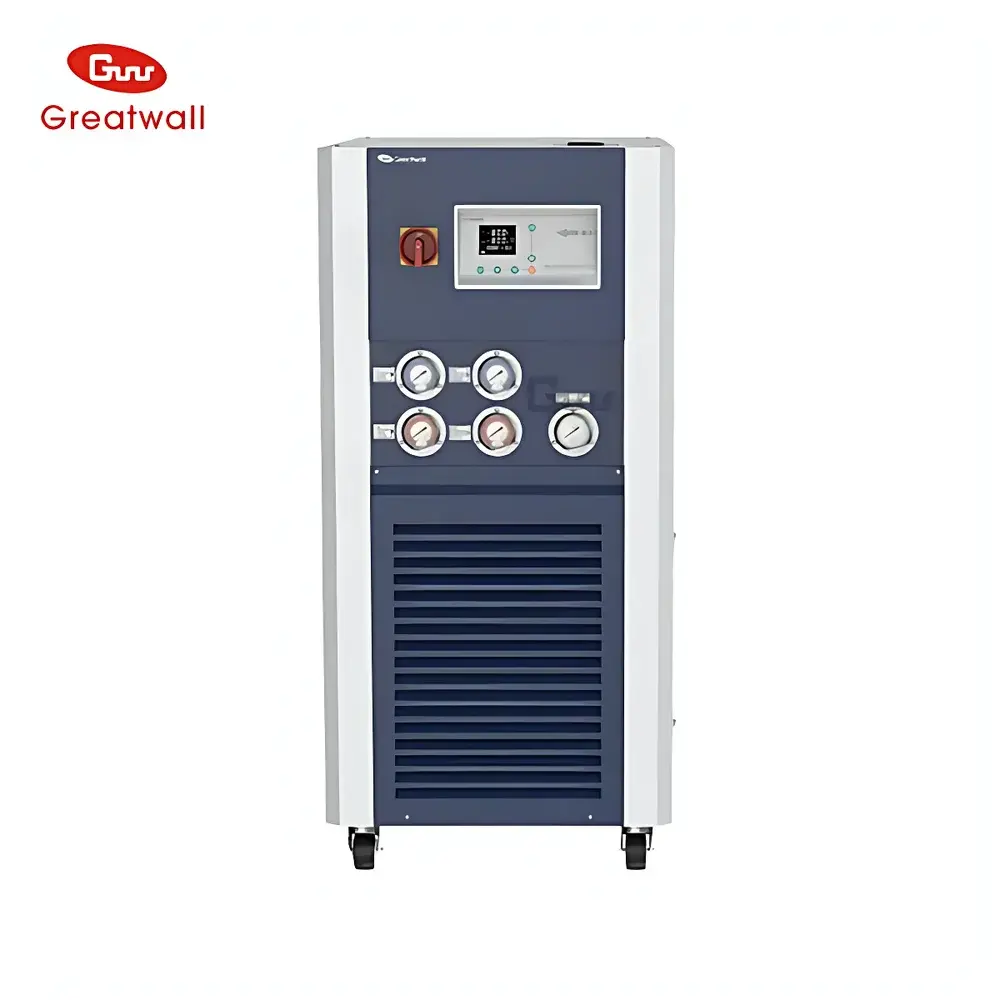
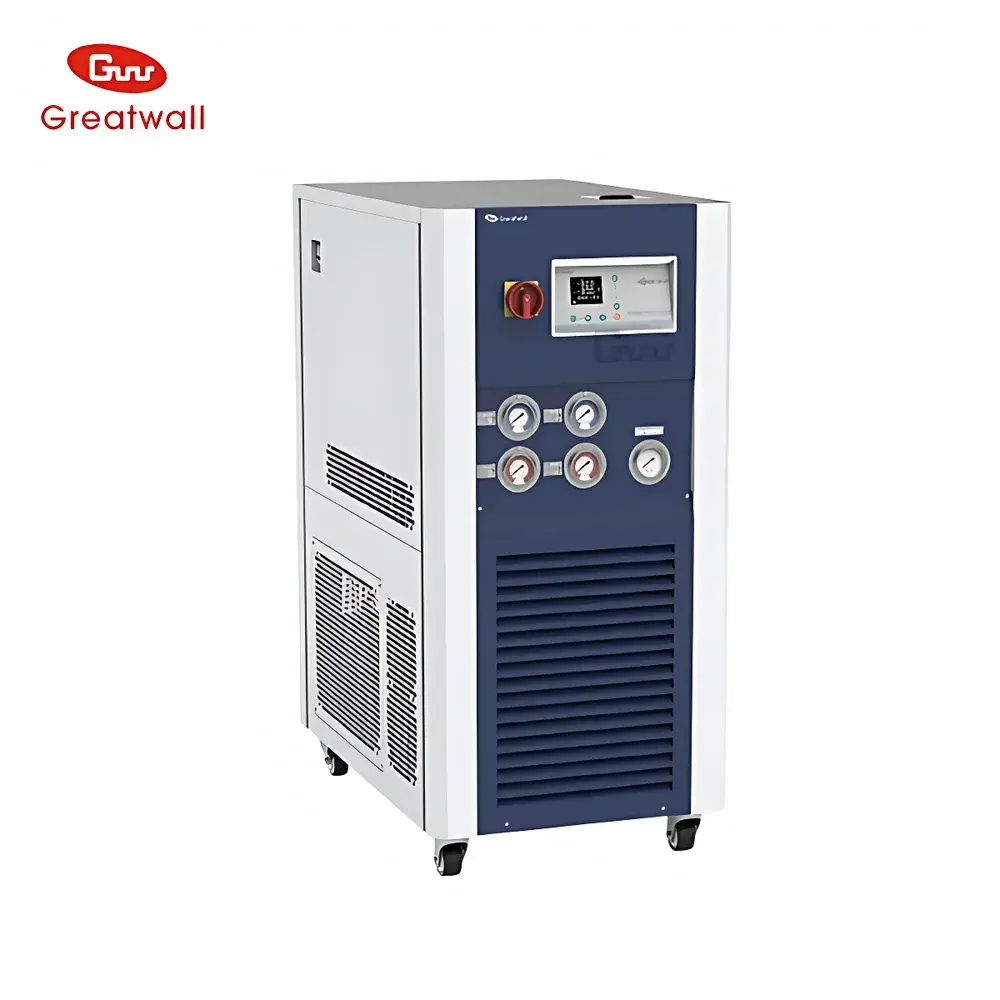
LT Series Ultra-Low Temperature Circulating Chiller – The Great Wall Model LT-20-80
| Brand | The Great Wall |
|---|---|
| Origin | Henan, China |
| Manufacturer Type | Direct Manufacturer |
| Instrument Type | Integrated Unit |
| Temperature Range | −80 °C to −40 °C |
| Cooling Capacity | 450 W (at −80 °C) / 1400 W (at −60 °C) / 2000 W (at −40 °C) |
| Temperature Stability | ±2 °C |
| Circulating Pump Pressure | 1 bar |
| Flow Rate | 30 L/min |
| Power Input | 4900 W |
| Supply Voltage | 3-phase, 380 V, 50 Hz |
| Refrigerants | R404A & R23 |
| Reservoir Volume | 10 L |
| Tank Material | SUS304 Stainless Steel |
| Dimensions (W×D×H) | 645 × 1060 × 1320 mm |
| Net Weight | 235 kg |
| Ambient Operating Conditions | 5–35 °C, ≤70% RH |
| Temperature Sensor | Pt100 |
| Display | Digital LED |
Overview
The LT Series Ultra-Low Temperature Circulating Chiller (Model LT-20-80) is an integrated, high-performance refrigeration system engineered for precise, stable thermal control in demanding laboratory and pilot-scale industrial applications. Designed around a dual-stage cascade refrigeration architecture using R404A (high-stage) and R23 (low-stage) refrigerants, the unit delivers consistent cooling output across a wide operational range from −80 °C to −40 °C. Its closed-loop circulation design minimizes evaporation loss and moisture ingress—critical for maintaining fluid integrity when using low-volatility heat-transfer media such as silicone oils or specialized low-temperature glycol mixtures. Unlike open-bath chillers, the LT-20-80 maintains process stability under dynamic load conditions, making it suitable for exothermic reaction control in jacketed reactors, cryogenic material characterization, and temperature-programmed testing protocols requiring reproducible thermal profiles.
Key Features
- Integrated cascade refrigeration system with independent high- and low-stage compressors, enabling reliable operation down to −80 °C without external cryogen dependency.
- Hermetically sealed stainless steel (SUS304) reservoir with 10 L capacity, resistant to corrosion from common organic and aqueous heat-transfer fluids.
- High-flow centrifugal circulation pump delivering up to 30 L/min at 1 bar pressure—sufficient for multi-point distribution or long-loop configurations with minimal head loss.
- Comprehensive safety architecture: compressor delay start, high/low-pressure cutouts, phase-sequence monitoring, thermal overload protection, and overcurrent interruption—all compliant with IEC 61000-6-2/6-4 EMC standards.
- Automatic overflow relief valve prevents overfilling during fluid replenishment; excess fluid is safely diverted via dedicated drain port.
- Digital Pt100 temperature sensor with ±0.3 °C accuracy and LED display interface offering real-time setpoint and actual bath temperature readout.
Sample Compatibility & Compliance
The LT-20-80 supports a broad spectrum of heat-transfer fluids—including synthetic hydrocarbons, silicone-based oils, and custom-formulated low-temperature glycols—without degradation or phase separation under prolonged static or dynamic conditions. Its sealed loop design inherently limits oxidation and water absorption, preserving fluid thermal properties over extended service intervals. From a regulatory standpoint, the chiller meets essential electrical safety requirements per GB 4793.1 (equivalent to IEC 61010-1) and conforms to ISO 14001 environmental management benchmarks in manufacturing. While not intrinsically rated for hazardous area use, its robust enclosure (IP20 rating) and grounded chassis support deployment in GMP-aligned laboratories where equipment qualification (IQ/OQ/PQ) is required. Documentation packages include factory calibration certificates traceable to NIM (National Institute of Metrology, China), supporting audit readiness for GLP and pharmaceutical development workflows.
Software & Data Management
The LT-20-80 operates as a standalone instrument with no embedded software stack or network connectivity. All control logic resides in a hardened microcontroller with non-volatile parameter memory. Temperature setpoints, run-time status, and fault logs are accessible via front-panel interface only—ensuring deterministic behavior and eliminating cybersecurity surface area. For integration into automated environments, optional analog (4–20 mA) and digital (RS485 Modbus RTU) outputs enable remote monitoring of temperature, pump status, and alarm states within SCADA or LIMS platforms. Audit trails are maintained manually through operator logbooks; electronic recordkeeping requires external data acquisition systems compliant with FDA 21 CFR Part 11 if used in regulated biopharmaceutical processes.
Applications
- Low-temperature reaction control in glass or stainless-steel jacketed reactors (e.g., Grignard additions, lithiation, hydrogenation below −60 °C).
- Thermal conditioning of rheometers, DSC, TMA, and DMA instruments during sub-ambient mechanical property evaluation.
- Simulating extreme environmental conditions for polymer aging studies, battery electrolyte stability testing, and superconductivity research.
- Cooling of high-power lasers, X-ray detectors, and vacuum chamber cold traps requiring stable, vibration-damped thermal sinks.
- Process validation support in API synthesis and lyophilization development where controlled ramp-and-hold thermal cycles are critical.
FAQ
What is the minimum achievable temperature at full load?
At nominal ambient conditions (25 °C, 50% RH), the LT-20-80 achieves −80 °C with a sustained cooling capacity of 450 W. Performance degrades linearly above 30 °C ambient; consult derating curves in the technical manual for elevated environment operation.
Can this chiller be used with flammable heat-transfer fluids?
No. The unit is not explosion-proof and lacks ATEX or UL Class I Div 2 certification. Only non-flammable, thermally stable fluids meeting ASTM D6920 or ISO 6743-22 specifications are recommended.
Is remote monitoring supported out-of-the-box?
Standard configuration includes local LED display only. RS485 Modbus RTU and 4–20 mA analog outputs are available as factory-installed options—contact technical sales for ordering codes and protocol documentation.
How often does the refrigerant require servicing?
Under normal operation and proper installation (adequate ventilation, level mounting, clean condenser coils), the sealed refrigeration circuit requires no scheduled refrigerant recharge. Annual preventive maintenance includes filter inspection, electrical terminal tightening, and performance verification against factory calibration points.
What is the expected service life of the compressors?
Dual-stage hermetic compressors are rated for ≥25,000 operating hours under continuous duty cycle. Compressor longevity is maximized by observing startup delay intervals (>3 minutes between power cycles) and avoiding frequent short-cycling due to undersized load matching.
Related Products



