
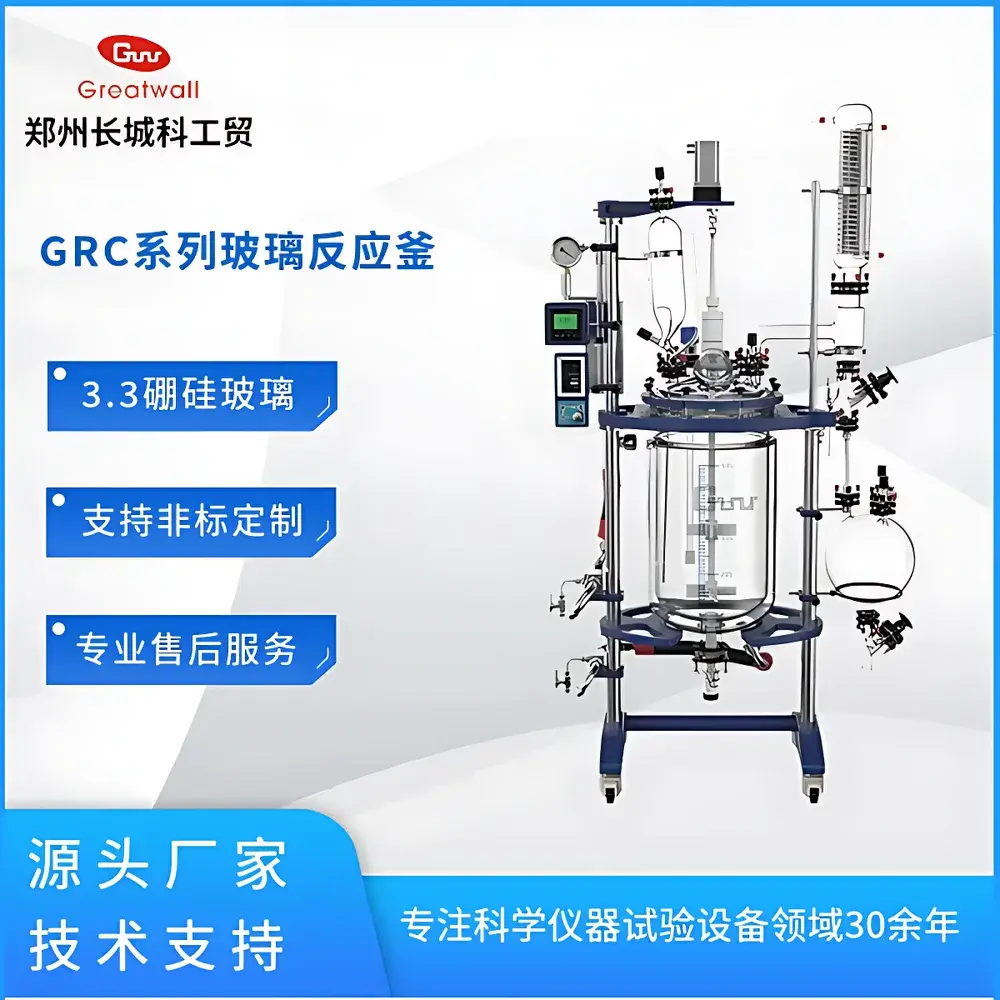
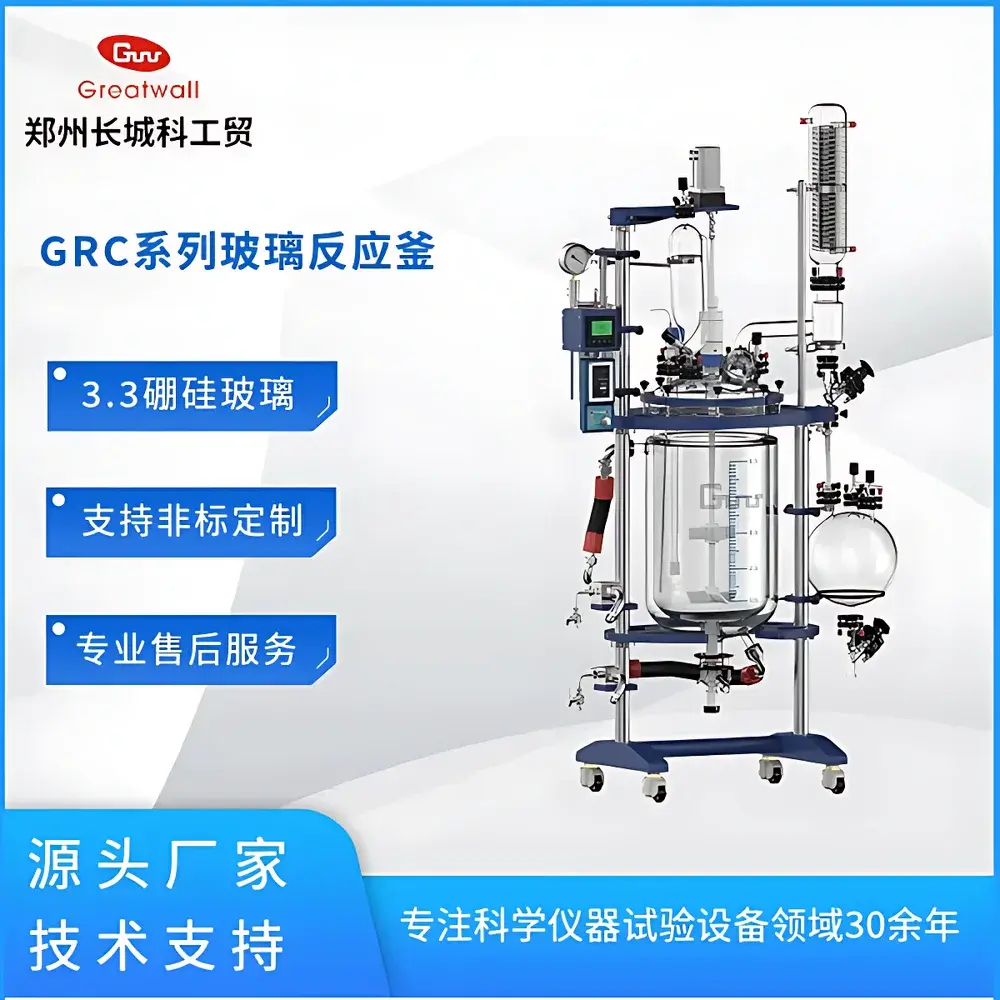
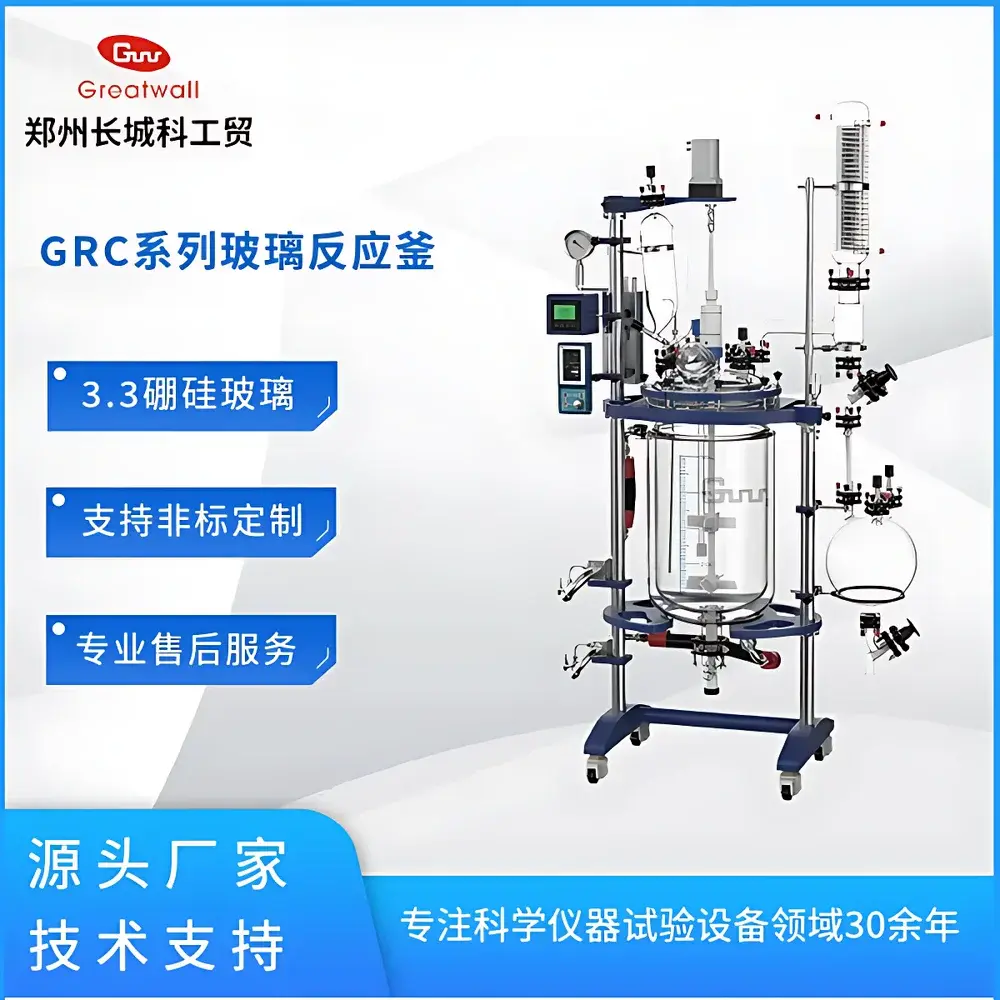
GRC-50 Adjustable-Speed Glass Reactor by The Great Wall
| Brand | The Great Wall |
|---|---|
| Origin | Henan, China |
| Manufacturer Type | Direct Manufacturer |
| Origin Category | Domestic (China) |
| Model | GRC-50 |
| Instrument Classification | Jacketed Glass Reactor |
| Vessel Capacity | 50 L |
| Vessel Material | 3.3 Borosilicate Glass |
| Operating Pressure Range | –0.1 MPa to ambient |
| Temperature Range | –80 °C to +200 °C |
| Vacuum Performance | ≤ –0.095 MPa (absolute) |
| Sealing Components | PTFE旋塞 & PTFE-lined discharge valve |
| Jacket Configuration | Dual-layer (standard), optional triple-layer with vacuum-insulated outer jacket |
| Insulation | Integrated thermal insulation sleeve for external tubing connections |
| Customization Options | Filter-integrated configuration, bottom-mounted drip tray, feed control via constant-pressure dropping funnel, jacket fluid temperature regulation via external chiller/heater circulator |
| Compliance | Designed per general laboratory reactor safety and material compatibility guidelines (ASTM E2654, ISO 17025-supportive operation, GLP-aligned documentation practices) |
Overview
The GRC-50 Adjustable-Speed Glass Reactor is a dual-jacketed, laboratory-scale chemical reaction system engineered for precise control of temperature, pressure, and reagent addition during synthesis, distillation, concentration, and reflux processes. Built around a seamless 3.3 borosilicate glass vessel (DIN/ISO 3585 compliant), the reactor operates under controlled vacuum (down to –0.095 MPa absolute) or slight positive pressure (up to ambient), enabling applications ranging from low-temperature cryogenic reactions to high-boiling-point solvent removal. Its double-wall construction allows circulation of thermostatic fluid—such as silicone oil, ethylene glycol/water mixtures, or liquid nitrogen slurry—through the interstitial jacket to maintain uniform thermal profiles across the reaction volume. Optional triple-jacket configurations incorporate an evacuated outer annulus to minimize heat loss and improve thermal stability during extended exothermic or endothermic operations—critical for kinetic studies and scale-up validation.
Key Features
- High-purity 3.3 borosilicate glass body (Schott Duran / Pyrex-equivalent) offering exceptional thermal shock resistance (ΔT ≥ 120 °C), chemical inertness toward acids, alkalis, and organic solvents, and optical clarity for real-time visual monitoring.
- Adjustable-speed overhead stirring system with torque-sensing motor, enabling controlled agitation from 0–250 rpm with digital speed display and overload protection.
- Integrated PTFE stopcocks and PTFE-lined drain valve ensure leak-tight operation and long-term corrosion resistance—even with aggressive halogenated or strongly acidic reagents.
- Vacuum-rated ground-glass joints (ISO KF or standard taper, e.g., 24/40, 29/32) with reinforced silicone or Viton O-rings provide reliable sealing across pressure and temperature extremes.
- Modular feed system: compatible with constant-pressure addition funnels or dropping funnels equipped with fine-adjustment valves for metered reagent dosing under inert or reduced-pressure conditions.
- Pre-installed thermal insulation sleeves on all external fluid lines reduce condensation, prevent thermal bridging, and protect fragile glass interfaces during cryogenic or high-temperature operation.
- Structural design supports optional accessories including bottom-mounted drip trays (stainless steel or PTFE-coated), filter-bottom reactors (sintered glass frit, porosity grade G3/G4), and integrated pH/temperature probe ports.
Sample Compatibility & Compliance
The GRC-50 is suitable for homogeneous and heterogeneous reaction systems involving organic, inorganic, and organometallic compounds. Its inert glass surface prevents catalytic side reactions and facilitates post-run cleaning—essential for multi-step synthesis workflows. The reactor meets general-purpose laboratory equipment requirements aligned with ASTM E2654 (Standard Guide for Validation of Analytical Laboratory Equipment), supports GLP-compliant recordkeeping when paired with validated data loggers, and is routinely deployed in environments adhering to ISO/IEC 17025 quality management principles. While not certified to ASME BPVC Section VIII or PED 2014/68/EU, its –0.1 MPa to ambient pressure rating classifies it as a low-pressure laboratory reactor per IEC 61010-1:2010 safety standards for electrical equipment.
Software & Data Management
The GRC-50 operates as a standalone hardware platform; no embedded firmware or proprietary software is included. However, it is fully compatible with third-party process monitoring systems—including USB-connected thermocouple/data loggers (e.g., Omega OM-DAQPRO series), programmable chillers (Julabo, Huber), and vacuum controllers (Vacuubrand RV 12). Users may integrate the reactor into centralized lab automation frameworks via analog 0–10 V or 4–20 mA signal outputs (available upon customization) for temperature, stirring speed, or vacuum level feedback. Audit-trail-capable data acquisition is achievable using FDA 21 CFR Part 11–compliant platforms such as LabArchives ELN or DeltaV DCS when interfaced through industrial-grade signal conditioners.
Applications
- Batch synthesis of fine chemicals, pharmaceutical intermediates, and polymer precursors under controlled stoichiometry and thermal profile.
- Low-temperature lithiation, Grignard formation, and metal-halogen exchange reactions requiring sustained –40 °C to –78 °C operation.
- Solvent recovery via rotary-evaporation-compatible distillation at reduced pressure.
- Catalytic hydrogenation (with optional H₂-compatible fittings and palladium-on-carbon filtration variants).
- Crystallization screening under variable cooling rates and supersaturation control.
- Photochemical reactions utilizing UV-transparent glass and optional quartz viewport upgrades.
- Reaction calorimetry pre-studies where heat flow estimation relies on jacket fluid ΔT measurement and mass flow rate.
FAQ
What temperature range is supported with standard jacket fluid circulation?
With silicone oil (max. 200 °C) or 30% ethylene glycol/water (min. –30 °C), the GRC-50 maintains stable setpoints from –30 °C to +180 °C. For extended low-temperature operation (–80 °C), liquid nitrogen-cooled heat transfer fluids or cascade refrigeration units are required.
Can the reactor be used under inert atmosphere?
Yes—equipped with standard Schlenk-line compatible inlet/outlet ports and PTFE-sealed stopcocks, it supports nitrogen or argon purging and maintenance of inert headspace during air-sensitive reactions.
Is custom engineering support available for integration into existing process lines?
Yes. The Great Wall offers mechanical interface drawings (PDF/DXF), flange specifications (ANSI/DIN), and electrical interface schematics for OEM integration, including PLC-ready analog I/O and emergency stop circuitry.
Does the system include temperature or pressure sensors?
No—sensors are field-selectable and mounted externally per application requirements. Common configurations include Pt100 RTDs in the jacket inlet/outlet and digital vacuum gauges (capacitance manometers) on the vapor line.
What certifications accompany the unit for international shipment?
Each GRC-50 ships with CE-marked electrical components (motor controller, power supply), RoHS-compliant materials declaration, and a Factory Acceptance Test (FAT) report verifying vacuum integrity, thermal uniformity, and mechanical rotation performance.



