
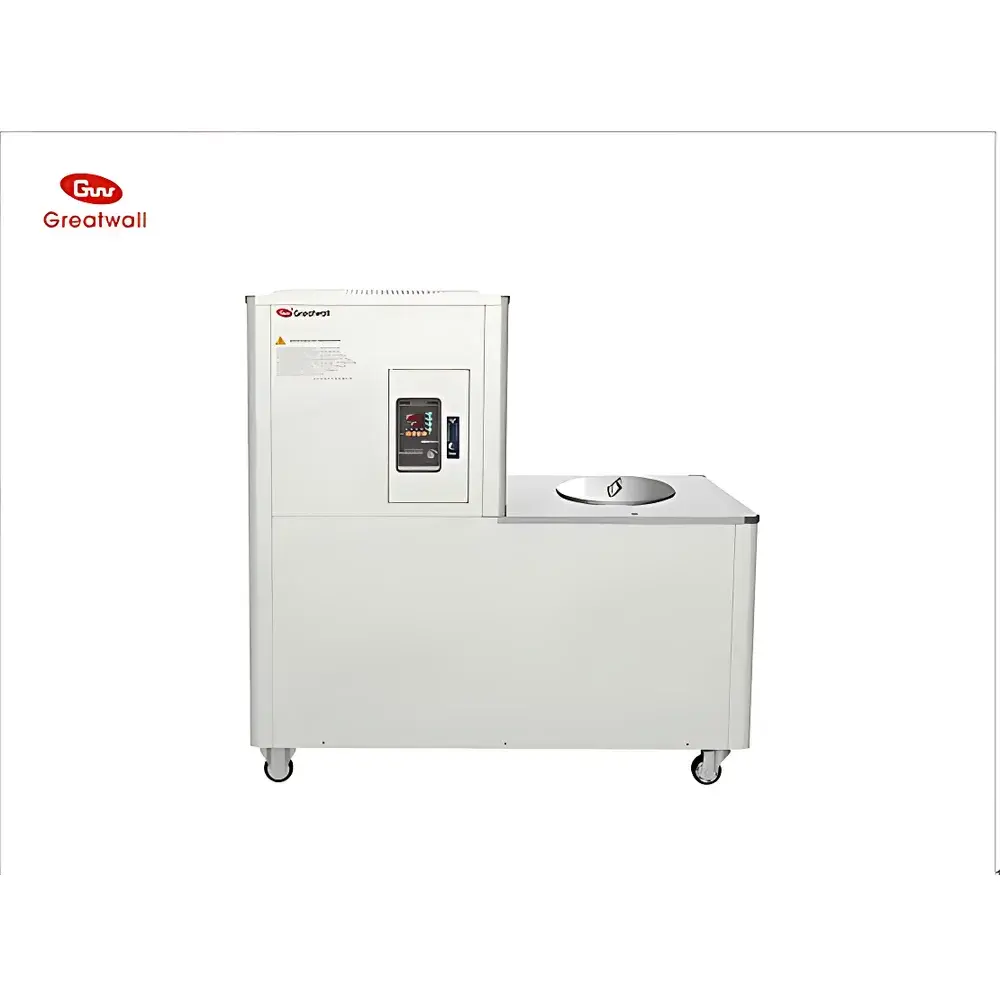
Great Wall DHJF-1230 Ultra-Low-Temperature Circulating Reaction Bath
| Brand | The Great Wall |
|---|---|
| Origin | Henan, China |
| Manufacturer Type | Direct Manufacturer |
| Model | DHJF-1230 |
| Cooling Capacity | 620 W at −60 °C, 480 W at −80 °C, 200 W at −100 °C, 80 W at −120 °C |
| Temperature Range | −120 °C to −60 °C |
| Temperature Stability | ±2 °C |
| Bath Volume | 30 L |
| Pump Flow Rate | 20 L/min |
| Max. Circulation Pressure | 0.4 bar |
| Power Supply | 3-phase, 380 V, 50 Hz |
| Total Power Consumption | 4 kW |
| Display | LCD with 0.1 °C resolution |
| Evaporator Type | Coil-in-tank (stainless steel coil immersed in bath fluid) |
| Compressor | Panasonic hermetic scroll compressor |
| Condenser | Air-cooled finned-tube with oxygen-free copper tubing |
| Refrigerant | Mixed refrigerant blend |
| Safety Protections | Phase sequence, overcurrent, overtemperature, and startup delay protection |
| Ambient Operating Conditions | 5–35 °C, ≤70% RH |
| External Port | 1/2″ BSP |
| Bath Opening Diameter | 320 mm |
| Bath Internal Dimensions | Ø400 × 235 mm |
| Max. Flask Capacity | 10,000 mL |
| Bath Material | AISI 304 stainless steel |
| Unit Dimensions (W×D×H) | 1160 × 800 × 1310 mm |
| Net Weight | 190 kg |
| Critical Operational Constraint | External circulation must be disabled when bath temperature < −90 °C |
Overview
The Great Wall DHJF-1230 Ultra-Low-Temperature Circulating Reaction Bath is an engineered solution for laboratory-scale cryogenic reaction control, low-temperature synthesis, and precision thermal conditioning of chemical and material science processes. It operates on a single-stage compression cascade-enhanced refrigeration architecture—specifically, a patented series-connected heat exchanger system that enables stable operation down to −120 °C using a single hermetic scroll compressor. Unlike conventional dual- or triple-stage mechanical refrigeration units, this design achieves deep-cryogenic capability through optimized phase separation and staged condensation within a fully welded refrigerant loop, minimizing leak paths and maximizing long-term reliability. The unit integrates a submersible coil-type evaporator directly mounted inside the 30 L AISI 304 stainless steel reservoir, ensuring uniform thermal distribution and mechanical resilience—even under full solidification of heat transfer fluid. Its operational envelope (−120 °C to −60 °C) targets applications requiring sustained sub-liquid-nitrogen temperatures without reliance on consumable cryogens.
Key Features
- Hermetic Panasonic scroll compressor with integrated thermal overload protection and flexible mounting for vibration damping
- Air-cooled finned-tube condenser constructed from oxygen-free copper tubing with proprietary expansion-bonding technology for enhanced thermal conductivity and service accessibility
- Series-connected multi-stage heat exchanger assembly enabling −120 °C performance via single-compressor architecture; fully welded construction reduces potential leak points and supports GLP-aligned maintenance logging
- Submersible stainless steel coil evaporator housed entirely within the bath reservoir—designed to withstand complete freezing of silicone oil or ethylene glycol-based heat transfer media without structural compromise
- Low-temperature-rated centrifugal circulation pump (100 W, 20 L/min flow, 0.4 bar max pressure) with 304 stainless steel wetted parts and non-metallic shaft seal compatible with aggressive cryogenic fluids
- Digital PID controller with high-resolution LCD interface, 0.1 °C temperature readout accuracy, and intuitive keypad navigation for setpoint programming, ramp/soak profiles, and alarm configuration
- Comprehensive safety suite including phase-sequence monitoring, overcurrent cutoff, real-time compressor discharge temperature sensing, and programmable startup delay to prevent liquid slug ingestion
Sample Compatibility & Compliance
The DHJF-1230 accommodates standard laboratory glassware up to 10 L capacity (e.g., jacketed reactors, three-neck flasks, and cryo-condensers) via its 320 mm diameter open-top reservoir. All fluid-contact surfaces—including bath tank, internal coil, circulation tubing, and pump head—are fabricated from AISI 304 stainless steel, ensuring resistance to chloride-induced stress corrosion cracking and compatibility with common low-temperature heat transfer fluids (e.g., silicone oils, polyalphaolefins, and inhibited glycol/water mixtures). While not certified to UL/CSA or CE for hazardous location use, the system complies with IEC 61000-6-2 (immunity) and IEC 61000-6-4 (emissions) standards. Its control firmware supports audit-trail-ready parameter logging (time-stamped setpoints, actual temperatures, and fault events), aligning with basic GLP documentation requirements for method validation and equipment qualification protocols.
Software & Data Management
The DHJF-1230 operates via embedded firmware with no external PC dependency. All operational parameters—including temperature setpoint, ramp rate, hold duration, and safety thresholds—are configurable and retained in non-volatile memory after power cycling. The controller records up to 1,000 timestamped data points (date/time + bath temperature) internally, accessible via scroll navigation on the LCD. Optional RS485 Modbus RTU output (standard on request) enables integration into centralized SCADA or LIMS environments for automated data capture, trend analysis, and electronic batch record generation. When interfaced with compliant software platforms, the system supports 21 CFR Part 11–aligned user authentication, electronic signatures, and change history tracking for regulated pharmaceutical or contract research applications.
Applications
- Catalytic hydrogenation and lithiation reactions requiring strict thermal control below −80 °C
- Polymerization initiation under cryogenic conditions to suppress side reactions and improve tacticity
- Low-temperature crystallization studies of high-purity organic intermediates and APIs
- Calibration and verification of cryogenic sensors and thermocouples per ASTM E220 or ISO 17025 procedures
- Condensation trapping in vacuum distillation or solvent recovery systems operating near atmospheric boiling points of chlorinated solvents
- Material testing of elastomers, composites, and battery electrolytes across extreme thermal gradients
FAQ
What heat transfer fluids are recommended for operation at −120 °C?
Silicone-based oils with pour points ≤ −50 °C (e.g., DC-704, PMX-200) or specially formulated polyalphaolefin blends are validated for continuous use. Aqueous glycols are prohibited below −40 °C.
Can external recirculation remain active below −90 °C?
No. The controller enforces automatic pump shutdown when bath temperature falls below −90 °C to prevent cavitation, vapor lock, and irreversible pump damage.
Is the unit suitable for use in an inert atmosphere glovebox?
Not without modification. The air-cooled condenser requires ambient airflow; retrofitting with a water-cooled condenser kit is available upon request.
Does the system support remote monitoring via Ethernet or Wi-Fi?
Standard configuration includes only RS485 Modbus RTU. Ethernet/Wi-Fi connectivity requires third-party gateway integration and is not natively supported.
What maintenance intervals are recommended for the refrigeration circuit?
Compressor oil inspection every 2,000 operating hours; full refrigerant charge verification and moisture filter replacement every 5 years or after any system breach.



