
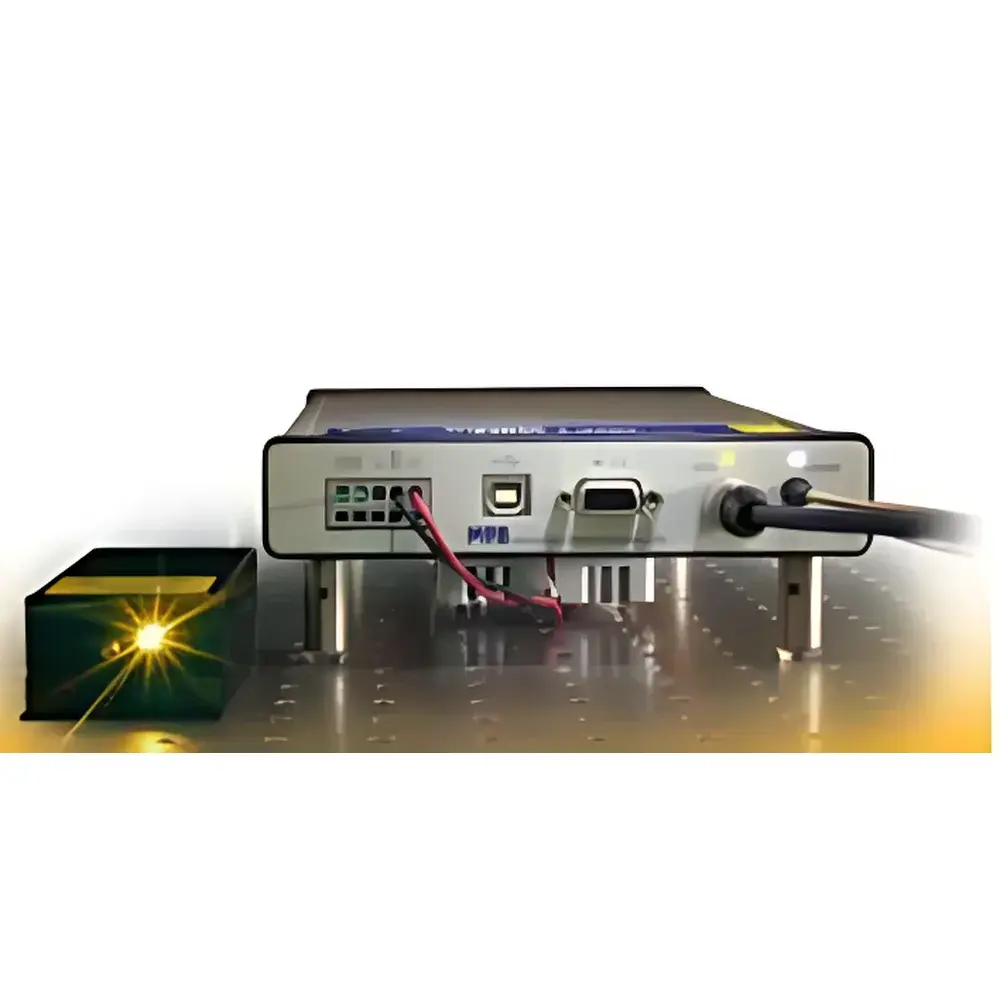
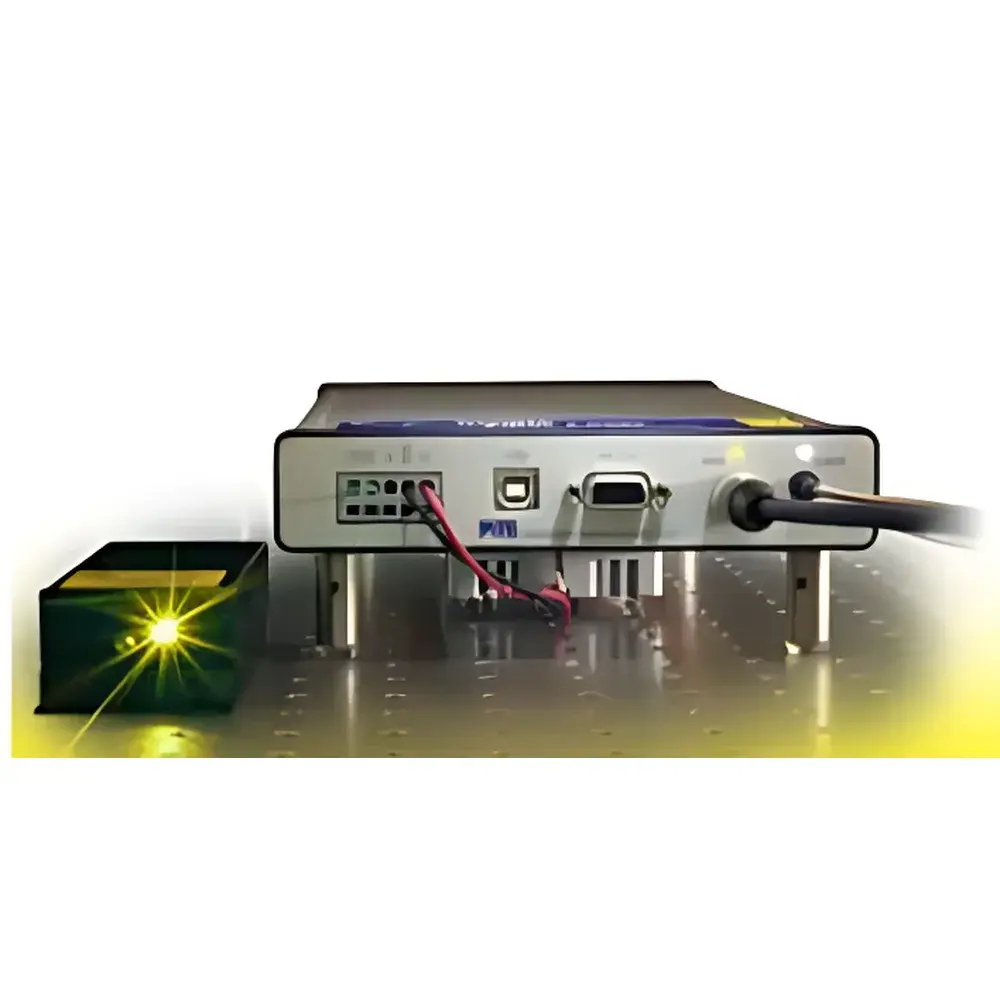
MPB VFL-P-200-580 Continuous-Wave 580 nm Fiber Laser
| Brand | MPB |
|---|---|
| Origin | Canada |
| Model | VFL-P-200-580 |
| Output Power | 200 mW |
| Wavelength | 580 nm |
| Beam Mode | TEM₀₀ |
| M² | ≤1.1 |
| Polarization | Linear, vertical to baseplate |
| Beam Divergence (Full Angle) | <5 mrad |
| Power Stability (RMS, 8h) | ±0.5% |
| Wavelength Stability | ±0.02 nm |
| Control Interface | RS232 & USB |
| Cooling | Air-cooled |
| Form Factor | Benchtop or 2RU Rack-mountable (19", 23", ETSI compliant) |
| Safety | Interlock-enabled (benchtop), Integrated Transformer + Emergency Stop (rackmount) |
Overview
The MPB VFL-P-200-580 is a continuous-wave (CW), single-frequency, visible-wavelength fiber laser engineered for high-stability spectroscopic and biomedical applications requiring precise 580 nm emission. Unlike diode-pumped solid-state (DPSS) alternatives, this laser employs MPB’s proprietary frequency-doubled fiber architecture—where a fundamental infrared signal generated in a polarization-maintaining ytterbium-doped fiber is nonlinearly converted via periodically poled lithium niobate (PPLN) to produce diffraction-limited 580 nm output. The result is exceptional spectral purity (<0.1 pm linewidth), low relative intensity noise (<–140 dB/Hz), and intrinsic immunity to mode hopping. Designed for integration into regulated laboratory environments, the system meets IEC 60825-1:2014 Class 3B laser safety requirements and supports full traceability under GLP/GMP-aligned operational protocols.
Key Features
- Stable CW output at 580 nm with <±0.02 nm wavelength drift over 8 hours—critical for resonance-sensitive fluorescence excitation and Raman pump applications.
- Diffraction-limited beam quality (M² ≤1.1) and TEM₀₀ spatial profile ensure optimal coupling into single-mode fibers, confocal pinholes, and high-NA microscope objectives.
- Dual control architecture: RS232 for SCPI-compliant remote integration into automated test benches; USB for local GUI-based operation with real-time power monitoring and calibration logging.
- Air-cooled thermal management eliminates need for external chillers—reducing footprint, acoustic noise, and maintenance overhead while maintaining <0.5% RMS power stability over ambient temperature variations from 15°C to 30°C.
- Configurable form factor: benchtop version includes mechanical safety interlock and key-switch enable; rack-mount variant (2RU) integrates internal AC/DC conversion, redundant emergency stop circuitry, and ETSI 300 119-compliant mounting hardware.
Sample Compatibility & Compliance
The VFL-P-200-580 is routinely deployed in applications demanding strict photostability and minimal thermal load on delicate specimens—including live-cell fluorescence imaging, flow cytometry of phycoerythrin (PE)-conjugated probes, and ophthalmic retinal stimulation studies. Its narrow spectral bandwidth and low-amplitude noise preserve quantum yield integrity in organic fluorophores (e.g., Texas Red, mCherry) without inducing photobleaching artifacts. From a regulatory standpoint, the laser complies with FDA 21 CFR Part 11 requirements for electronic records when used with MPB’s optional audit-trail-enabled software package. System documentation—including factory calibration certificates, beam parameter reports (ISO 11146-1), and CE/UKCA declarations—is provided per ISO/IEC 17025-accredited procedures.
Software & Data Management
MPB’s LaserControl Suite (v4.2+) provides a validated, platform-independent GUI supporting real-time power trending, scheduled power ramping, and automated wavelength verification via integrated wavemeter feedback (optional). All operational parameters—including setpoints, timestamps, interlock status, and thermal sensor readings—are logged in HDF5 format with SHA-256 checksums to ensure data integrity. For enterprise integration, the SDK supports Python (PySerial, NumPy), MATLAB Instrument Control Toolbox, and LabVIEW drivers—enabling synchronization with time-of-flight detectors, galvo scanners, or multi-channel DAQ systems. Audit trails record user identity, action type, and timestamp per GLP Annex 11 and ISO 13485 Annex C guidelines.
Applications
- Fluorescence Microspectroscopy: Excitation source for dual-color ratiometric imaging where 580 nm selectively activates orange-emitting probes without cross-excitation of green fluorophores.
- Flow Cytometry: High-sensitivity detection of PE and PE-Cy5 conjugates in clinical hematology analyzers—leveraging the laser’s low noise floor to improve signal-to-background ratio in low-abundance cell populations.
- Ophthalmology Research: Non-invasive retinal stimulation in optogenetic models using channelrhodopsin variants with peak activation near 580 nm.
- Thin-Film Characterization: Pump source for transient absorption spectroscopy of perovskite solar cell layers, where precise wavelength matching enables selective carrier generation in mixed-halide compositions.
- Laser Sintering R&D: Low-power additive manufacturing process development for temperature-sensitive polymer composites requiring controlled photothermal initiation without bulk melting.
FAQ
Is the 580 nm output spectrally tunable?
No—the VFL-P series operates at fixed wavelengths defined by the PPLN crystal poling period and temperature stabilization. Custom wavelengths between 532 nm and 640 nm are available upon request with lead-time adjustment.
Can multiple units be synchronized for pump-probe experiments?
Yes—via external TTL trigger input (BNC) with jitter <1 ns, enabling sub-picosecond timing alignment with femtosecond oscillator systems.
What is the expected lifetime of the nonlinear crystal under continuous operation?
MPB specifies >20,000 hours MTBF for the PPLN module when operated within specified thermal and power density limits (validated per Telcordia GR-1221-CORE).
Does the rack-mount version support redundant power supplies?
Not standard—but dual-input 100–240 VAC auto-ranging PSU is included; external 24 VDC backup input is available as an engineering option (consult MPB Technical Sales).
Are calibration reports NIST-traceable?
Yes—all optical power calibrations are performed using NIST-traceable thermal sensors (Ophir 3A-FS) and certified annually by an A2LA-accredited lab (Certificate #MPB-CL-2024-0871).





