
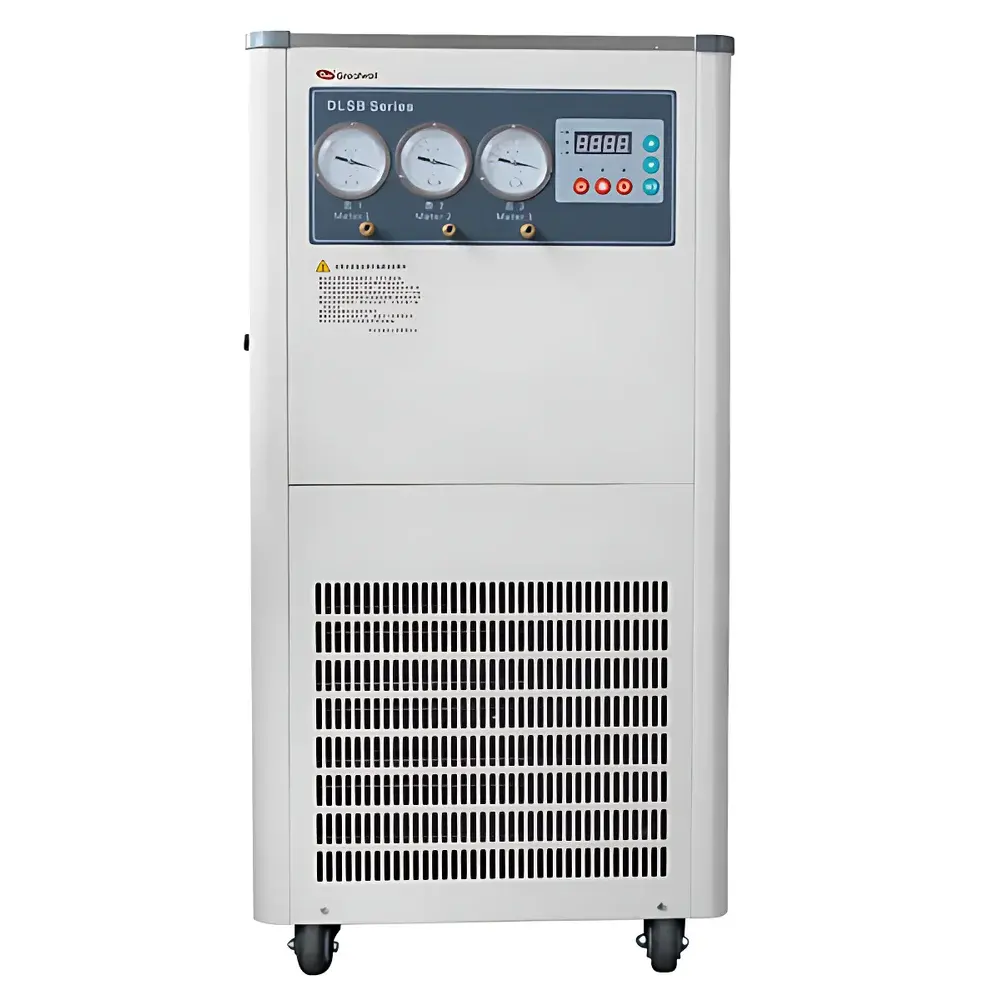
Great Wall DLSB-ZC Vacuum Cryogenic Pump
| Brand | The Great Wall |
|---|---|
| Origin | Henan, China |
| Manufacturer Type | Direct Manufacturer |
| Country of Origin | China |
| Model | DLSB-ZC |
| Operating Temperature Range | −10 °C to 25 °C |
| Ambient Temperature Range | 5 °C to 25 °C |
| Temperature Stability | ±2 °C |
| Total Power Consumption | 1650 W |
| Electrical Supply | 220–240 V~, 50 Hz |
| Reservoir Volume | 20 L |
| Refrigeration Capacity | 600–2550 W |
| Circulating Pump Power | 280 W |
| Rated Flow Rate | 30 L/min |
| Maximum Pressure Output | 1.0 bar |
| Ultimate Vacuum Level | 0.098 MPa (2 kPa) |
| Number of Vacuum Ports | 3 |
| Single-Port Pumping Speed | 10 L/min |
| Dimensions (W×D×H) | 595 × 475 × 925 mm |
Overview
The Great Wall DLSB-ZC Vacuum Cryogenic Pump is a dual-function laboratory system engineered for precise low-temperature circulation and high-efficiency vacuum generation in parallel or independent operation modes. It integrates a closed-loop refrigerated circulator with a multi-port vacuum pump assembly, enabling simultaneous cooling of reaction vessels or analytical instrumentation while maintaining stable sub-atmospheric pressure conditions. The system operates on a vapor-compression refrigeration cycle using environmentally compliant R404A or R507 refrigerant (subject to regional regulations), and employs an oil-lubricated rotary vane vacuum pump architecture optimized for continuous duty in chemical synthesis, vacuum distillation, freeze-drying pre-chilling, and low-temperature material testing environments. Its design prioritizes thermal stability under vacuum load, with active temperature regulation maintained within ±2 °C across the full operating range (−10 °C to 25 °C), ensuring reproducibility in temperature-sensitive vacuum processes.
Key Features
- Dual-mode operation: Independent or synchronized control of refrigeration and vacuum functions via integrated digital interface
- Triple vacuum port configuration (3 × 10 L/min pumping speed per port) supports concurrent multi-vessel evacuation or staged pressure reduction protocols
- 20 L stainless steel reservoir with corrosion-resistant internal coating, compatible with water, ethanol/water mixtures, and silicone oils (viscosity ≤ 50 cSt)
- High-capacity refrigeration system (600–2550 W adjustable output) enables rapid cooldown of external jackets up to 5 L volume
- Low-noise circulating pump (280 W, 30 L/min rated flow) with pressure regulation up to 1.0 bar for forced-flow applications
- Ultimate vacuum performance of 0.098 MPa (2 kPa absolute), verified per ISO 21809-3 methodology using capacitance manometry
- Robust mechanical construction: Powder-coated steel frame, IP20-rated electrical enclosure, and vibration-damped mounting for benchtop or floor-standing deployment
Sample Compatibility & Compliance
The DLSB-ZC accommodates standard laboratory glassware including round-bottom flasks (up to 5 L), Schlenk lines, vacuum desiccators, and jacketed reactors. All wetted materials—reservoir liner, pump head gaskets, and fluid pathways—are chemically resistant to common organic solvents, mild acids, and bases. The unit complies with IEC 61010-1:2010 for laboratory electrical safety and meets CE marking requirements for electromagnetic compatibility (EMC Directive 2014/30/EU). While not certified to ISO/IEC 17025 as a measurement standard, its temperature and vacuum stability metrics align with routine QC validation protocols referenced in ASTM E2915-22 (standard guide for evaluating thermal stability of equipment) and USP (analytical instrument qualification). No radioactive or highly pyrophoric materials may be processed without prior engineering review.
Software & Data Management
The DLSB-ZC operates via a front-panel LCD controller with real-time display of reservoir temperature, vacuum level (kPa), pump status, and system faults. Optional RS485 Modbus RTU interface enables integration into centralized lab automation platforms (e.g., LabArchives ELN, DeltaV DCS) for time-stamped parameter logging. Audit trail functionality records all setpoint changes, alarm events, and manual overrides—supporting GLP-compliant documentation when paired with validated third-party data acquisition software. Firmware updates are performed via USB flash drive; no cloud connectivity or remote access capabilities are included, preserving network security integrity per NIST SP 800-53 Rev. 5 AC-17 controls.
Applications
- Vacuum-assisted low-temperature crystallization and solvent removal in pharmaceutical intermediate synthesis
- Cooling and evacuation of Kugelrohr apparatus for high-boiling-point compound purification
- Pre-cooling condenser traps in rotary evaporation systems to enhance solvent recovery efficiency
- Thermal conditioning of vacuum chambers during material outgassing studies (ASTM E595)
- Controlled-rate freezing of biological samples prior to lyophilization cycle initiation
- Calibration support for vacuum gauge reference standards requiring stable thermal environments
FAQ
What refrigerants are compatible with the DLSB-ZC system?
The unit is factory-charged with R404A refrigerant. Retrofitting to R507 or other alternatives requires authorized service technician verification of compressor compatibility and pressure relief valve recalibration.
Can the vacuum and cooling functions operate simultaneously without performance degradation?
Yes. Thermal load from vacuum pump heat dissipation is actively compensated by the refrigeration circuit; temperature stability remains within ±2 °C at ultimate vacuum (2 kPa) across the full operating range.
Is the system suitable for use with aggressive solvents such as chlorinated hydrocarbons?
No. Chlorinated solvents (e.g., chloroform, methylene chloride) degrade nitrile elastomer seals and may contaminate the refrigeration oil. Use only with alcohols, ketones, esters, or hydrocarbons with flash points >35 °C.
Does the DLSB-ZC include validation documentation for GMP environments?
The base unit ships with Factory Acceptance Test (FAT) report verifying temperature uniformity, vacuum decay rate (<0.1 kPa/min at 2 kPa), and electrical safety. IQ/OQ protocol templates are available upon request for user-executed qualification.
What maintenance intervals are recommended for sustained vacuum performance?
Vacuum pump oil replacement every 500 operating hours or annually (whichever occurs first); refrigerant charge verification every 24 months; reservoir cleaning with isopropanol every 6 months when used with aqueous solutions.



