
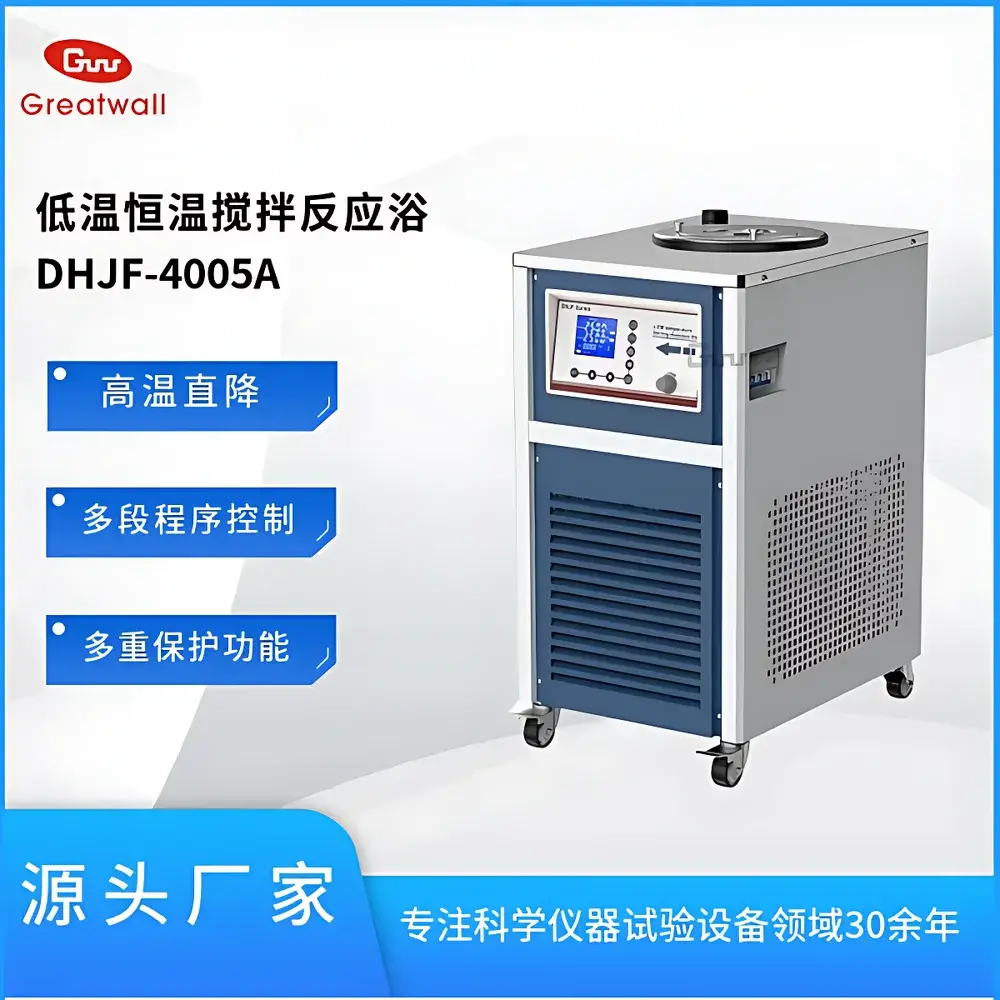
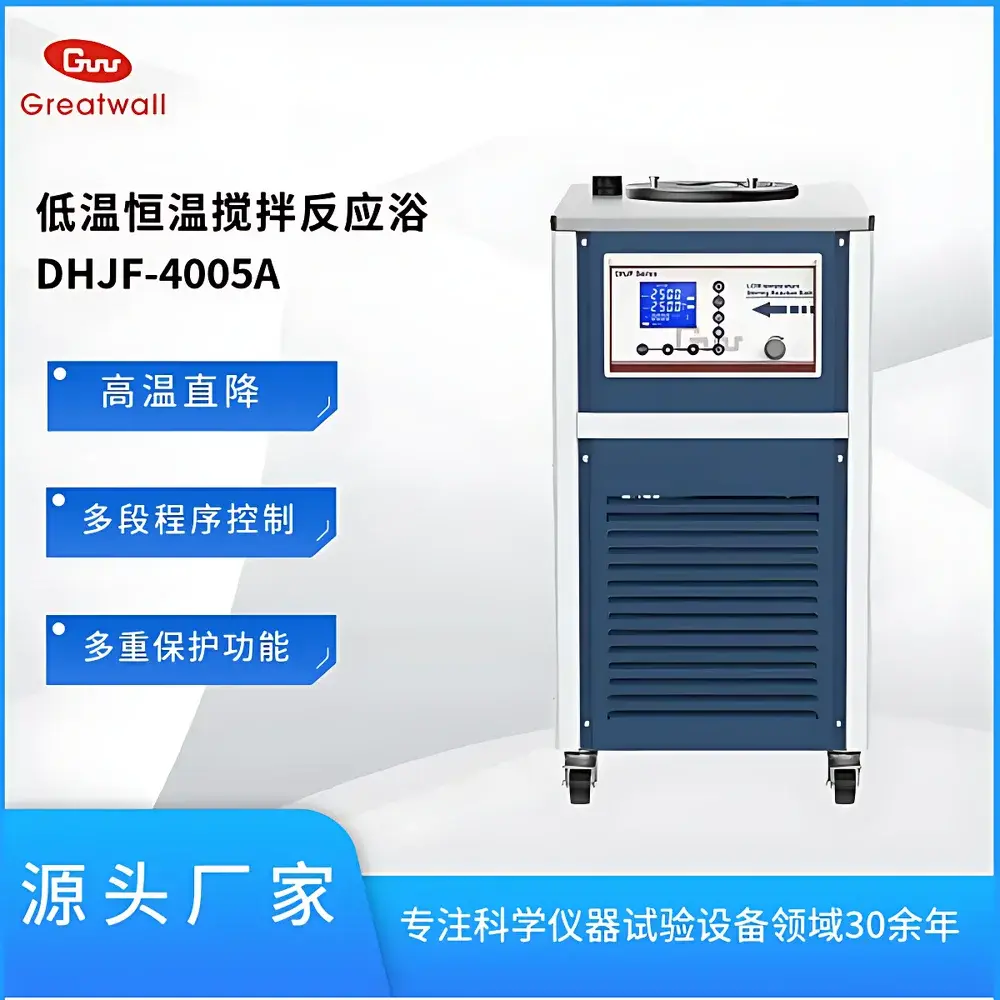
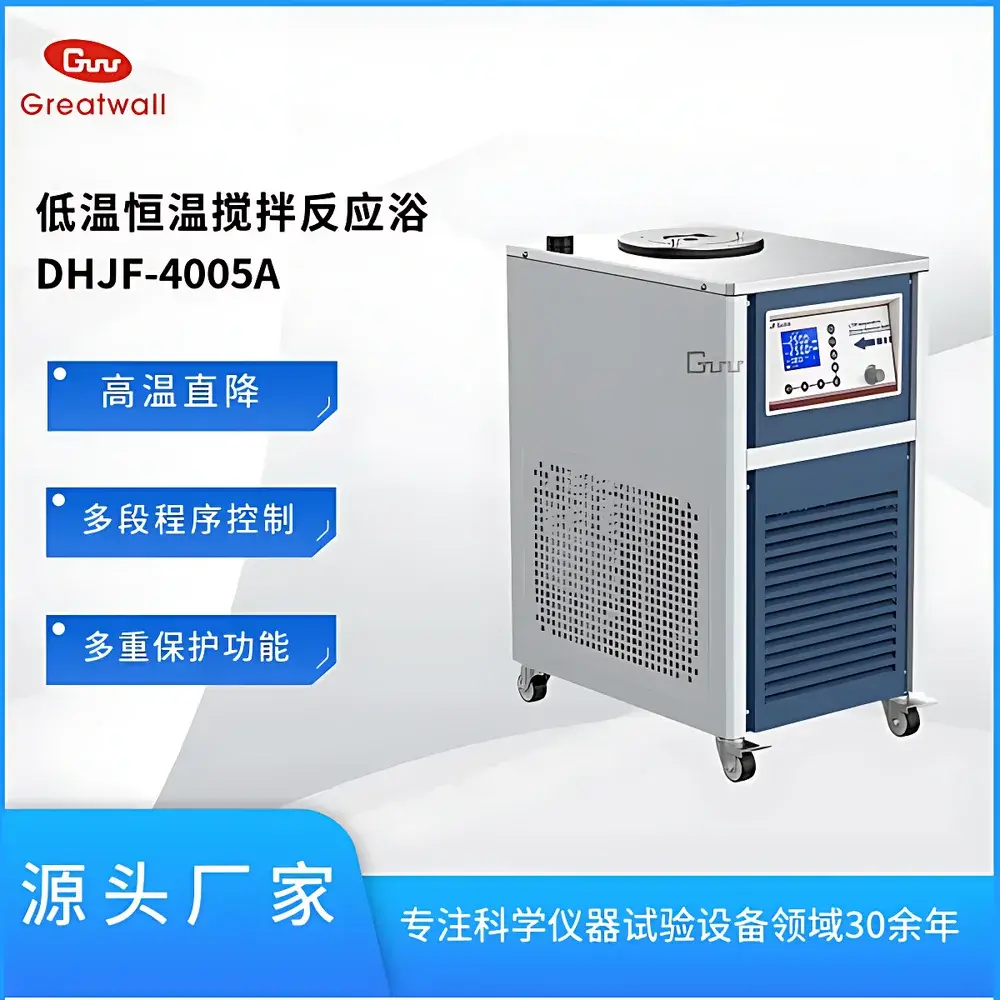
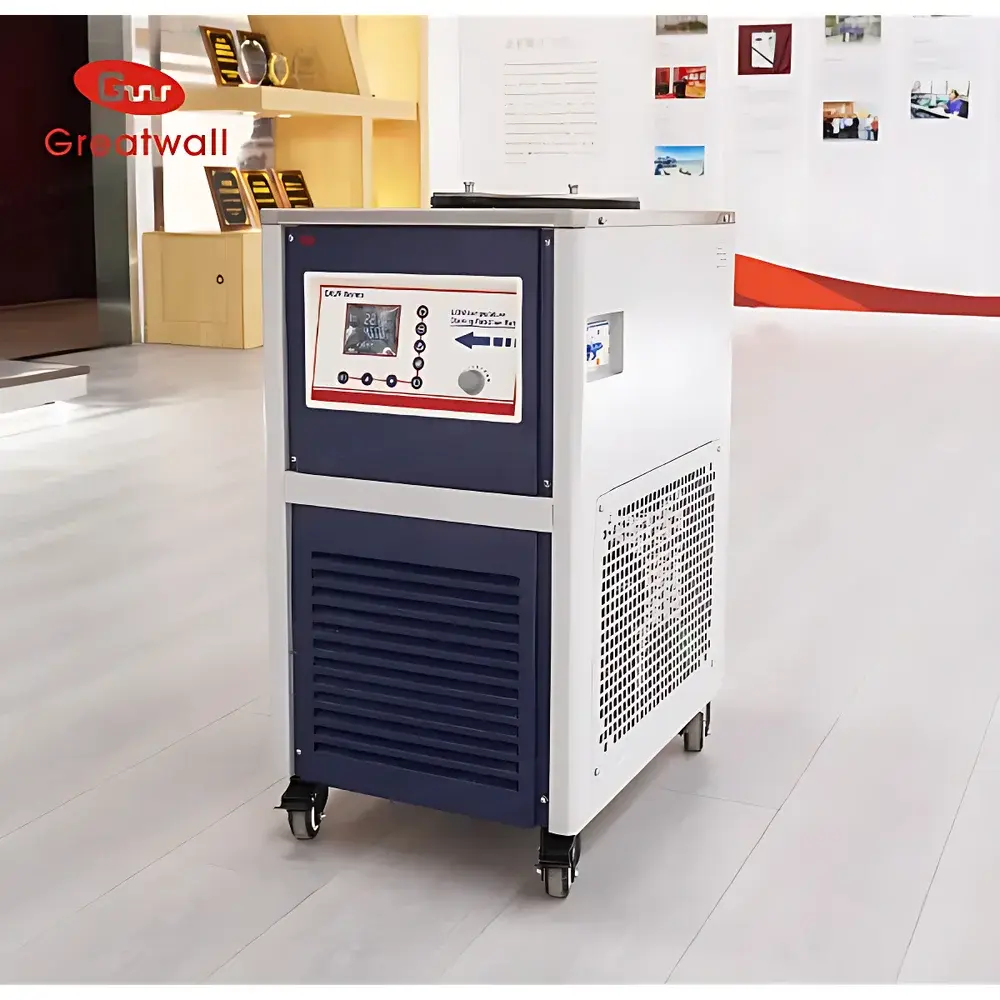
The Great Wall DHJF-4005A Low-Temperature Constant-Temperature Stirred Reaction Bath
| Brand | The Great Wall |
|---|---|
| Origin | Henan, China |
| Manufacturer Type | Manufacturer |
| Product Category | Domestic |
| Model | DHJF-4005A |
| Instrument Type | Constant-Temperature Bath |
| Circulation Function | External Circulation |
| Temperature Control Mode | Refrigeration & Heating |
| Bath Volume | 5 L |
| Temperature Range | −40 °C to +99 °C |
| Temperature Stability | ±0.2 °C |
| Temperature Resolution | 0.01 °C |
| Total Power Input | 2450 W |
| Heating Power | 1500 W |
| Circulation Pump Power | 100 W |
| Flow Rate | 20 L/min |
| Maximum Pressure | 0.4 bar |
| Magnetic Stirring Power | 50 W |
| Stirring Speed Range | 100–1000 rpm |
| Refrigerant | R404A |
| Cooling Capacity (W) | 1100 @ 90 °C, 720 @ 10 °C, 640 @ −10 °C, 500 @ −20 °C, 310 @ −30 °C, 150 @ −40 °C |
| Power Supply | 220 V AC, 50 Hz |
| Ambient Operating Conditions | 5–35 °C, ≤70% RH |
| External Port | Rc1/2 |
| Opening Diameter | Ø210 mm |
| Bath Dimensions | Ø250 × 130 mm (D × H) |
| Max Flask Capacity Supported | 2000 mL |
| Bath Material | 304 Stainless Steel |
| Overall Dimensions | 385 W × 560 D × 735 H mm |
| Net Weight | 60 kg |
Overview
The Great Wall DHJF-4005A Low-Temperature Constant-Temperature Stirred Reaction Bath is an integrated thermal management system engineered for precise temperature control and active mixing in laboratory-scale chemical synthesis, material testing, and reaction kinetics studies. It combines refrigeration, resistive heating, external fluid circulation, and magnetic stirring within a single robust platform. Its core operational principle relies on closed-loop thermodynamic regulation: a vapor-compression refrigeration cycle (using R404A refrigerant) provides sub-ambient cooling, while a high-efficiency tubular heater delivers accurate heating up to +99 °C. Temperature is maintained via a PID-controlled feedback loop that continuously modulates compressor duty cycle and heater power output based on real-time sensor input from a high-stability Pt100 probe immersed in the 304 stainless steel bath reservoir. The system’s dual-mode capability enables seamless transitions between exothermic and endothermic reaction conditions without equipment changeover—critical for catalytic screening, polymerization protocols, and low-temperature crystallization workflows.
Key Features
- Wide operational temperature range of −40 °C to +99 °C with ±0.2 °C stability and 0.01 °C digital resolution, validated per ASTM E742 for thermal uniformity in liquid baths
- Integrated magnetic stirrer (50 W, 100–1000 rpm) enabling homogeneous heat transfer and reagent dispersion during extended reactions
- High-capacity external circulation loop (20 L/min flow rate, 0.4 bar pressure) compatible with jacketed reactors, condensers, or auxiliary heat exchangers
- Corrosion-resistant 304 stainless steel bath tank and circulation tubing, rated for prolonged exposure to aqueous, organic, and mildly acidic/alkaline media
- Embraco hermetic piston compressor paired with Danfoss thermostatic expansion valve and copper-fin air-cooled condenser for reliable low-temperature performance down to −40 °C
- Five-segment programmable temperature ramping profile storage, supporting GLP-compliant protocol execution without PC dependency
- Comprehensive safety architecture including overtemperature cutoff (mechanical and electronic), overcurrent protection, ground-fault detection, and high-pressure shutdown
- RS485 serial interface compliant with MODBUS RTU protocol for integration into centralized lab automation systems or SCADA environments
Sample Compatibility & Compliance
The DHJF-4005A accommodates standard laboratory glassware up to 2000 mL (e.g., three-neck flasks, jacketed vessels, or immersion coil reactors) via its Ø210 mm opening. Its 5 L working volume supports both direct immersion and indirect jacketed configurations. All wetted components—including the evaporator coil, pump head, and circulation manifolds—are constructed from electropolished 304 stainless steel, ensuring compatibility with common solvents (acetone, ethanol, ethylene glycol/water mixtures, silicone oils) and resistance to thermal shock across the full operating range. The unit complies with IEC 61010-1:2010 for electrical safety in laboratory equipment and meets CE marking requirements for EMC (EN 61326-1) and low-voltage directives. While not certified for hazardous area use, its sealed refrigeration circuit and grounded chassis support safe operation in general chemistry laboratories under ISO/IEC 17025-accredited quality systems.
Software & Data Management
Local operation is managed through a backlit LCD interface with intuitive menu navigation and real-time display of setpoint, actual bath temperature, stirring speed, and system status flags. The embedded controller logs temperature deviation history for each active program segment, storing up to 30 days of timestamped data (sampled at 1 Hz) in non-volatile memory. When connected via RS485, third-party software (e.g., LabVIEW, MATLAB, or custom Python-based DAQ tools) can initiate remote setpoint changes, trigger data acquisition, and retrieve audit trails—including operator ID (via optional RFID reader integration), parameter modifications, and alarm events. All logged data includes ISO 8601 timestamps and adheres to ALCOA+ principles when exported as CSV or XML, facilitating traceability in regulated environments governed by FDA 21 CFR Part 11 or EU Annex 11 requirements.
Applications
- Controlled-rate cooling for cryo-crystallization of pharmaceutical intermediates and chiral compounds
- Exothermic reaction quenching in Grignard, lithiation, or nitration processes
- Temperature-dependent viscosity profiling of polymer melts and colloidal dispersions
- Calibration of thermocouples, RTDs, and infrared pyrometers across extended thermal spans
- Stabilized thermal environment for spectroscopic cells (UV-Vis, FTIR) requiring vibration-free, low-drift conditions
- Pre-conditioning of samples prior to mechanical testing (tensile, impact) per ASTM D638 or ISO 527
- Long-duration stability testing of battery electrolytes and solid-state electrolyte films
FAQ
What refrigerant is used, and is it compliant with current environmental regulations?
R404A is employed for its balanced low-temperature performance and compatibility with Embraco compressors. While classified as a high-GWP HFC, it remains permissible for laboratory equipment under Article 11 exemptions of the EU F-Gas Regulation (No. 517/2014) and EPA SNAP Program for essential uses.
Can the unit maintain temperature while circulating fluid through a 10-meter external loop?
Yes—the 0.4 bar maximum head pressure and 20 L/min flow rate support typical lab-scale external circuits up to 15 meters total length with ≤12 mm ID tubing, assuming minimal elevation gain and standard fittings.
Is the magnetic stirrer compatible with PTFE-coated stir bars in corrosive media?
Yes. The drive magnet assembly is fully sealed and isolated from the bath fluid; only the stir bar contacts the sample, allowing full compatibility with chemically resistant coatings.
Does the system support validation documentation (IQ/OQ/PQ) packages?
Factory-provided calibration certificates (NIST-traceable Pt100 probe, ±0.05 °C uncertainty) and FAT reports are available upon request. Full qualification support—including protocol templates aligned with USP and GAMP5—is offered through The Great Wall’s Application Engineering team.
What maintenance intervals are recommended for sustained performance?
Condenser coil cleaning every 6 months (or more frequently in dusty environments); annual inspection of refrigerant charge integrity and electrical grounding continuity; biannual verification of temperature uniformity per ASTM E742 using a 9-point probe array.



