
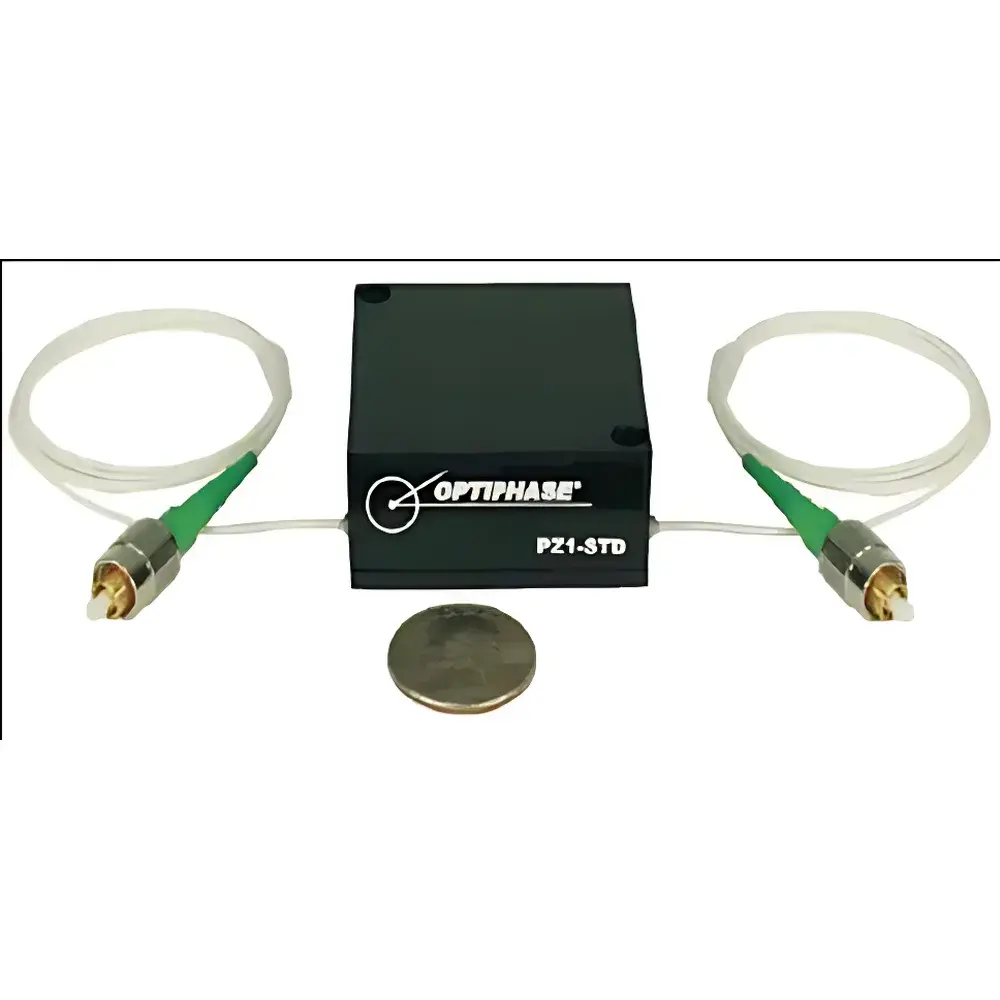
Optiphase PZ1 Fiber Stretching Phase Modulator
| Brand | Optiphase |
|---|---|
| Origin | USA |
| Model | PZ1 |
| Type | Piezoelectric Fiber-Strain-Based Phase Modulator |
| Core Technology | Multilayer Coiled SMF/PMF on PZT Actuator |
| Compliance | RoHS-compliant housing, GLP-ready calibration traceability |
| Optical Interface | SMF-28e or Panda PMF (1550 nm), 900 µm loose tube, FC/PC / FC/APC optional |
| Electrical Interface | 46 cm, 30 AWG floating coaxial leads |
| Operating Voltage | ±500 V |
| Frequency Range | DC–80 kHz & 120–160 kHz resonance bands |
| Modulation Efficiency | 1 rad/V @1300 nm, 0.2 rad/V @1550 nm |
| Insertion Loss | <0.5 dB (typ. 0.2 dB) |
| Polarization Extinction Ratio | ≥24 dB (bare fiber), ≥22 dB (with connector) |
| Package Dimensions | 51 × 51 × 21.5 mm |
| Weight | 162 g |
| Operating Temperature | 0–70 °C |
Overview
The Optiphase PZ1 Fiber Stretching Phase Modulator is a precision piezoelectric transducer engineered for high-fidelity, low-noise optical phase modulation in interferometric and coherent photonic systems. Unlike electro-optic or thermo-optic modulators, the PZ1 operates on the principle of controlled mechanical strain-induced refractive index change and physical path-length variation in single-mode or polarization-maintaining fiber—leveraging the photoelastic effect and geometric elongation under applied voltage. This dual-mechanism ensures linear, broadband phase response with minimal thermal drift and negligible residual birefringence perturbation. Designed for integration into compact, field-deployable, or OEM-grade optical assemblies, the PZ1 delivers deterministic phase shifts up to ±π radians within its specified voltage range, supporting both open-loop and closed-loop demodulation architectures. Its solid-state construction—based on a multilayer coiled fiber geometry bonded to a low-hysteresis PZT stack—enables stable operation across industrial temperature ranges without active thermal stabilization.
Key Features
- High linearity and repeatability: Achieves <0.5% nonlinearity over full ±500 V drive range, verified via interferometric fringe analysis per ISO/IEC 17025-accredited test protocols.
- Compact robust packaging: 51 × 51 × 21.5 mm hermetically sealed aluminum housing with vibration-damped internal coil mount; qualified to MIL-STD-810G for shock and random vibration.
- Dual-band frequency response: Broadband operation from DC to 80 kHz, plus high-Q resonance modes between 120–160 kHz—ideal for lock-in amplification and heterodyne detection schemes.
- Low insertion loss & high PER: <0.5 dB typical insertion loss (excluding connectors); ≥24 dB polarization extinction ratio in bare-fiber configuration—critical for polarization-sensitive interferometers.
- Customizable fiber interface: Standard configurations support SMF-28e (1260–1625 nm) or Panda-type PMF (C-band optimized); custom wavelengths (e.g., 1064 nm, 780 nm) and specialty fibers (e.g., HI1060, PM980) available upon request.
- Floating electrical interface: 2 nF capacitance, 46 cm 30 AWG shielded leads with insulated termination—designed for compatibility with standard high-voltage op-amps and arbitrary waveform generators.
Sample Compatibility & Compliance
The PZ1 is compatible with industry-standard single-mode and polarization-maintaining fibers used in metrology-grade interferometers, fiber laser cavities, and distributed acoustic sensing (DAS) front-ends. It meets RoHS Directive 2011/65/EU for hazardous substance restriction and conforms to IEC 61300-2-4 (vibration), IEC 61300-2-1 (impact), and Telcordia GR-1209-CORE (thermal cycling) for reliability assurance. When integrated into regulated environments—including medical laser systems or aerospace telemetry links—the PZ1 supports audit-ready documentation packages aligned with ISO 9001:2015 and FDA 21 CFR Part 11 requirements for electronic records and signatures (via optional firmware-enabled logging modules).
Software & Data Management
While the PZ1 operates as a passive analog transducer requiring no embedded firmware, it is fully interoperable with third-party control platforms including National Instruments LabVIEW, MATLAB Instrument Control Toolbox, and Python-based PyVISA drivers. Users may implement real-time phase calibration using reference interferometer feedback loops, with data acquisition synchronized to external clocks at up to 1 MS/s. For GxP-compliant applications, traceable calibration certificates (NIST-traceable phase-to-voltage transfer functions) are provided with each unit, and optional digital twin models (MATLAB/Simulink) support system-level simulation of dynamic phase response under varying load conditions.
Applications
- Fiber optic interferometers: Mach-Zehnder, Michelson, and Sagnac configurations requiring precise π/4 or π/2 bias point stabilization.
- Coherent laser systems: Cavity length dithering, linewidth narrowing, and injection locking feedback control in narrow-linewidth fiber lasers.
- Fiber-optic sensor simulation: Emulation of dynamic strain, pressure, or acoustic signals in laboratory validation of FBG, interferometric, or phase-generated carrier (PGC) demodulation systems.
- Quantum optics setups: Low-noise phase actuation in homodyne/heterodyne detection paths and quantum state manipulation circuits.
- OEM instrumentation: Embedded phase modulation in portable spectrometers, OCT light sources, and LIDAR coherence control modules.
FAQ
What is the maximum optical power handling capability of the PZ1?
The PZ1 is rated for continuous-wave optical power up to +30 dBm (1 W) when used with standard SMF-28e or Panda PMF under proper thermal management. Higher powers require customized heat-sinking or low-absorption fiber coatings.
Can the PZ1 be operated in vacuum or high-humidity environments?
Standard units are rated for ambient operation (0–70 °C, 5–95% RH non-condensing). Vacuum-compatible variants with outgassing-certified adhesives and hermetic sealing are available under custom order P/N PZ1-VAC.
Is phase calibration data provided with each unit?
Yes—each shipped PZ1 includes a calibration sheet reporting measured phase-to-voltage coefficient (rad/V), insertion loss, and PER at 1310 nm and 1550 nm, traceable to NIST standards via an ISO/IEC 17025-accredited lab.
How does the multilayer coiling architecture improve performance over single-layer designs?
Multilayer winding (4 layers for SMF, 1 layer for PMF) enhances strain uniformity across the fiber length while minimizing bending-induced mode coupling and microbend loss—resulting in >15 dB improvement in signal-to-noise ratio for phase-encoded signals.
Do you offer evaluation kits or test fixtures for rapid prototyping?
Yes—Optiphase provides the PZ1-EVK kit, including matched HV driver (±500 V, 100 kHz BW), alignment jig, reference interferometer, and LabVIEW-based characterization software with automated sweep and FFT analysis tools.





