
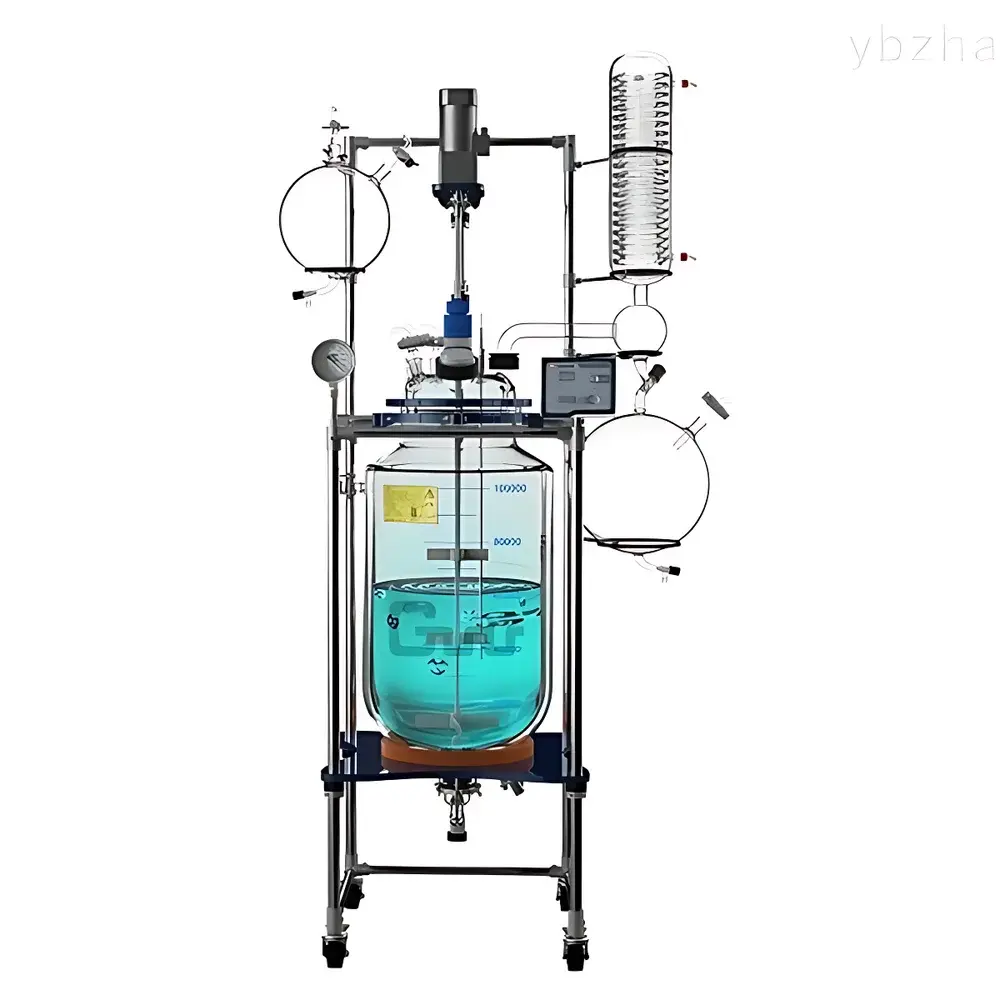
Great Wall GR-100 Dual-Jacketed Borosilicate Glass Reactor
| Brand | The Great Wall |
|---|---|
| Origin | Henan, China |
| Manufacturer Type | Direct Producer |
| Model | GR-100 |
| Capacity | 100 L (Working Volume) |
| Jacket Volume | 30 L |
| Jacket Heat Transfer Area | 1.09 m² |
| Condenser Heat Transfer Area | 0.5 m² |
| Material | ASTM E438 Type I, Class A Borosilicate 3.3 Glass |
| Support Frame & Fittings | AISI 304 Stainless Steel |
| Operating Temperature Range | −80 °C to +200 °C |
| Pressure Rating | Ambient or Vacuum (Max. Vacuum: −0.098 MPa gauge / ≤ 2 kPa abs) |
| Agitator Motor | 370 W, Variable-Frequency Drive (VFD) |
| Stirring Speed | 50–500 rpm |
| Sealing System | PTFE-lined magnetic coupling with corrosion-resistant ceramic bearing |
| Discharge Valve | Side-mounted, zero-dead-volume PTFE-sealed valve |
| Power Supply | 220 V AC, 50/60 Hz |
| Overall Dimensions (L×W×H) | 1200 × 790 × 2480 mm |
| Temperature Sensor | Fluoropolymer-coated 304 SS probe |
| Stirrer Type | Propeller-type, shaft and blade fully clad in PTFE |
| Port Configuration | 7 standardized openings (including 60 mm agitator flange, dual 34# standard taper joints, 40# constant-pressure funnel port, 50# spherical joint for condenser, 95# solid-feed flange, DN15 circulation ports) |
Overview
The Great Wall GR-100 Dual-Jacketed Borosilicate Glass Reactor is an engineered platform for controlled synthesis, process development, and scalable laboratory-to-pilot transition in chemical, pharmaceutical, and advanced materials research. Based on the Couette flow principle and jacketed thermal management architecture, it enables precise regulation of reaction thermodynamics—combining simultaneous vacuum operation, high-fidelity temperature control (−80 °C to +200 °C), and reproducible mechanical agitation under inert or reduced-pressure environments. Its all-glass wetted path—constructed from DIN ISO 3585-compliant borosilicate 3.3 glass—ensures exceptional resistance to thermal shock, alkali corrosion, and organic solvent degradation. The reactor’s structural integrity is reinforced by a rigid AISI 304 stainless steel support frame and load-distributed mounting system, optimized for long-term stability during extended batch operations.
Key Features
- Borosilicate 3.3 glass vessel conforming to ASTM E438 Type I, Class A specifications, certified for thermal cycling up to 200 °C and cryogenic exposure down to −80 °C.
- Dual-jacket design (30 L volume, 1.09 m² heat transfer area) compatible with external chillers, heating circulators, or thermal oil systems for rapid ramp rates and tight ±0.5 °C temperature control.
- Vacuum-rated construction achieving ≤2 kPa absolute pressure (−0.098 MPa gauge); validated per ISO 2859-1 sampling plans for leak integrity.
- 370 W variable-frequency drive motor delivering smooth, low-vibration stirring across 50–500 rpm with digital speed feedback and overload protection.
- PTFE-clad propeller agitator and magnetic coupling assembly with ceramic bearings—designed to eliminate metal contact in the reaction zone and ensure continuous operation under abrasive or viscous media.
- Zero-dead-volume side discharge valve with fluoropolymer sealing, positioned at 350 mm above floor level for ergonomic compatibility with receiving vessels and downstream filtration units.
- Seven standardized access ports—including 60 mm agitator flange, dual 34# taper joints, 40# constant-pressure addition port, 50# spherical condenser interface, 95# solid-feed flange, and DN15 jacket inlet/outlet—support modular integration with distillation, reflux, gas dispersion, or inline monitoring accessories.
Sample Compatibility & Compliance
The GR-100 is suitable for heterogeneous catalysis, Grignard reactions, polymerization, crystallization, hydrogenation (with optional H₂-compatible fittings), and lyophilization precursor synthesis. Its all-glass fluid path meets USP and EP 3.2.1 requirements for extractables profiling. The system complies with CE machinery directive 2006/42/EC and conforms to EN 61000-6-2 (EMC immunity) and EN 61000-6-4 (EMC emission) standards. When operated with validated vacuum pumps and temperature controllers, it supports GLP-aligned experimental records and can be configured for 21 CFR Part 11-compliant data archiving when paired with compliant third-party acquisition software.
Software & Data Management
While the GR-100 operates as a standalone analog/digital hybrid unit—with LED-based rpm and temperature readouts—it is designed for seamless interoperability with external process control systems. Analog 4–20 mA outputs are available for agitation speed and jacket temperature signals; RS485 Modbus RTU interface enables bidirectional communication with PLCs or SCADA platforms. Users may integrate the reactor into centralized lab networks via optional I/O modules supporting OPC UA protocol. All operational parameters—including setpoints, actual values, alarm states, and runtime logs—can be timestamped and exported in CSV or XML format for audit-ready documentation aligned with ISO/IEC 17025 clause 7.7.
Applications
- Process optimization of exothermic nitration and sulfonation reactions under controlled vacuum and sub-zero jacket conditions.
- Development of nanoparticle dispersions requiring inert atmosphere purging and shear-sensitive mixing protocols.
- Multi-step cascade synthesis involving sequential reagent addition, intermediate isolation, and in-situ FTIR monitoring through optional viewport adapters.
- Pilot-scale formulation of pharmaceutical intermediates compliant with ICH Q5A and Q5D guidelines for biotechnological product consistency.
- Material science studies of sol-gel transitions, hydrogel crosslinking kinetics, and MOF crystallization under programmable thermal ramps.
FAQ
What is the maximum allowable working temperature of the glass vessel?
The borosilicate 3.3 glass body is rated for continuous operation up to +200 °C; short-term excursions to +220 °C are permissible under static, non-agitated conditions per DIN 12575.
Can the GR-100 be used under positive pressure?
No—the reactor is designed exclusively for ambient or vacuum service; it lacks pressure certification per PED 2014/68/EU and must not be pressurized beyond atmospheric.
Is the stirring system suitable for highly viscous media (e.g., >50,000 mPa·s)?
Yes, when equipped with optional anchor or helical ribbon impellers (available as accessories), the 370 W motor maintains torque stability up to 80,000 mPa·s at 50 rpm.
How is calibration traceability maintained for temperature and speed measurements?
Factory calibration certificates (NIST-traceable reference standards) are supplied for the integrated Pt100 sensor and tachometer circuit; users may perform field verification using ISO/IEC 17025-accredited secondary standards.
What maintenance intervals are recommended for the magnetic coupling and PTFE seals?
Visual inspection every 200 operating hours; full seal replacement every 1,500 hours or annually—whichever occurs first—under typical organic solvent exposure conditions.



