
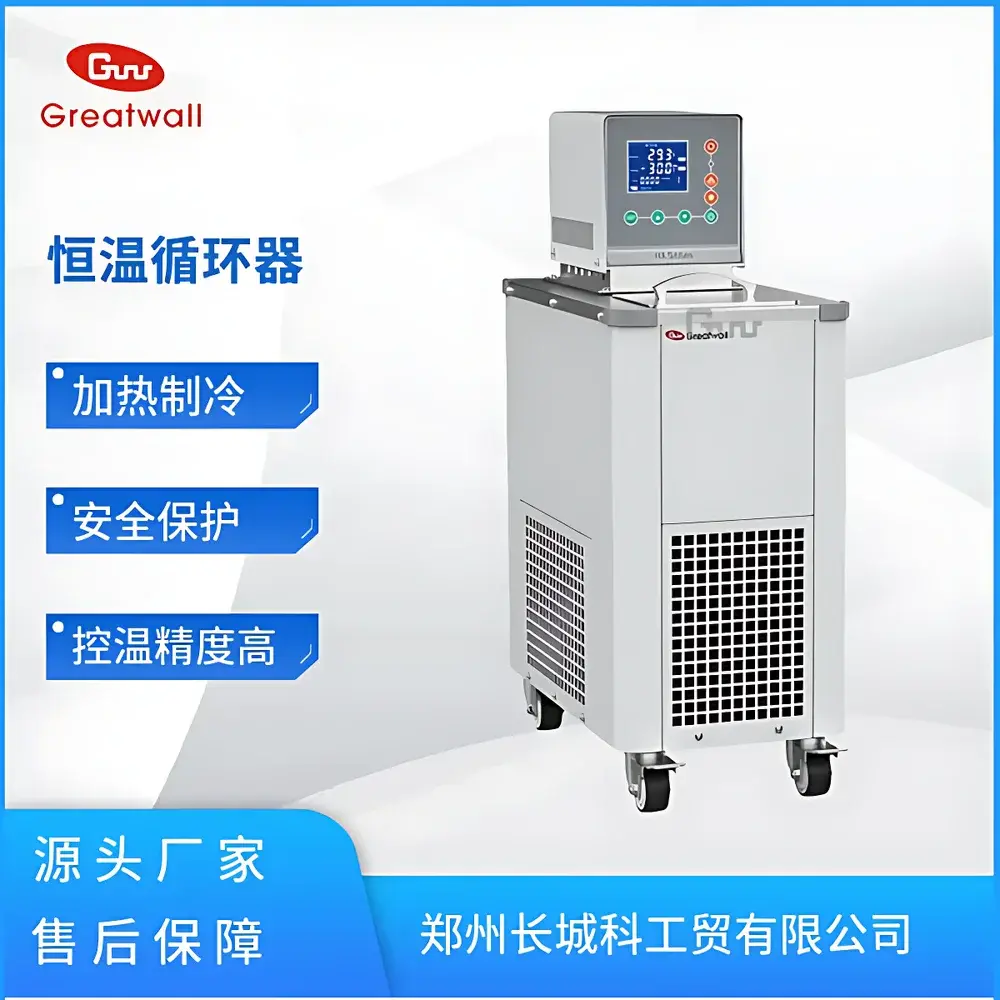
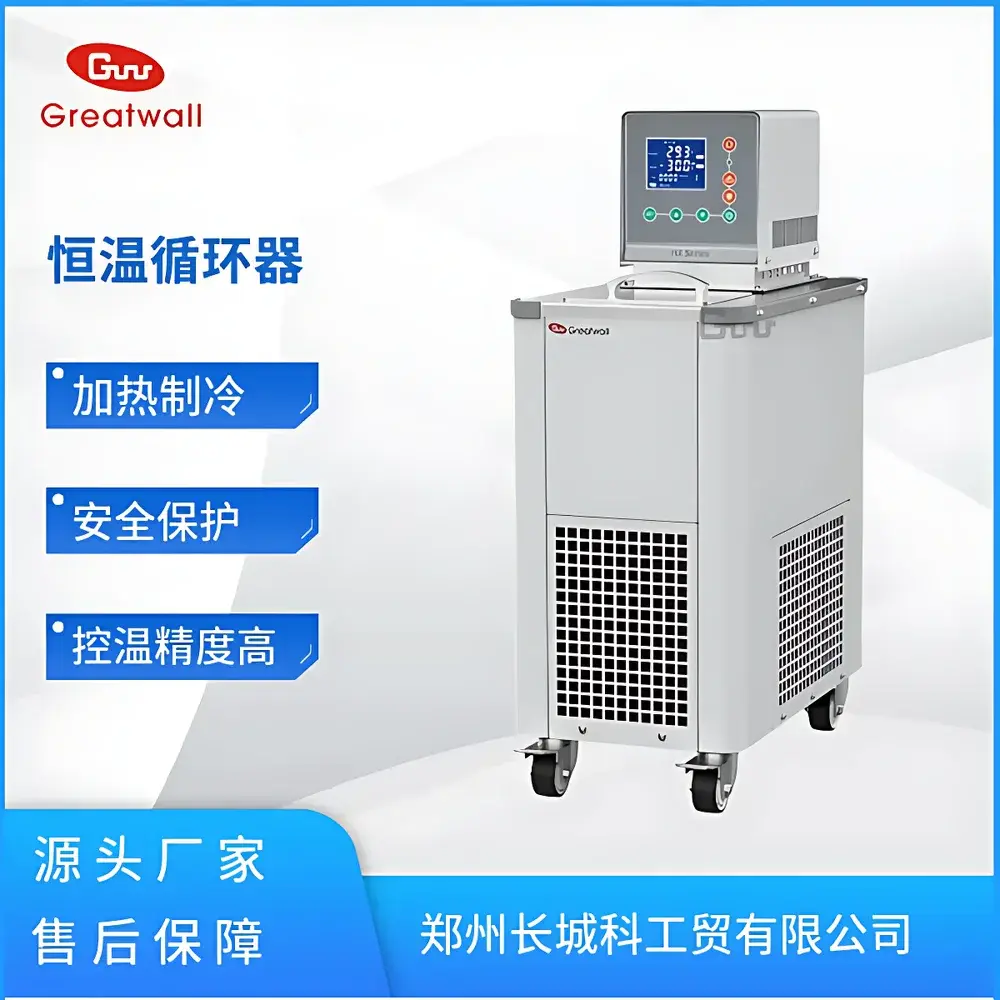
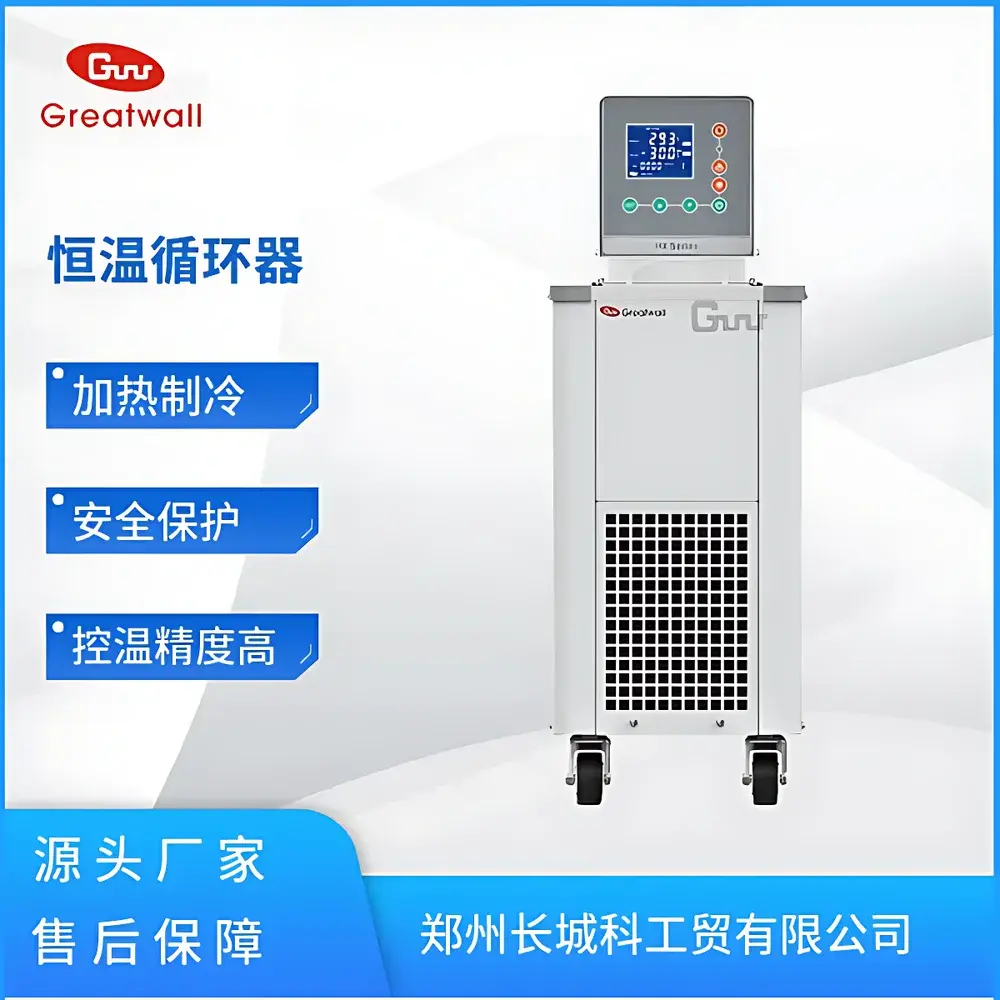
Great Wall HX-3010 High-Precision Circulating Chiller/Heater
| Brand | Great Wall |
|---|---|
| Origin | Henan, China |
| Manufacturer Type | Direct Manufacturer |
| Model | HX-3010 |
| Temperature Range | −30 °C to +99 °C |
| Temperature Stability | ±0.2 °C |
| Display Resolution | 0.1 °C |
| Heating Power | 1600 W |
| Refrigerant | R404A |
| Max. Pump Pressure | 0.2 bar |
| Max. Flow Rate | 10 L/min |
| Reservoir Volume | 10 L |
| Reservoir Opening | 120 mm (W) × 141 mm (D) |
| Reservoir Depth | 145 mm |
| Dimensions (W×D×H) | 255 mm × 490 mm × 693 mm |
| Weight | 55 kg |
| Power Supply | 220–240 V~, 50 Hz |
| Total Power Consumption | 2160 W |
| Communication Interface | RS485 |
| Enclosure Material | Cold-Rolled Steel with Electrostatic Powder Coating |
| IP Rating | IP20 |
| Pollution Degree | 2 |
| Operating Ambient | 5–35 °C, ≤70% RH |
Overview
The Great Wall HX-3010 High-Precision Circulating Chiller/Heater is an engineered thermal management system designed for laboratory-scale temperature control of external devices and reaction vessels. It operates on a closed-loop circulation principle, utilizing a dual-impeller centrifugal pump to deliver consistent flow of heat-transfer fluid—typically water, water-glycol mixtures, or silicone oil—across a wide operational range from −30 °C to +99 °C. Its core function relies on integrated refrigeration (R404A-based vapor-compression cycle) and resistive heating elements, coordinated via PID feedback control to achieve ±0.2 °C temperature stability under steady-state conditions. This level of thermal precision supports applications requiring strict thermal boundary conditions—such as electrophoresis power supplies, viscometers, electron probe microanalyzers (EPMA), jacketed reactors, and calibration baths—where uncontrolled thermal drift would compromise measurement repeatability or reaction kinetics.
Key Features
- PID-controlled temperature regulation with 0.1 °C digital resolution and programmable setpoint ramping, enabling precise thermal profiling for time-dependent experiments.
- Dual-impeller circulation pump with self-priming capability—capable of delivering up to 10 L/min at 0.2 bar pressure head—suitable for both open-bath and sealed-system configurations, including vacuum-jacketed vessels and pressurized reactors.
- Uniform thermal distribution ensured by internal impeller-driven agitation within the 10 L reservoir, minimizing axial and radial temperature gradients across the working fluid volume.
- Robust mechanical architecture featuring cold-rolled steel housing with electrostatic powder coating, rated IP20 for indoor laboratory use and compliant with pollution degree 2 per IEC 60664-1.
- RS485 serial interface supporting Modbus RTU protocol for integration into centralized lab automation systems or SCADA environments, facilitating remote monitoring and scheduled operation.
Sample Compatibility & Compliance
The HX-3010 is compatible with standard 12 mm OD flexible tubing connections and interfaces seamlessly with common analytical and process equipment—including but not limited to rotational viscometers (ASTM D2196), electrophoresis units (IEC 61010-1), calorimeters, and jacketed glass reactors. Its thermal performance meets baseline requirements for ISO/IEC 17025-accredited laboratories performing temperature-sensitive measurements. While not intrinsically certified for hazardous locations, its design adheres to IEC 61010-1 safety standards for electrical equipment used in laboratory settings. The unit supports GLP-compliant workflows through traceable temperature logging when paired with external data acquisition systems connected via RS485.
Software & Data Management
The HX-3010 does not include embedded software or touchscreen UI; instead, it delivers deterministic analog and digital control signals optimized for reliability and electromagnetic compatibility in electromagnetically noisy lab environments. The RS485 interface enables bidirectional communication with third-party platforms such as LabVIEW, MATLAB, or custom Python-based controllers using standard Modbus register mapping. Users may configure alarm thresholds (e.g., low-flow, overtemperature, refrigerant pressure fault), store up to five user-defined temperature programs, and retrieve real-time sensor values—including bath temperature, outlet temperature, and pump status. Audit trails require external logging infrastructure; however, all operational parameters are accessible for integration into 21 CFR Part 11–compliant electronic record systems when deployed with validated middleware.
Applications
- Temperature stabilization of electrophoresis tanks to prevent DNA band smearing during high-voltage runs.
- Cooling of electron optical columns in EPMA and SEM sample stages to reduce thermal drift during quantitative elemental mapping.
- Thermal conditioning of viscometer baths per ASTM D445 and ISO 3104 protocols, ensuring shear-rate-independent kinematic viscosity measurements.
- Controlled heating/cooling cycles in small-scale batch reactors for kinetic studies in pharmaceutical process development.
- Calibration support for thermocouples, RTDs, and infrared thermometers in metrology labs accredited to ISO/IEC 17025.
FAQ
What types of heat-transfer fluids are compatible with the HX-3010?
Water, 30% aqueous ethylene glycol, and silicone oils (up to 100 cSt viscosity) are routinely used. Fluid selection must consider freezing point depression, thermal conductivity, and chemical compatibility with stainless steel wetted parts.
Can the HX-3010 operate continuously at −30 °C?
Yes, provided ambient conditions remain within 5–35 °C and relative humidity stays below 70%. Sustained sub-zero operation requires periodic defrost cycles and proper fluid maintenance to avoid ice nucleation in the reservoir.
Is the RS485 interface optically isolated?
No—electrical isolation is not built-in. For noise-prone environments or long cable runs (>15 m), users should implement externally powered, galvanically isolated RS485 transceivers.
Does the unit meet CE or UL certification requirements?
It complies with IEC 61010-1:2010 for laboratory equipment safety. CE marking is available upon request for EU-bound units, subject to harmonized testing and documentation per Directive 2014/35/EU.
What maintenance intervals are recommended?
Annual inspection of refrigerant charge, pump seal integrity, and electrical grounding is advised. Reservoir fluid should be replaced every 6–12 months depending on usage frequency and contamination risk.
Related Products



