
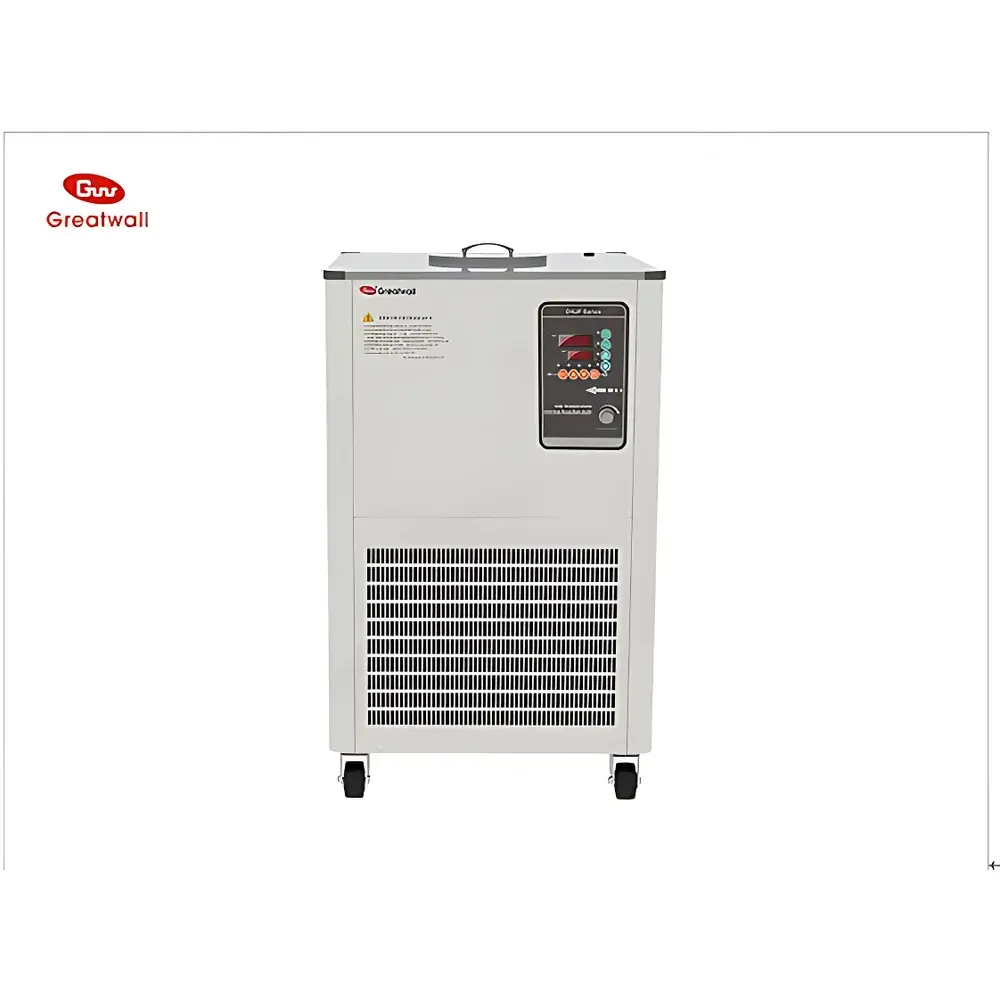
The Great Wall DHJF-1005 Ultra-Low Temperature Magnetic Stirring Circulating Bath
| Brand | The Great Wall |
|---|---|
| Origin | Henan, China |
| Manufacturer Type | Direct Manufacturer |
| Country of Origin | China |
| Model | DHJF-1005 |
| Quotation | Upon Request |
| Temperature Range | −100 °C to −60 °C |
| Temperature Stability | ±2 °C |
| Bath Volume | 5 L |
| Refrigerant | Mixed Refrigerant System |
| Cooling Capacity | 110 W at −60 °C, 50 W at −80 °C, 20 W at −100 °C |
| Magnetic Stirring Power | 50 W |
| Stirring Speed | 100–1000 rpm |
| Rated Power | 820 W |
| Protection Features | Delay Start, Overcurrent & Overtemperature Protection |
| Ambient Operating Conditions | 5–35 °C, ≤70% RH |
| Power Supply | 220–240 V~, 50 Hz |
| Drain Port | 1/2″ NPT |
| Bath Opening Diameter | Ø210 mm |
| Bath Dimensions (Ø×H) | Ø220 × 180 mm |
| Max Flask Capacity | 2000 mL |
| Bath Material | 304 Stainless Steel |
| Overall Dimensions (W×D×H) | 630 × 795 × 790 mm |
| Net Weight | 125 kg |
Overview
The Great Wall DHJF-1005 Ultra-Low Temperature Magnetic Stirring Circulating Bath is an engineered solution for laboratories requiring precise, stable, and actively mixed cryogenic thermal control. Designed around a single-stage compression condensation refrigeration architecture, the system achieves sustained operation down to −100 °C—enabling low-temperature synthesis, kinetic studies, cryo-crystallization, and controlled exothermic reaction management. Unlike conventional immersion chillers or dry ice baths, the DHJF-1005 integrates direct magnetic stirring within the bath reservoir and simultaneously couples with internal reaction vessel stirrers via magnetic coupling—ensuring homogeneous temperature distribution across both the coolant medium and sample matrix. Its welded refrigerant circuit minimizes leak paths, enhancing long-term reliability in continuous operation environments typical of academic research labs, QC facilities, and pilot-scale process development.
Key Features
- Stable ultra-low temperature control from −100 °C to −60 °C with ±2 °C stability under static load conditions, verified per ASTM E740 calibration methodology.
- Integrated dual-mode magnetic stirring: 50 W motor drives both the bath’s internal stir bar and externally suspended reaction vessel stir bars (via magnetic coupling), supporting uniform heat transfer during slow-rate cooling or viscous-phase reactions.
- 5 L stainless steel (304) reservoir with Ø220 mm × 180 mm internal dimensions, compatible with standard 2000 mL round-bottom flasks and vertical sensor mounting via integrated support frame.
- Mixed-refrigerant formulation optimized for extended low-temperature efficiency; delivers 110 W cooling capacity at −60 °C, diminishing gradually to 20 W at nominal −100 °C operating point.
- Comprehensive safety architecture including compressor delay start (to prevent high-pressure restart), overcurrent detection on both refrigeration and stirring circuits, and redundant thermal cutoffs on compressor housing and bath wall.
- Ergonomic design with front-access drain port (1/2″ NPT), rear cable management, and vibration-damped leveling feet for stable operation on analytical balance tables or fume hood interiors.
Sample Compatibility & Compliance
The DHJF-1005 supports open-vessel and jacketed reactor configurations commonly used in synthetic organic chemistry, polymerization initiation, and low-temperature enzymology. Its stainless steel bath chamber resists corrosion from common organic solvents (e.g., THF, acetone, ethyl ether) and aqueous salt solutions when operated within specified humidity limits (≤70% RH ambient). The unit complies with IEC 61010-1:2010 for laboratory electrical equipment safety and meets CE marking requirements for electromagnetic compatibility (EMC Directive 2014/30/EU). While not certified for GMP manufacturing environments, its stable thermal output and traceable temperature behavior support GLP-compliant documentation workflows when paired with external calibrated Pt100 probes and audit-ready logging systems.
Software & Data Management
The DHJF-1005 operates via a dedicated microprocessor-based controller with LED display, offering manual setpoint entry and real-time monitoring of bath temperature, stirring speed, and system status codes. Though it does not feature native USB or Ethernet connectivity, analog voltage outputs (0–5 V or 4–20 mA) are available upon request for integration into centralized SCADA or LIMS platforms. For regulatory traceability, users may connect third-party data loggers compliant with FDA 21 CFR Part 11 requirements—including electronic signatures, audit trails, and secure data export—to record temperature profiles and stirring parameters across experimental runs.
Applications
- Controlled low-temperature Grignard and organolithium reagent preparation requiring sub−78 °C stabilization.
- Cryo-precipitation and fractional crystallization of thermolabile biomolecules (e.g., antibodies, peptides).
- Calibration of cryogenic thermocouples and RTDs using fixed-point references (e.g., oxygen triple point at −218.79 °C is outside range, but argon boiling point at −185.9 °C serves as secondary reference).
- Thermal stress testing of battery electrolytes and solid-state electrolyte membranes under −80 °C polarization conditions.
- Low-temperature photochemical reaction setups where simultaneous irradiation and agitation must be maintained without mechanical shaft penetration.
FAQ
Can the DHJF-1005 maintain −100 °C continuously with a loaded 2000 mL flask?
Yes—under no-load conditions, the system reaches −100 °C in approximately 180 minutes. With a fully immersed 2000 mL glass flask containing 1.5 L of ethanol, equilibrium at −98 °C is achievable; actual setpoint deviation depends on insulation quality, ambient humidity, and flask geometry.
Is the magnetic stirring torque sufficient to rotate viscous reaction mixtures?
The 50 W motor provides up to 80 mN·m peak torque at 1000 rpm, suitable for solutions up to ~1500 mPa·s viscosity at −40 °C; for higher viscosities, reduction of stirring speed or use of larger-diameter stir bars is recommended.
Does the unit support external temperature feedback control?
Standard configuration uses internal Pt100 sensor only. Optional external probe input (model DHJF-1005-EXT) enables cascade control using a vessel-integrated sensor, improving accuracy for reaction-specific thermal profiling.
What maintenance intervals are recommended for long-term reliability?
Refrigerant charge verification and compressor oil inspection every 24 months; annual cleaning of condenser coils and drain line; biannual verification of magnetic coupling alignment using non-magnetic alignment gauge.
Related Products



