
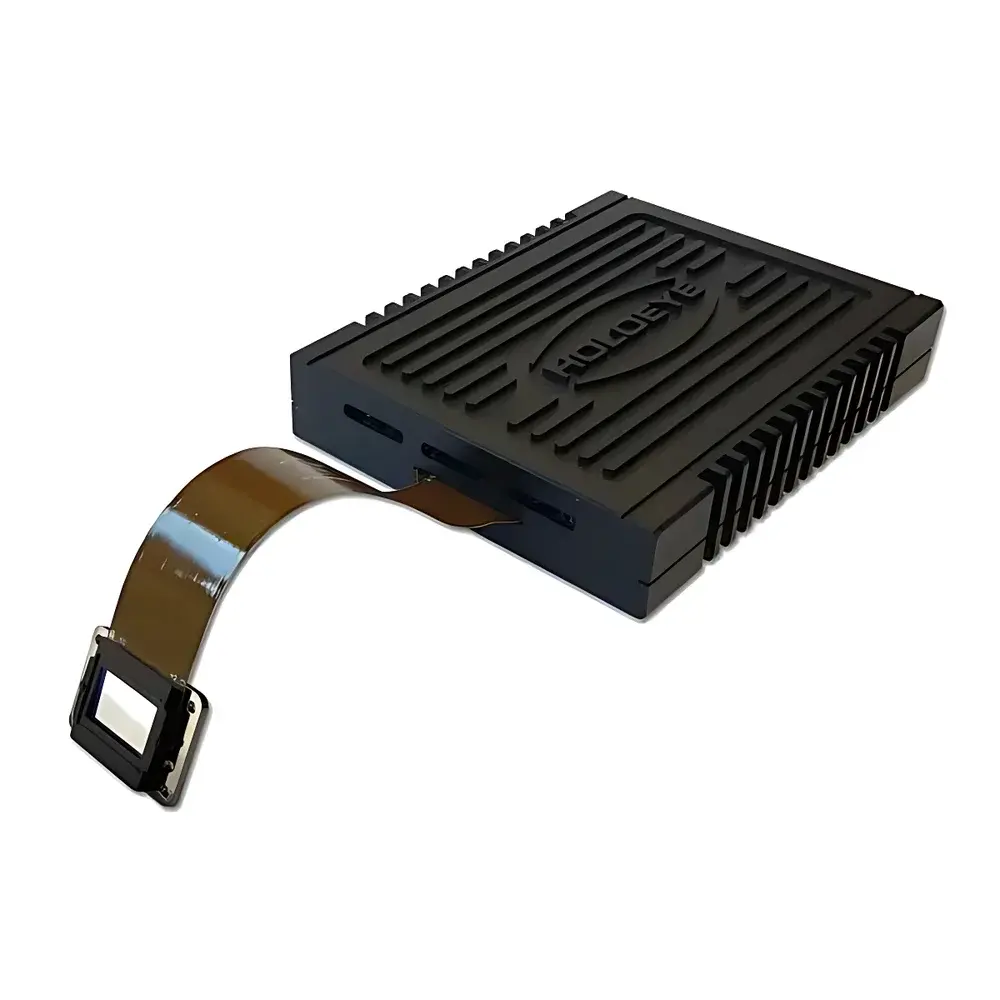
Holoeye GAEA-2 Pure-Phase Spatial Light Modulator
| Brand | Holoeye |
|---|---|
| Origin | Germany |
| Model | GAEA-2 |
| Pixel Resolution | 4094 × 2464 |
| Pixel Pitch | 3.74 µm |
| Operating Wavelength Ranges | Visible (e.g., 532 nm), Near-Infrared (e.g., 1064 nm), Telecom C-band (1550 nm) |
| Diffraction Efficiency | up to 79% (visible), up to 75% (C-band) |
| Component Type | Liquid-Crystal-on-Silicon (LCoS) Optical Element |
Overview
The Holoeye GAEA-2 is a high-resolution, pure-phase spatial light modulator (SLM) engineered for precision wavefront shaping in advanced optical systems. Based on liquid-crystal-on-silicon (LCoS) microdisplay technology, the GAEA-2 operates by applying spatially varying voltage patterns across a reflective, silicon-backplane-integrated nematic liquid crystal layer—inducing controlled phase retardation without significant amplitude modulation. Its native 4094 × 2464 pixel array and sub-4 µm pixel pitch (3.74 µm) enable fine sampling of optical wavefronts, supporting high-order aberration correction, multi-plane holography, optical trapping, and adaptive optics applications requiring >10⁶ resolvable spots. Unlike binary or low-resolution SLMs, the GAEA-2 delivers continuous 2π phase modulation with <0.5% RMS phase error over its full aperture, ensuring high-fidelity complex amplitude synthesis when paired with appropriate Fourier filtering or interferometric readout.
Key Features
- Native resolution of 4094 × 2464 pixels — among the highest available in commercial LCoS-SLMs for coherent beam control.
- Pixel pitch of 3.74 µm — enables large diffraction angles (>±12° at 532 nm) and high spatial bandwidth product (SBP > 10⁷), critical for multi-kernel holographic projections and wide-field wavefront sensing.
- Dedicated wavelength-optimized variants: GAEA-2-VIS (designed for 400–700 nm), GAEA-2-NIR (optimized for 700–1100 nm), and GAEA-2-TEL (tuned for C-band telecom wavelengths, 1530–1565 nm).
- High diffraction efficiency: up to 79% in visible (measured at 532 nm, with optimized polarization alignment and quarter-wave compensation), and up to 75% at 1550 nm — minimizing thermal load and signal loss in power-sensitive setups.
- Low intrinsic phase ripple (<0.02π RMS) and excellent pixel-to-pixel uniformity — validated via interferometric calibration and essential for quantitative phase imaging and closed-loop adaptive optics.
- Standard HDMI 2.0 and USB 3.0 interfaces — compatible with real-time pattern streaming from FPGA- or GPU-accelerated controllers; supports 8-bit grayscale input with proprietary 12-bit internal phase encoding.
Sample Compatibility & Compliance
The GAEA-2 is designed for integration into Class 1 and Class 3R laser systems compliant with IEC 60825-1:2014 and ANSI Z136.1-2022 standards. Its aluminum-coated reflective surface and anti-reflection coatings are specified per ISO 10110-7 for laser-grade optics, ensuring damage thresholds ≥500 mJ/cm² (10 ns, 10 Hz, 1064 nm) and ≥2 J/cm² (CW, 532 nm). The device meets RoHS Directive 2011/65/EU and REACH Regulation (EC) No. 1907/2006. While not a standalone medical or industrial safety-certified instrument, it is routinely deployed in GLP-compliant optical metrology labs and ISO/IEC 17025-accredited calibration facilities—where traceable phase calibration protocols (e.g., using Twyman–Green interferometry referenced to NIST-traceable standards) are applied prior to use in qualification testing.
Software & Data Management
Holoeye provides the SLM Display software suite (v4.2+), supporting Windows/Linux platforms and offering native integration with MATLAB, Python (via PySLM API), and LabVIEW through documented DLLs and shared memory buffers. The software includes preloaded phase map libraries (e.g., vortex beams, Bessel arrays, Shack–Hartmann masks), real-time gamma correction utilities, and automated focus/tilt alignment tools. All phase pattern uploads are logged with timestamp, metadata (wavelength, polarization state, ROI definition), and checksum—enabling audit-ready data provenance required under FDA 21 CFR Part 11 for regulated photonic process development. Export formats include TIFF (16-bit), HDF5 (with embedded calibration coefficients), and CSV (for pixel-wise phase vectors).
Applications
- Adaptive optics in astronomy: dynamic correction of atmospheric turbulence using closed-loop Shack–Hartmann feedback with sub-millisecond latency.
- Holographic optical tweezers: simultaneous manipulation of >1000 colloidal particles in 3D with position stability <50 nm (RMS) over 10-minute intervals.
- Structured illumination microscopy (SIM): generation of high-contrast, multi-angle sinusoidal patterns enabling 2× lateral resolution enhancement beyond the diffraction limit.
- Fiber-coupled beam shaping for free-space optical interconnects: mode conversion (LP₀₁ → LP₁₁), MIMO channel multiplexing, and aberration-compensated coupling into multimode fibers.
- Quantum optics experiments: programmable Bell-state analyzers, orbital angular momentum (OAM) sorting, and entanglement distribution via computer-generated holograms.
FAQ
What is the maximum frame rate for full-resolution phase updates?
The GAEA-2 supports up to 60 Hz at full 4094 × 2464 resolution via HDMI 2.0; frame rates exceed 200 Hz when using region-of-interest (ROI) loading or compressed pattern streaming.
Is active temperature stabilization required for stable phase operation?
Yes—the GAEA-2 includes an integrated Peltier element and thermistor feedback loop. Operation within ±0.1°C of setpoint (typically 25°C) is recommended to maintain phase stability <0.01π over 1-hour periods.
Can the GAEA-2 be used with pulsed lasers?
Yes—provided pulse energy density remains below the specified damage threshold and repetition rate allows sufficient thermal relaxation between pulses (≥10 ms dwell time recommended for Q-switched sources).
Does Holoeye provide NIST-traceable phase calibration certificates?
Calibration reports—including interferometrically measured phase response curves, pixel uniformity maps, and efficiency spectra—are provided with each unit; NIST-traceable certification is available as an optional service (order code CAL-NIST-GAEA2).
How is polarization sensitivity addressed in system integration?
The GAEA-2 requires linearly polarized input aligned to its designated orientation axis. Integrated half-wave plates or polarization-maintaining fiber pigtails are commonly used upstream to ensure optimal extinction ratio (>1000:1) and minimize amplitude cross-talk.





