
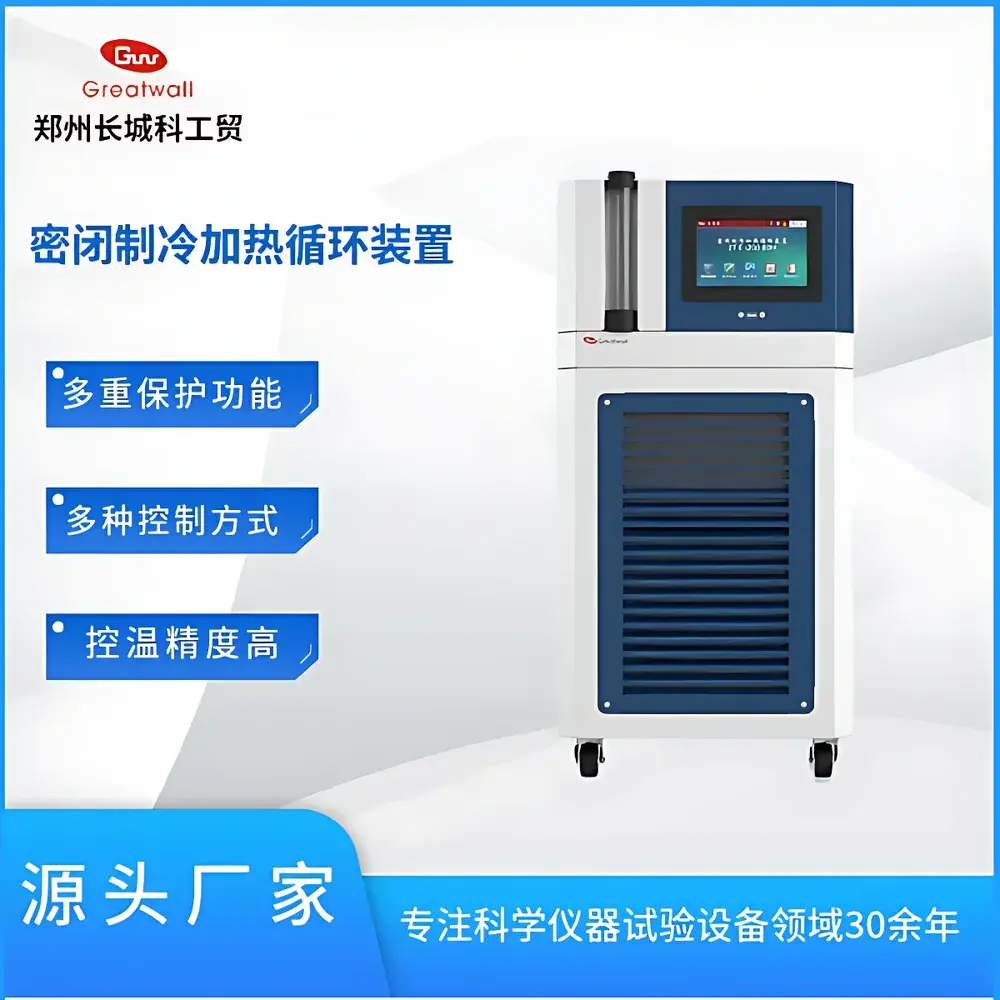
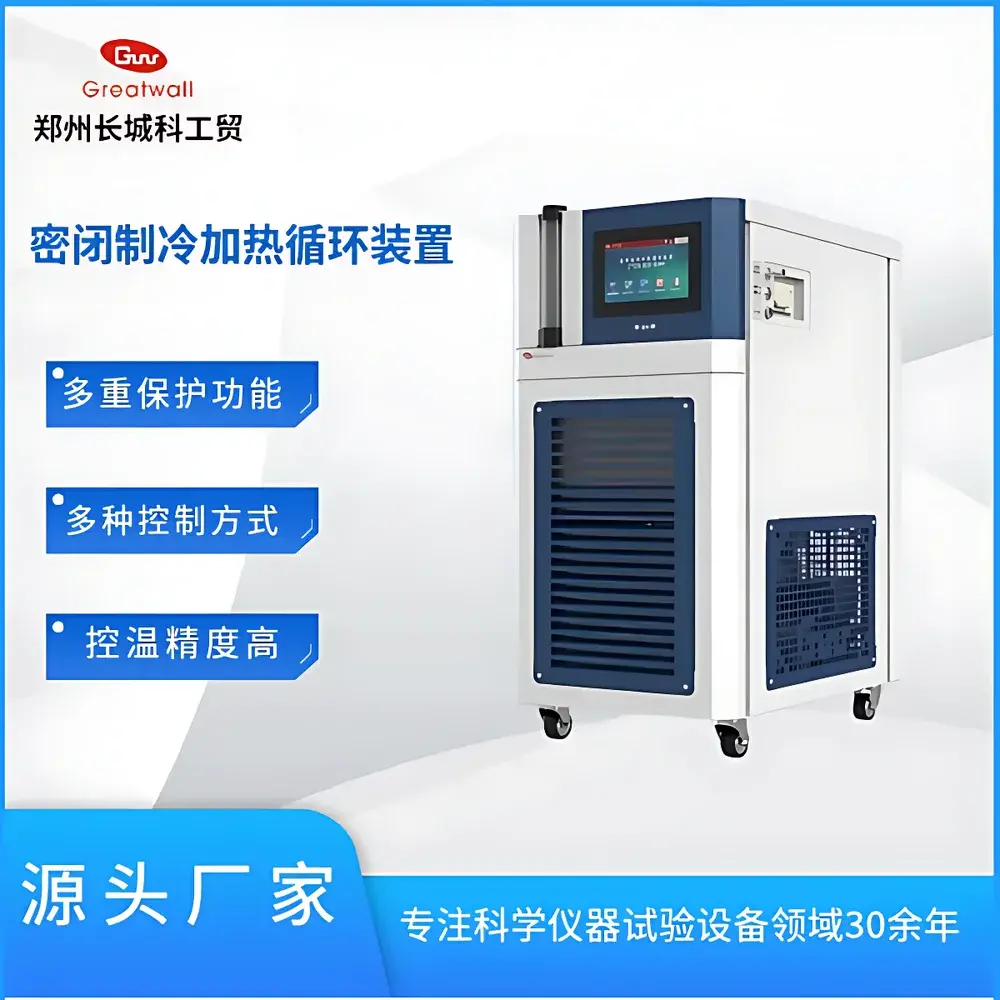
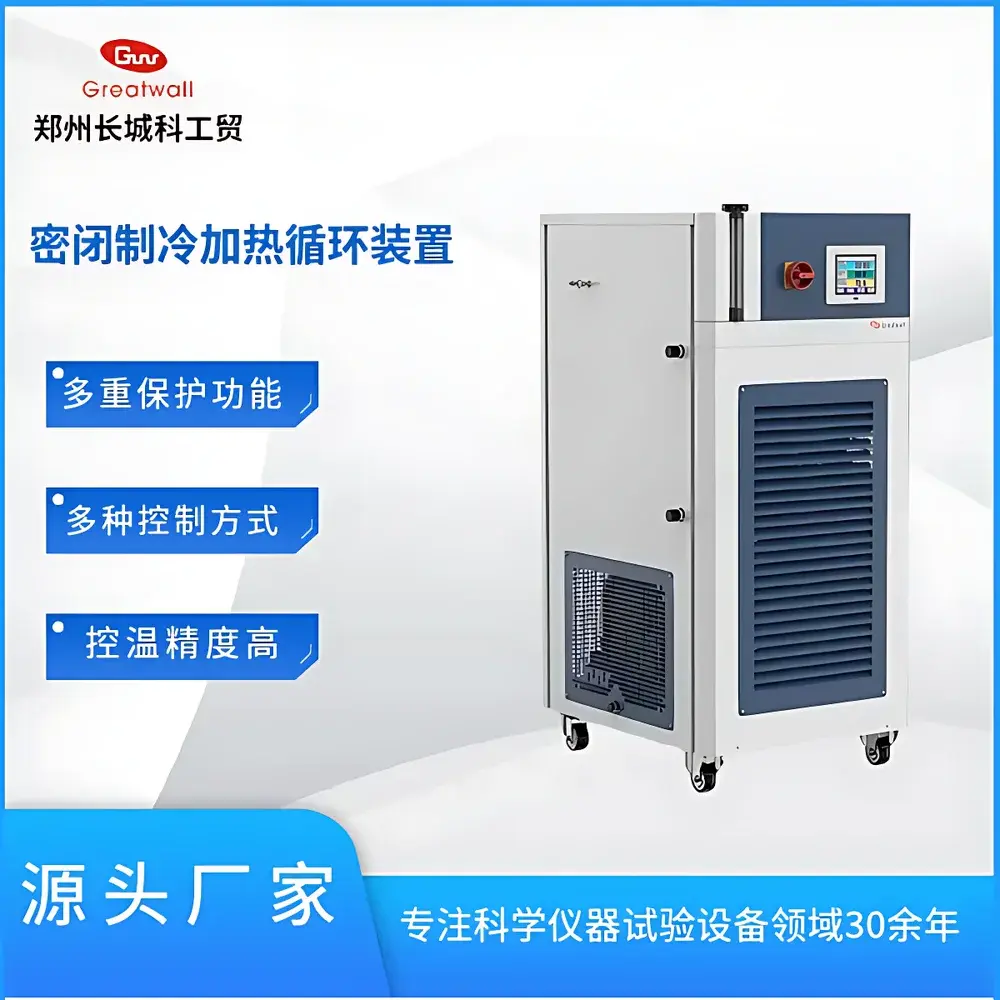
The Great Wall ZT-5-200-30H Closed-Loop Refrigerated & Heated Circulator
| Brand | The Great Wall |
|---|---|
| Origin | Henan, China |
| Manufacturer Type | Direct Manufacturer |
| Product Type | Integrated Circulating Chiller |
| Cooling Method | Air-Cooled |
| Temperature Control Range | −30 °C to +200 °C |
| Temperature Stability | ±0.5 °C (at 25 °C ambient, internal material temperature control) |
| Refrigeration Capacity | 0.6 kW @ 10 °C |
| Heating Power | 2.0 kW |
| Total Power Consumption | 3.0 kW |
| Circulation Pump Flow Rate | 25 L/min (max) |
| Circulation Pump Pressure | 1.5 bar (max) |
| Heat Transfer Fluid Volume | 3.5 L |
| Display | 7-inch color TFT touchscreen |
| Temperature Resolution & Setpoint Accuracy | 0.01 °C |
| Communication Interfaces | RS485, USB |
| Protection Features | Independent overtemperature, high-pressure refrigerant, leakage, phase sequence, thermal overload, and overcurrent protection |
| Enclosure Rating | IP20 |
| Refrigerant | R404A |
| Ambient Operating Conditions | 5–35 °C, ≤70% RH |
| Dimensions (W×D×H) | 420 × 640 × 850 mm |
| Weight | 106 kg |
Overview
The Great Wall ZT-5-200-30H is an integrated closed-loop refrigerated and heated circulator engineered for precise, stable thermal management of external process equipment—including jacketed reactors, rotary evaporators, calorimeters, and analytical instrumentation. It operates on a dual-mode thermodynamic cycle utilizing a hermetic scroll compressor, R404A refrigerant, and a high-efficiency electric heating system, enabling continuous bidirectional temperature control from −30 °C to +200 °C without fluid exchange or atmospheric exposure. The fully sealed circulation architecture prevents oxidation, moisture absorption, and volatile loss of heat transfer fluids—critical for maintaining long-term fluid integrity in applications requiring extended operation with silicone oils, glycol-water mixtures, or specialized synthetic heat transfer media.
Key Features
- Hermetically sealed fluid circuit with real-time liquid level monitoring via capacitive sensor—ensures uninterrupted operation and prevents dry-run pump failure.
- Dual-stage safety architecture: independent hardware-level protections including overtemperature cutoff (material-sensing), refrigerant high-pressure shutdown, earth-leakage detection, phase-sequence verification, thermal overload relays, and motor overcurrent limiting.
- Intelligent compressor management with programmable delay-on-start and adaptive load balancing to extend service life and reduce mechanical stress.
- 7-inch high-resolution color TFT touchscreen interface supporting dynamic graphical display of real-time process curves (e.g., material temperature vs. time), setpoint ramping profiles, and historical trend logging.
- Flexible control modes: internal PID regulation using built-in Pt100 sensor or external feedback via user-supplied probe (compatible with standard 2-/3-/4-wire RTDs or thermocouples).
- Standard digital connectivity via isolated RS485 (Modbus RTU protocol) and USB host port for firmware updates, batch data export (CSV), and integration into centralized lab automation systems (e.g., LabVantage, STARLIMS, or custom SCADA).
Sample Compatibility & Compliance
The ZT-5-200-30H supports compatibility with a broad range of industrial and laboratory heat transfer fluids—including methyl silicone oil (e.g., DC-200 series), polyalphaolefin (PAO)-based synthetics, and aqueous ethylene/propylene glycol solutions—within its specified viscosity and flash point limits. Its closed-loop design meets ASTM E2913-22 requirements for thermal stability testing apparatus and aligns with ISO 17025 clause 6.4.3 regarding environmental condition control for calibration-grade thermal systems. While not certified to UL/CSA or CE for standalone medical device use, the unit conforms to IEC 61010-1:2010 for electrical safety in laboratory equipment and incorporates design elements supporting GLP-compliant operation—including audit-trail-capable parameter logging and non-volatile configuration storage.
Software & Data Management
Data acquisition and remote supervision are enabled through native Modbus RTU support over RS485, allowing seamless integration with PLC-based control networks or PC-hosted HMI platforms. The embedded controller logs timestamped temperature, pressure, and status events at user-configurable intervals (1 s to 60 min), storing up to 30 days of compressed data internally. USB export generates ISO 8601-formatted CSV files containing setpoint, actual temperature, pump status, compressor state, and alarm history—structured for direct import into MATLAB, Python (pandas), or statistical process control (SPC) software. Firmware updates preserve all user-defined PID parameters and calibration offsets, ensuring continuity across maintenance cycles.
Applications
- Precise temperature control of glass-jacketed reaction vessels during exothermic/endothermic synthesis under inert atmosphere (e.g., Grignard, lithiation, hydrogenation).
- Stabilization of detector housings and optical benches in FTIR, Raman, and UV-Vis spectrometers requiring sub-1 °C thermal drift suppression.
- Thermal conditioning of HPLC columns and autosampler trays to improve retention time reproducibility per USP and ICH Q5C guidelines.
- Calibration support for thermocouple and RTD reference standards in metrology labs operating per ISO/IEC 17025 Annex A.2.
- Material testing workflows involving dynamic DSC, TMA, or DMA where controlled ramp-and-hold thermal profiles must be synchronized with mechanical stimulus.
FAQ
What types of heat transfer fluids are compatible with the ZT-5-200-30H?
Silicone oils (e.g., Dow Corning DC-200 series), polyalphaolefins (PAOs), and glycol-water mixtures (up to 60% concentration) are verified for use. Fluids must exhibit flash points >150 °C at maximum operating temperature and kinematic viscosity <100 cSt at −30 °C.
Does the unit support external temperature feedback for cascade control?
Yes—via configurable analog input (0–10 V or 4–20 mA) or digital RTD/thermocouple input; the controller automatically switches between internal and external sensor sources based on user selection.
Is the RS485 interface galvanically isolated?
Yes—RS485 communication employs opto-isolated transceivers compliant with ANSI/TIA/EIA-485-A, enabling noise-immune daisy-chaining in electrically noisy environments.
Can the device operate continuously at −30 °C ambient?
No—the specified operating ambient range is 5–35 °C. Operation below 5 °C may impair condensate drainage and refrigerant return velocity, risking compressor slugging.
How is traceability ensured for calibration-critical applications?
The system stores factory calibration coefficients for all sensors in write-protected memory and supports user-initiated calibration offset entry with electronic signature logging—fully auditable for FDA 21 CFR Part 11–aligned workflows when paired with validated third-party software.



