
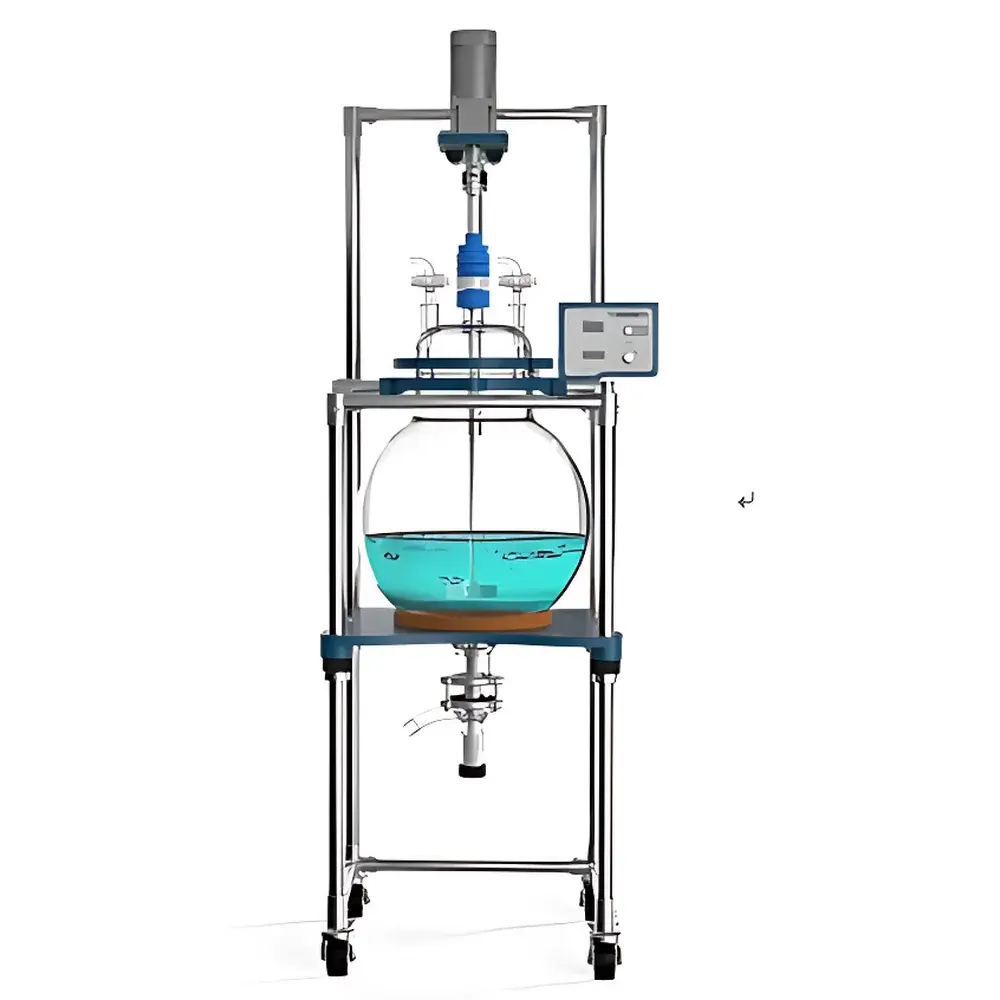
Glass Separatory Reactor GFY-10L by The Great Wall
| Brand | The Great Wall |
|---|---|
| Origin | Henan, China |
| Manufacturer Type | Direct Manufacturer |
| Country of Origin | China |
| Model | GFY-10L |
| Price Range | USD 2,800–7,000 (FOB) |
| Usable Volume | 10 L |
| Vessel Material | Borosilicate Glass 3.3 |
| Operating Pressure Range | −0.1 MPa to 0.0 MPa (Vacuum to Atmospheric) |
| Frame Material | SUS304 Stainless Steel |
| Temperature Resistance | −80 °C to +200 °C |
| Stirring Motor Power | 90 W |
| Speed Control | Frequency Inverter |
| Rotational Speed Range | 50–500 rpm |
| Lid Port Configuration | One 50# flange (stirrer), Two 34/35 standard taper joints (liquid feed & vent), Electrical Supply: 220–240 V~, 50 Hz |
Overview
The Glass Separatory Reactor GFY-10L is a purpose-engineered bench-scale reaction and phase-separation system designed for controlled synthesis, extraction, and multi-phase processing under vacuum or inert atmosphere. Built upon the fundamental principle of gravity-driven liquid–liquid phase separation within a vertically oriented, calibrated glass vessel, the GFY-10L integrates precise mechanical agitation with modular porting to support sequential reaction, quenching, settling, and layer withdrawal—all within a single, chemically inert borosilicate glass 3.3 (Duran®/Pyrex® equivalent) chamber. Its low-pressure operational envelope (−0.1 MPa to ambient) enables solvent removal via rotary evaporation coupling, moisture-sensitive reactions under nitrogen purge, or vacuum-assisted degassing prior to phase separation. Unlike sealed metal reactors, the all-glass construction provides real-time visual monitoring of emulsion formation, interfacial stability, sedimentation kinetics, and phase boundary movement—critical parameters in process development for pharmaceutical intermediates, fine chemical synthesis, and natural product isolation.
Key Features
- Borosilicate glass 3.3 vessel (DIN/ISO-compliant) with calibrated volume markings and ground-glass separatory valve for repeatable, drip-free layer discharge
- SUS304 stainless steel support frame with adjustable height and vibration-dampening feet for stable operation at up to 500 rpm
- Integrated frequency-controlled stirring motor (90 W) delivering consistent torque across 50–500 rpm range; compatible with PTFE-coated anchor, paddle, or propeller impellers
- Modular lid assembly featuring one 50# DIN flange (for stirrer shaft and optional temperature probe), two 34/35 standard taper joints (for reagent addition and gas venting/exhaust), and optional pressure/vacuum gauge port
- Full vacuum compatibility (−0.1 MPa absolute) verified per ISO 15896:2018 for laboratory glassware integrity under cyclic vacuum stress
- Thermal resilience from −80 °C (dry ice/acetone bath immersion) to +200 °C (oil bath heating), enabling cryogenic Grignard additions or high-temperature esterifications
Sample Compatibility & Compliance
The GFY-10L is compatible with organic solvents (e.g., dichloromethane, ethyl acetate, THF, toluene), aqueous acids/bases (pH 1–13), and halogenated media—provided thermal and chemical exposure remains within borosilicate 3.3 limits. It complies with ISO 3585 (borosilicate glass specifications), ASTM E438 Type I, Class A for volumetric accuracy, and EU Directive 2006/42/EC for machinery safety when used with certified drive units. While not intrinsically rated for explosion-proof environments, it may be operated inside certified fume hoods meeting EN 14175-3 standards. Documentation supports GLP-compliant recordkeeping when paired with validated temperature and pressure loggers.
Software & Data Management
The GFY-10L operates as a standalone analog instrument; no embedded firmware or proprietary software is included. However, its motor controller outputs 0–10 V analog speed signal and accepts 4–20 mA setpoint input, enabling integration into third-party SCADA or LabVIEW-based control systems (e.g., for automated ramp-and-hold agitation profiles). Optional digital tachometers (with RS-485 output) and PT100 temperature transmitters (DIN B tolerance) can be mounted externally and logged via compliant data acquisition platforms satisfying FDA 21 CFR Part 11 requirements when configured with audit trail and electronic signature modules.
Applications
- Multi-step synthesis workflows requiring in-situ extraction (e.g., Suzuki coupling followed by aqueous workup)
- Development of continuous-flow batch hybrid processes where reaction, phase separation, and intermediate isolation occur sequentially
- Method validation for pharmacopeial extraction procedures (USP , EP 2.4.24) involving volatile organic residue determination
- Kinetic studies of emulsion breakage and coalescence under controlled shear and interfacial tension conditions
- Teaching laboratories demonstrating partition coefficients (log P), distribution ratios, and solvent selection criteria per IUPAC recommendations
FAQ
Can the GFY-10L be used for hydrogenation reactions under H₂ pressure?
No. It is rated only for vacuum to atmospheric pressure (−0.1 to 0.0 MPa); pressurized gas reactions require ASME-coded autoclaves.
Is the separatory valve interchangeable with other standard glassware?
Yes—the valve uses ISO K 29/32 thread and is compatible with standard 29/32 taper joints from major suppliers (Chemglass, Kontes, Wheaton).
What calibration documentation is provided?
A factory-verified volumetric calibration certificate (traceable to NIM China) is supplied, covering 10%, 50%, and 100% fill points per ISO 4787.
Does the unit include a condenser or heating mantle?
No—these are optional accessories selected separately based on thermal management requirements and must comply with IEC 61000-6-3 EMC standards.
How is cleaning validation performed?
Residue testing follows ASTM E3054 guidelines using swab sampling and HPLC-UV analysis; the smooth, crevice-free glass interior and absence of gasketed seals simplify qualification.



