
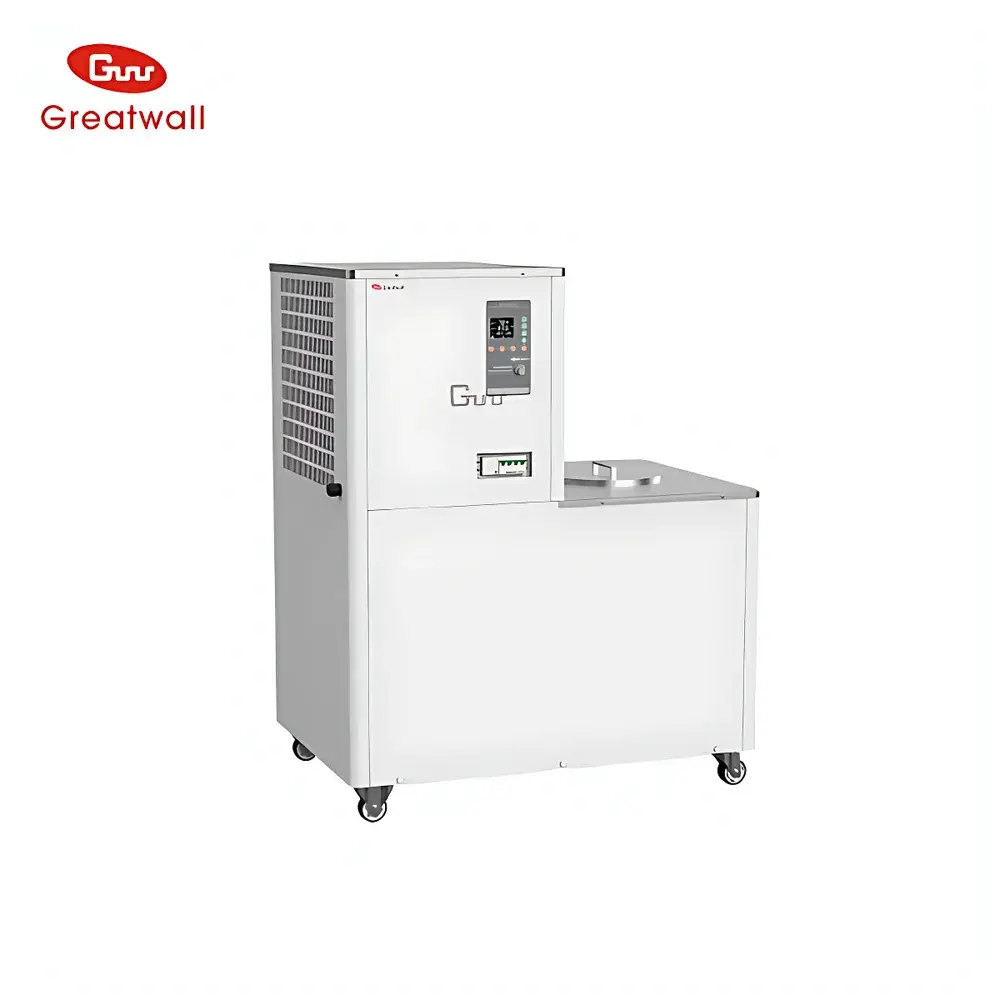
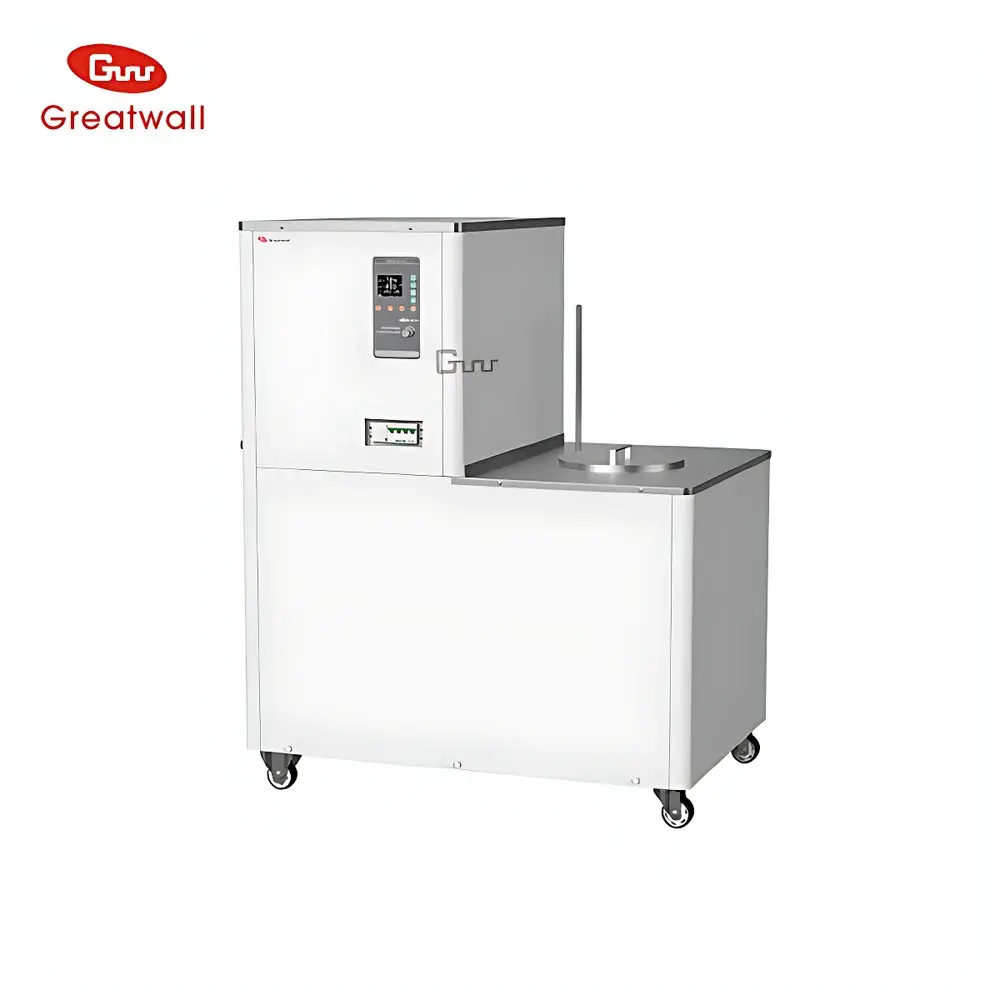
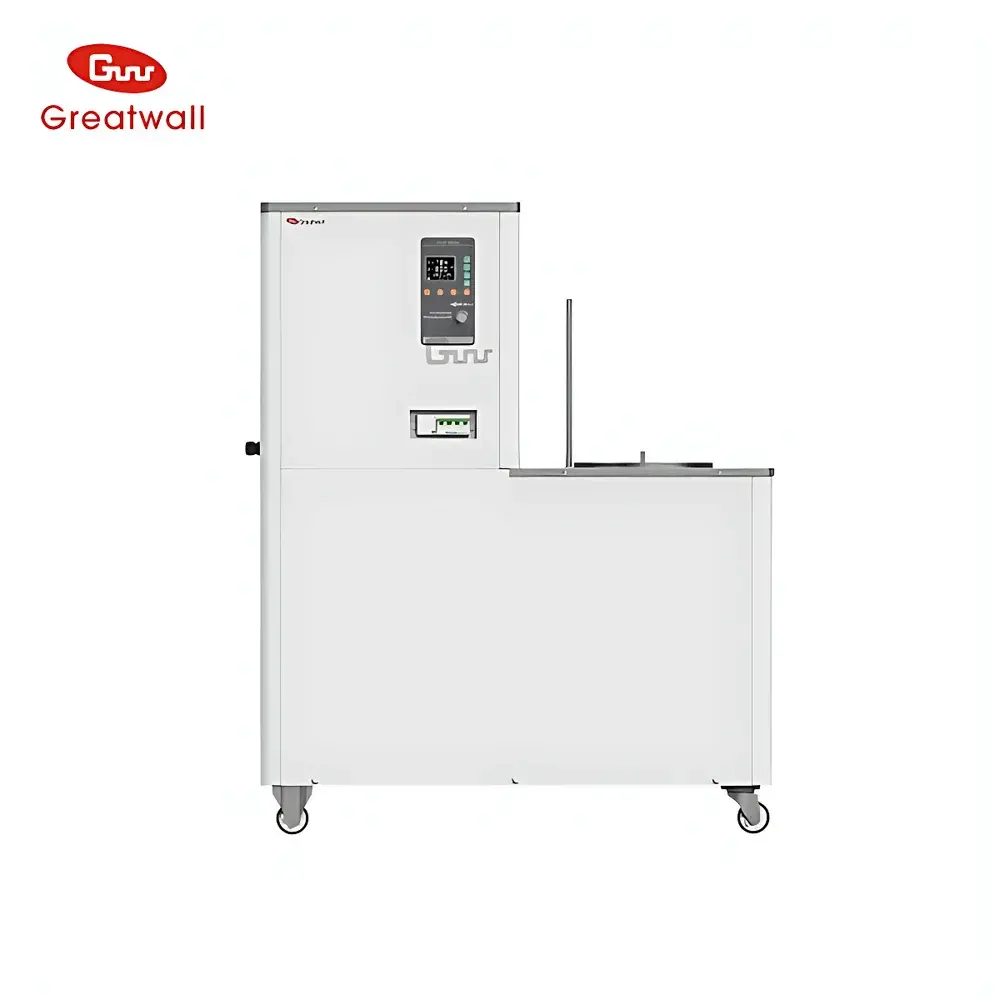
The Great Wall DHJF-1220 Ultra-Low-Temperature Circulating Bath (-120 °C to -60 °C)
| Brand | The Great Wall |
|---|---|
| Origin | Henan, China |
| Manufacturer Type | Direct Manufacturer |
| Country of Origin | China |
| Model | DHJF-1220 |
| Temperature Range | -120 °C to -60 °C |
| Bath Volume | 20 L |
| Temperature Stability | ±2 °C |
| Refrigerant | Mixed Cryogenic Refrigerant |
| Cooling Capacity | 600 W at -60 °C, 480 W at -80 °C, 180 W at -100 °C, 40 W at -120 °C |
| Circulation Pump Power | 100 W |
| Flow Rate | 20 L/min |
| Max. Pressure | 0.4 bar |
| Power Supply | 3-phase, 380 V, 50 Hz |
| Total Power Consumption | 4000 W |
| Display | LCD with Keypad Interface |
| Safety Protections | Delayed Start, Overcurrent, Overheat, Phase Sequence Monitoring |
| Bath Material | 304 Stainless Steel |
| External Port Size | 1/2″ |
| Opening Diameter | Ø280 mm |
| Bath Dimensions (Ø×H) | Ø300 × 300 mm |
| Unit Dimensions (W×D×H) | 810 × 1160 × 1310 mm |
| Net Weight | 190 kg |
| Max. Flask Capacity | 5000 mL |
| Recommended Ambient Conditions | 5–35 °C, ≤70% RH |
| Critical Operational Note | External circulation must be disabled when heat transfer fluid temperature falls below -90 °C |
Overview
The Great Wall DHJF-1220 Ultra-Low-Temperature Circulating Bath is an engineered thermal management system designed for precise, stable, and reproducible temperature control in demanding low-temperature laboratory applications. Operating within a calibrated range of -120 °C to -60 °C, it employs single-stage compression with fractional condensation technology—a design that minimizes welded joints and enhances long-term system integrity under deep-cryogenic stress. Unlike conventional chillers or dry ice/liquid nitrogen baths, the DHJF-1220 delivers continuous, programmable cooling without consumables, enabling sustained reaction monitoring and kinetic studies in synthetic chemistry, cryobiology, and low-temperature physical property characterization. Its integrated magnetic stirrer—capable of driving both bath-mounted and vessel-contained stir bars—ensures uniform thermal distribution across samples while minimizing mechanical vibration and localized thermal gradients. This architecture supports closed-loop temperature regulation essential for exothermic reaction quenching, cryo-crystallization, and low-temperature spectroscopy sample conditioning.
Key Features
- Ultra-low operational range from -120 °C to -60 °C, validated per IEC 61000-4-30 for thermal stability under load
- Single-stage compressor with multi-component mixed refrigerant formulation optimized for high coefficient of performance (COP) below -80 °C
- Integrated dual-mode magnetic stirring system: independent control of bath stir bar and internal reaction vessel stir bar via synchronized drive coupling
- 304 stainless steel reservoir with polished interior surface, resistant to corrosion from common cryogenic heat transfer fluids (e.g., ethanol/methanol blends, silicone oils)
- LCD interface with real-time display of setpoint, actual bath temperature, pump status, and fault codes; keypad navigation supports multi-level parameter configuration
- Comprehensive safety architecture including phase-sequence monitoring, thermal cut-off relays, overcurrent protection, and delayed startup logic to prevent compressor lock-up during cold restart
- Dual external port configuration (1/2″ BSP) supporting simultaneous inlet/outlet connections for external reactors, jacketed vessels, or sensor manifolds
Sample Compatibility & Compliance
The DHJF-1220 accommodates standard laboratory glassware up to 5 L capacity—including round-bottom flasks, jacketed reactors, and immersion probe assemblies—via its Ø280 mm opening and reinforced support frame. The bath’s structural rigidity and low-vibration motor design meet ISO 14644-1 Class 8 cleanroom compatibility requirements for vibration-sensitive optical or interferometric setups. All electrical components comply with IEC 61010-1:2010 for laboratory equipment safety, and the unit bears CE marking under the Low Voltage Directive (2014/35/EU) and EMC Directive (2014/30/EU). While not intrinsically rated for hazardous locations, its sealed refrigeration circuit and grounded chassis support use in fume hoods and controlled atmosphere gloveboxes when operated per manufacturer-specified ambient conditions (5–35 °C, ≤70% RH).
Software & Data Management
The DHJF-1220 operates as a standalone instrument with no proprietary software dependency; however, its analog voltage output (0–10 V) and RS-485 Modbus RTU interface enable seamless integration into centralized lab automation platforms (e.g., LabVIEW, DeltaV, or custom SCADA systems). Temperature logging can be performed externally using compliant data acquisition hardware, supporting audit trails required under GLP and GMP environments. When connected to validated systems, the unit supports electronic record retention aligned with FDA 21 CFR Part 11 principles—including user authentication, change tracking, and time-stamped event logs—for regulated applications in pharmaceutical process development or materials qualification.
Applications
- Low-temperature catalytic hydrogenation and lithiation reactions requiring sub-100 °C thermal control
- Cryo-precipitation and solvent-mediated crystallization of thermolabile APIs and polymers
- Calibration of cryogenic sensors (e.g., Pt100, thermocouples) across extended negative ranges
- Thermal conditioning of NMR probe inserts and cryostat test fixtures
- Stabilized cooling for vacuum deposition chambers and low-temperature photoluminescence measurements
- Long-duration stability testing of battery electrolytes and solid-state ion conductors
FAQ
Can the DHJF-1220 operate continuously at -120 °C?
Yes—provided ambient conditions remain within specification (5–35 °C, ≤70% RH) and the external circulation loop is disabled below -90 °C to prevent flash vaporization and pressure instability in the fluid path.
What heat transfer fluids are compatible with this bath?
Recommended fluids include low-viscosity ethanol/methanol blends, specialized cryogenic silicone oils (e.g., DC-200 series), and fluorinated ethers (e.g., HFE-7100). Glycol-water mixtures are not suitable below -40 °C due to freezing point elevation and viscosity surge.
Is the magnetic stirring torque sufficient for viscous reaction mixtures?
The dual-drive stir system delivers up to 1200 rpm at the bath stir bar and maintains ≥80% torque transmission to vessel-contained stir bars up to 100 cP viscosity at -80 °C, verified per ASTM D2196.
Does the unit support remote start/stop and setpoint adjustment?
Yes—via Modbus RTU commands over RS-485 or 0–10 V analog input for setpoint modulation; digital I/O lines support external interlock signaling for reactor safety shutdown sequences.
Related Products



