
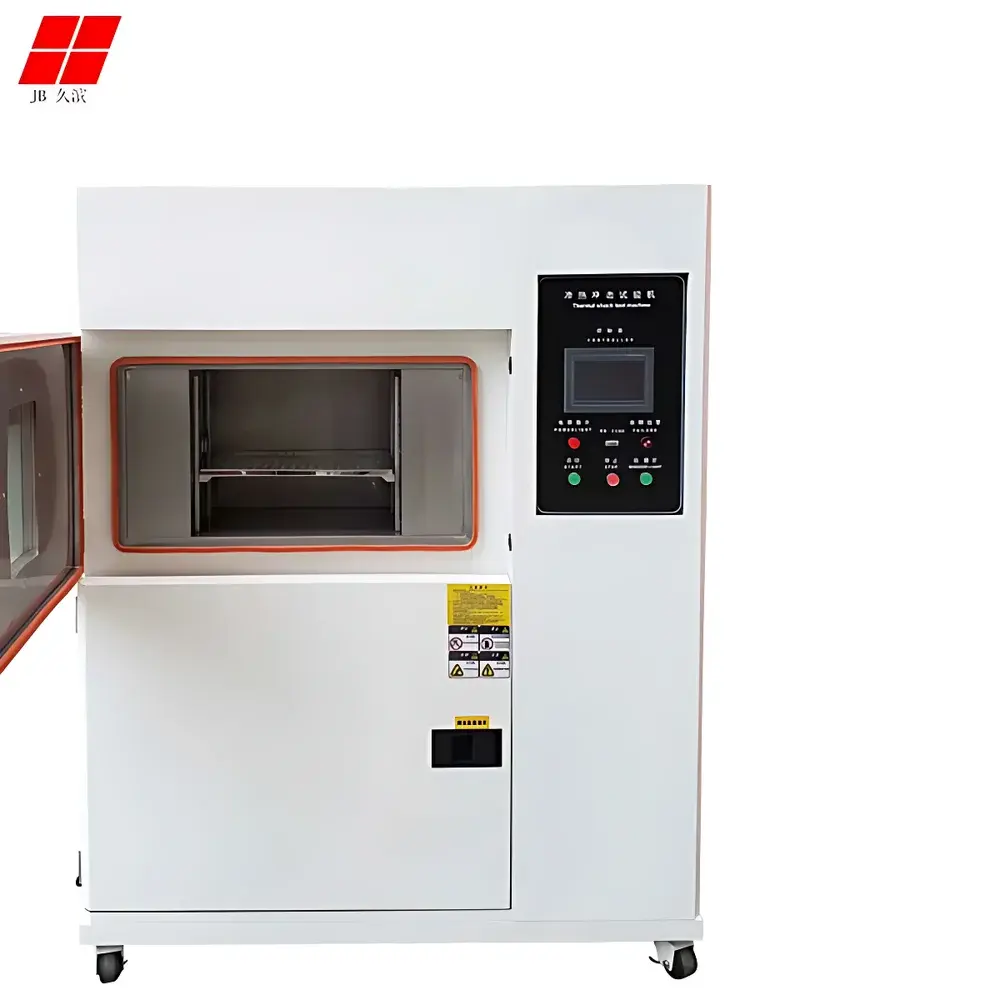
Jiubin JB-220D Thermal Shock Test Chamber
| Brand | Jiubin |
|---|---|
| Origin | Shanghai, China |
| Model | JB-220D |
| Internal Chamber Dimensions (W×H×D) | 450–600 × 350–500 × 350–500 mm |
| External Dimensions (W×H×D) | 1500–1900 × 1950–2000 × 1450–1550 mm |
| High-Temperature Zone Range | +80 to +200 °C |
| Low-Temperature Zone Range | −75 to −10 °C (selectable configurations: −55/−60/−75 °C) |
| Test Chamber Operating Range | +60 to +150 °C (high), −10 to −60 °C (low) |
| Temperature Transition Time | ≤25 min (−10 → +200 °C), ≤90 min (+20 → −75 °C) |
| Recovery Time | ≤5 min (after thermal shock cycle) |
| Payload Capacity | 2.5 / 5 / 10 kg |
| Inner Liner | Mirror-finish SUS304 stainless steel |
| Outer Casing | SUS304 stainless steel |
| Insulation | High-density glass wool + polyurethane foam |
| Refrigeration System | Cascade air-cooled or water-cooled dual-stage refrigeration with imported hermetic or semi-hermetic compressors |
| Refrigerants | R507 & R23 (HFC-based, ozone-friendly) |
| Controller | Programmable touchscreen HMI (LCD), multi-language interface (English/Chinese), real-time curve display and logging |
| Safety Protections | Compressor overcurrent/overheat, high/low pressure cutoff, heater dry-run prevention, motor overload, abnormal air pressure interlock |
| Power Supply | AC 3-phase 5-wire, ±10% tolerance, 50 Hz |
Overview
The Jiubin JB-220D Thermal Shock Test Chamber is an engineered environmental test system designed for rapid, repeatable, and highly controlled thermal cycling between extreme temperature extremes. It operates on the principle of three-zone thermal separation: a dedicated high-temperature chamber, a low-temperature chamber, and an intermediate test chamber where the specimen remains stationary. During operation, pneumatic or servo-driven damper mechanisms isolate and sequentially expose the test sample to pre-conditioned hot or cold air streams—eliminating mechanical movement of the specimen and minimizing thermal inertia-induced measurement lag. This architecture ensures precise dwell time control, high thermal ramp fidelity, and minimal overshoot—critical for evaluating material integrity under accelerated thermal fatigue conditions. The chamber meets foundational requirements for thermal shock testing per IEC 60068-2-14, MIL-STD-810H Method 503.6, and JESD22-A104, supporting qualification and reliability screening across electronics, automotive, aerospace, and advanced materials development workflows.
Key Features
- Three-compartment design with independent thermal reservoirs and dynamic airflow switching—ensures zero specimen displacement during transition phases
- Cascade refrigeration system utilizing dual-stage compressors and environmentally compliant refrigerants (R507/R23), enabling stable operation down to −75 °C without liquid nitrogen dependency
- Touchscreen programmable controller with embedded data logging, real-time temperature profiling, and user-configurable shock cycles (up to 999 segments)
- Mirror-finish SUS304 stainless steel interior surfaces for corrosion resistance, ease of cleaning, and long-term dimensional stability under thermal cycling
- Multi-layer insulation combining high-density glass wool and closed-cell PU foam, achieving thermal loss rates <0.8 K/min at steady-state extremes
- Comprehensive safety architecture including compressor discharge temperature monitoring, refrigerant pressure transducers, heater current sensing, and fail-safe door interlocks
- Modular payload support accommodating standard test fixtures (2.5 kg, 5 kg, or 10 kg load options) with adjustable stainless steel shelves and a 50 mm diameter test port for external sensor integration
Sample Compatibility & Compliance
The JB-220D accommodates rigid and semi-rigid specimens up to 10 kg, including PCB assemblies, IC packages, solder joints, polymer housings, metal castings, and ceramic substrates. Its static-test configuration avoids vibration artifacts common in lift-type shock chambers, making it suitable for delicate microelectromechanical systems (MEMS) and optoelectronic components. The chamber complies with structural and operational prerequisites outlined in ISO 16750-4 (road vehicles), AEC-Q200 (passive components), and IPC-9701 (solder joint reliability). While not certified to GLP or FDA 21 CFR Part 11 out-of-the-box, its audit-ready controller logs include timestamped setpoints, actual chamber temperatures, alarm events, and operator ID fields—enabling traceable validation per internal quality management systems aligned with ISO/IEC 17025 and IATF 16949.
Software & Data Management
The integrated HMI supports full-cycle programming—including dwell times, ramp rates, number of cycles, and conditional branching based on temperature thresholds. All operational parameters and real-time sensor data are logged to internal flash memory (≥16 GB) with CSV export capability via USB 2.0. Optional Ethernet connectivity enables remote monitoring through Modbus TCP or custom SCADA integration. Data files include metadata such as test ID, operator name, start/end timestamps, and firmware revision—facilitating automated report generation in laboratory information management systems (LIMS). The controller firmware adheres to IEC 62443-3-3 security guidelines for industrial control devices, with password-protected configuration access levels (Operator, Engineer, Administrator).
Applications
- Qualification testing of semiconductor packages (QFN, BGA, CSP) per JEDEC JESD22-A104 and A106
- Evaluation of thermal expansion mismatch in multilayer ceramic capacitors (MLCCs) and flex-rigid PCB laminates
- Accelerated aging studies of conformal coatings, potting compounds, and adhesive bonds used in automotive ECUs
- Reliability screening of battery module enclosures and thermal interface materials (TIMs) under cyclic thermal stress
- Validation of hermetic seal integrity in MEMS sensors and medical device housings
- Process window definition for reflow soldering and die-attach curing processes
FAQ
What is the maximum allowable specimen volume for the JB-220D?
The internal chamber volume ranges from 55 to 150 L depending on selected configuration; maximum usable volume is 80% of nominal capacity to ensure uniform airflow and thermal response.
Can the chamber be validated for IQ/OQ/PQ protocols?
Yes—the controller provides calibration point logging, sensor linearity verification tools, and certificate-ready reports. Third-party validation kits (including NIST-traceable PT100 probes and mapping software) are available upon request.
Is remote diagnostics supported?
Standard Ethernet port enables ping-based connectivity checks and basic status polling. Full remote control requires optional secure VPN gateway configuration and firmware version 3.2 or higher.
Does the system meet RoHS and REACH compliance?
All structural materials, wiring harnesses, and refrigerants comply with EU Directive 2011/65/EU (RoHS2) and Regulation (EC) No 1907/2006 (REACH), with full material declarations available in the technical documentation package.
What maintenance intervals are recommended?
Compressor oil analysis every 2,000 operating hours; refrigerant circuit leak check annually; air filter replacement quarterly; full thermal calibration biannually using certified reference standards.



