
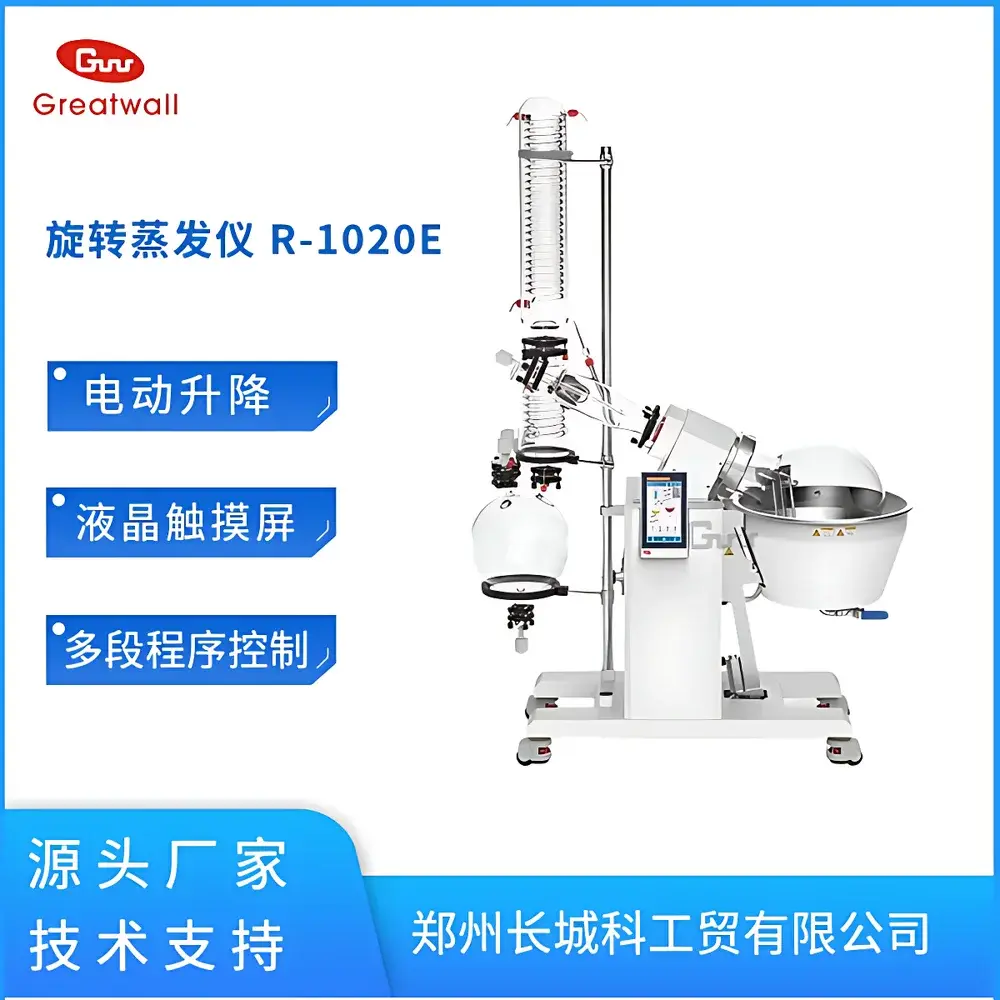
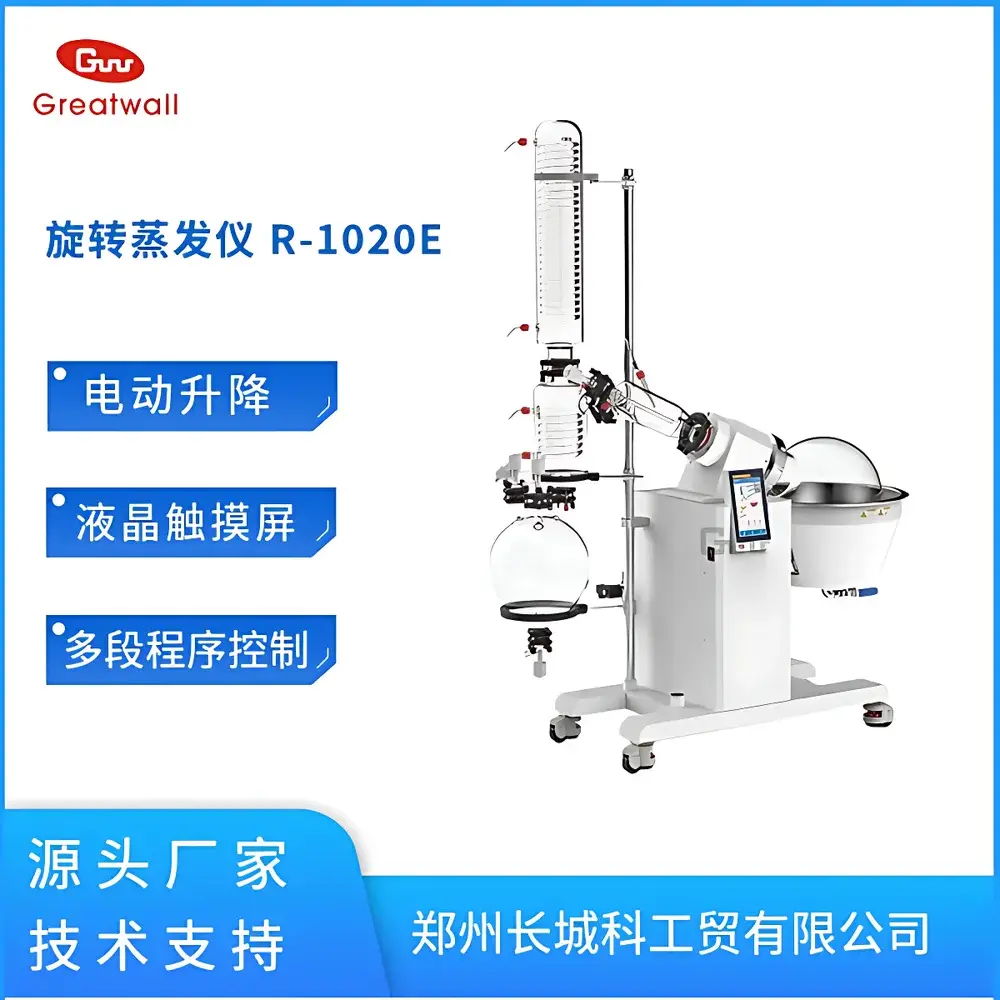
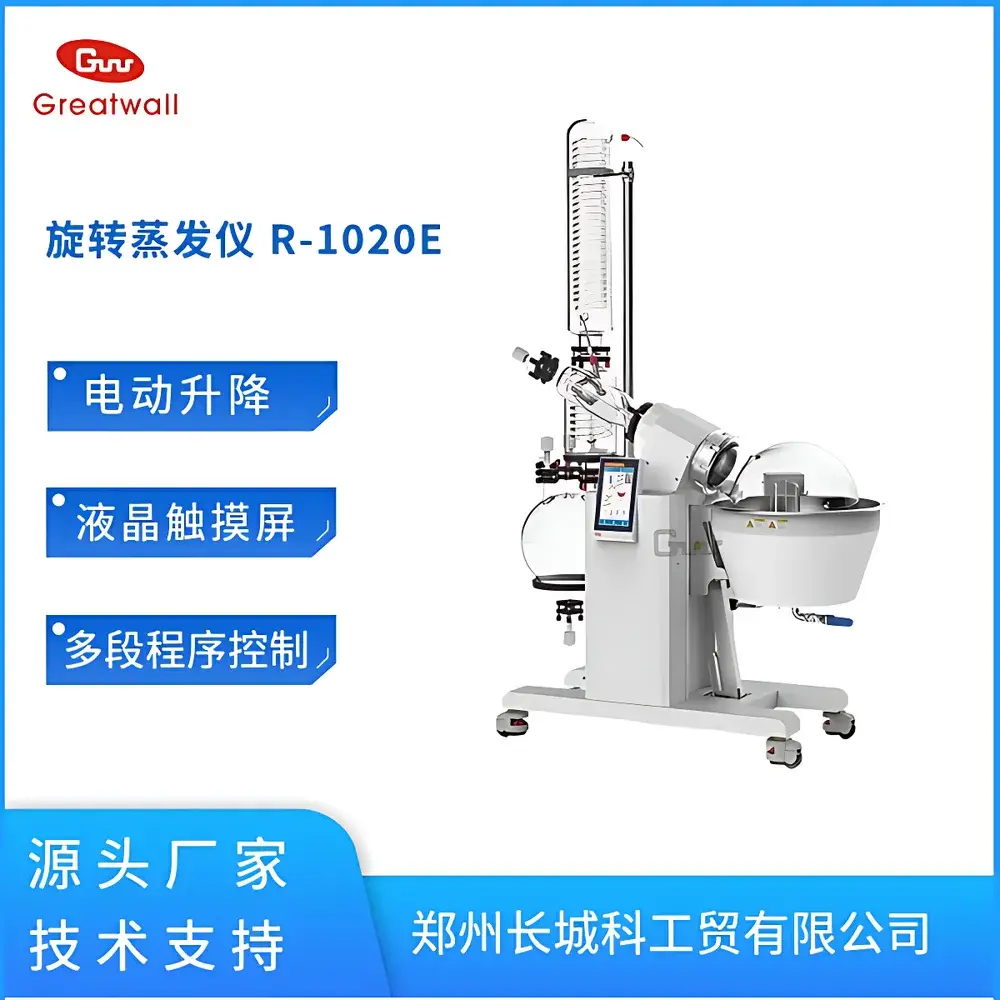
Great Wall R-1020E Intelligent Rotary Evaporator
| [Brand | Great Wall |
|---|---|
| Origin | Henan, China |
| Manufacturer Type | Direct Manufacturer |
| Model | R-1020E |
| Rotating Flask Capacity | 20.0 L (DN120 Flange) |
| Rotation Speed Range | 20–150 rpm |
| Temperature Control Range | Ambient +5 °C to 180 °C |
| Temperature Accuracy | ±1.5 °C (water bath), ±3.0 °C (oil bath) |
| Condensing Area | Main Condenser 0.95 m², Auxiliary Condenser 0.24 m² |
| Vacuum Range | 0–100 kPa (absolute) |
| Sealing Leakage Rate | <0.1 kPa/min |
| Power Supply | 220–240 V~, 50/60 Hz |
| Total Power Consumption | 4 kW |
| Dimensions (W×D×H) | 1235 × 650 × 1790 mm |
| Protection Class | IP20 |
| Max. Operating Altitude | ≤2000 m |
| Ambient Operating Conditions | 5–40 °C, ≤70% RH] |
Overview
The Great Wall R-1020E Intelligent Rotary Evaporator is an engineered solution for high-capacity solvent removal, concentration, and purification in research laboratories, pilot-scale process development, and quality control environments. Based on the principle of reduced-pressure distillation—where lowering the system pressure decreases the boiling point of solvents—the R-1020E enables efficient, gentle evaporation of heat-sensitive compounds without thermal degradation. Its 20.0 L rotating flask (DN120 flange interface) supports large-volume batch processing, while integrated temperature, rotation, and vacuum control ensures reproducible operation across diverse organic, aqueous, and mixed-solvent systems. Designed for compliance with fundamental laboratory safety and operational standards, the system incorporates fail-safes including overtemperature protection, leakage-resistant sealing, and electrical safety circuitry aligned with IEC 61010-1 requirements for laboratory equipment.
Key Features
- High-integrity borosilicate glass 3.3 construction for all major components—rotating flask, condenser, collection flask, and three-way buffer bottle—ensuring exceptional thermal shock resistance, chemical inertness, and optical clarity.
- Dual-stage condensation architecture: primary condenser (0.95 m²) paired with auxiliary condenser (0.24 m²) and optimized triple-reflux design to maximize vapor capture efficiency and solvent recovery rates—even under variable load or low-boiling solvent conditions.
- Electrically actuated vertical bath lift mechanism with overflow port, enabling precise immersion depth control and safe, repeatable flask positioning without manual handling.
- PTFE-modified sealing gaskets and PTFE-core discharge valve provide broad chemical compatibility and eliminate metal ion contamination—critical for pharmaceutical intermediate purification and analytical sample preparation.
- Intuitive 7-inch capacitive touchscreen interface with lockable operation mode, multilingual support (English/Chinese), real-time parameter monitoring (rotation speed, bath temperature, vapor temperature, coolant temperature, vacuum level, ambient temperature), and multi-segment programmable protocols.
- Integrated Modbus RTU communication protocol for bidirectional data exchange with LIMS or SCADA systems—supporting audit-ready logging, remote status interrogation, and centralized fleet management in regulated environments.
- Comprehensive safety architecture: dry-run prevention via temperature-based heating interlock, earth leakage protection, overcurrent cutoff, and automatic vacuum release upon critical fault detection.
Sample Compatibility & Compliance
The R-1020E accommodates a wide range of sample matrices—including polar/non-polar organic solvents (e.g., acetone, ethyl acetate, dichloromethane), aqueous solutions, polymer solutions, and heat-labile natural extracts—without compromising integrity or yield. Its borosilicate 3.3 glass train complies with ISO 3585 for laboratory glassware, while the electric heating bath meets IEC 60529 (IP20) ingress protection specifications. Though not intrinsically rated for hazardous area use, the system is routinely deployed in GMP-aligned QC labs where adherence to USP Analytical Instrument Qualification and FDA 21 CFR Part 11 data integrity principles is enforced through its secure user access control, electronic signature-capable data export (CSV/USB), and tamper-evident audit trail generation.
Software & Data Management
Embedded firmware supports time-stamped historical curve recording for up to six parameters simultaneously, with on-device storage and USB export functionality. All operational logs—including method execution timestamps, setpoint deviations, alarm events, and manual interventions—are retained with immutable metadata. The system does not require external PC software for basic operation; however, optional API integration enables automated method loading, batch report generation, and synchronization with enterprise ELN platforms. Data export files include embedded calibration identifiers and environmental context (ambient temperature/humidity), fulfilling GLP documentation traceability requirements.
Applications
- Concentration of natural product extracts (e.g., botanicals, marine metabolites) prior to HPLC or LC-MS analysis.
- Removal of residual solvents from synthetic intermediates in API manufacturing development.
- Recovery and recycling of high-value solvents (e.g., THF, DMF, chloroform) in academic and industrial chemistry labs.
- Preparative-scale dehydration of polymer solutions for film casting or nanoparticle formulation.
- Stabilization of thermolabile compounds—such as peptides or vitamins—via low-temperature, high-vacuum evaporation protocols.
- Process validation studies requiring documented repeatability across ≥100 consecutive runs under identical thermal/vacuum profiles.
FAQ
What is the maximum recommended operating vacuum level for optimal condensation efficiency?
The system achieves peak condenser performance at absolute pressures between 1.0–15.0 kPa, depending on solvent volatility and coolant temperature. Below 1.0 kPa, vapor velocity may exceed condenser residence time, reducing recovery yield.
Can the R-1020E be integrated into a nitrogen-purged or inert-gas recirculation setup?
Yes—the vacuum inlet includes a dedicated gas ballast port compatible with controlled inert gas bleed (e.g., N₂ or Ar) to stabilize foaming or prevent oxidation during distillation of air-sensitive compounds.
Is third-party calibration certification available for IQ/OQ/PQ documentation?
Great Wall provides factory-verified calibration reports for temperature sensors (±0.5 °C traceability to NIST), vacuum transducer (±1% FS), and rotational encoder (±1 rpm). Full qualification support packages—including URS alignment, test protocols, and deviation reporting—are offered upon request.
Does the system meet CE marking requirements for export to the European Economic Area?
The R-1020E conforms to the essential health and safety requirements of the EU Machinery Directive 2006/42/EC and Electromagnetic Compatibility Directive 2014/30/EU. CE Declaration of Conformity is supplied with each unit.
How is maintenance access designed for long-term reliability?
All serviceable components—including motor assembly, bath heater elements, vacuum pump interface, and touchscreen controller—are modular and accessible without disassembly of the glass train. Preventive maintenance intervals are defined per ISO 13374-1 for condition monitoring of rotating machinery and thermal systems.



