
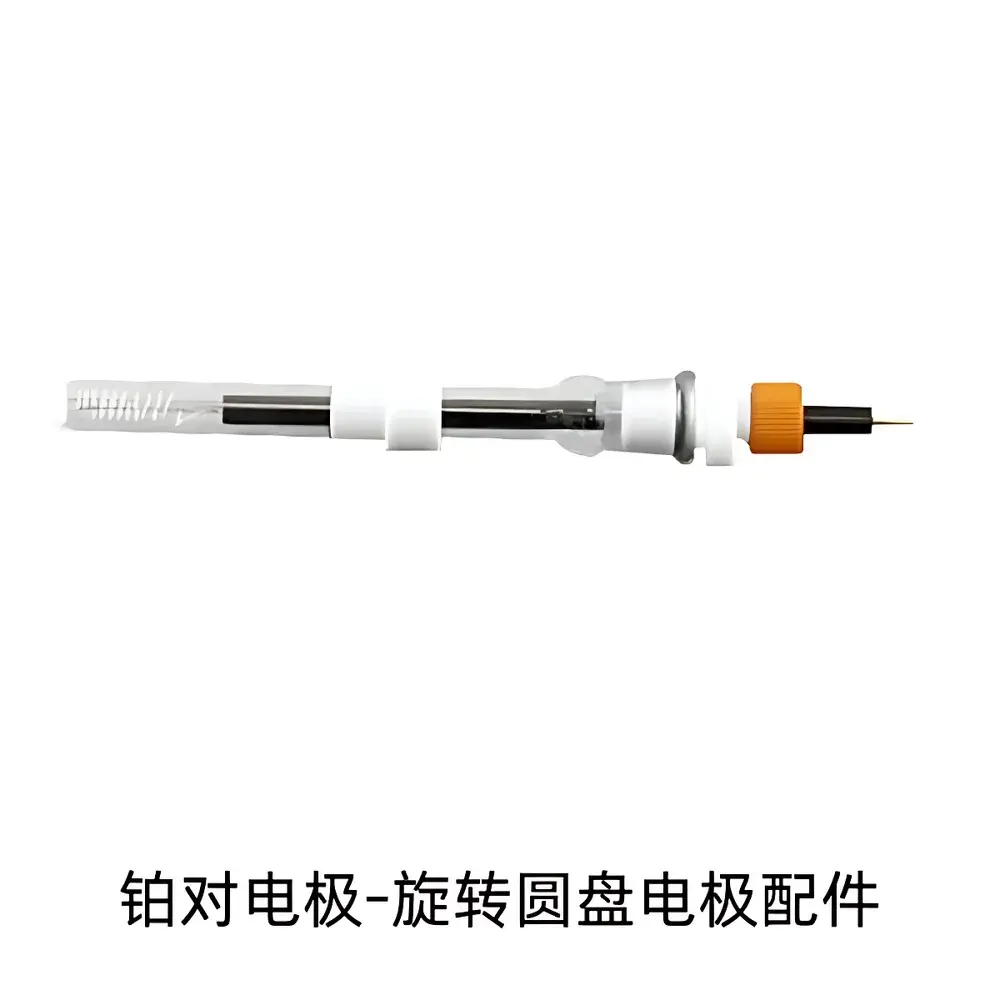
DCPTCounter Platinum Counter Electrode for Rotating Disk Electrode (RDE) Systems
| Brand | DC-Energies |
|---|---|
| Origin | Hubei, China |
| Model | DCPTCounter |
| Electrode Material | 99.99% Pure Platinum Wire |
| Connection Interface | Standard 14/20 Quick-Connect Ground-Glass Joint |
| Total Length | 29 cm |
| Compatibility | Designed for Conventional RDE Electrolytic Cells with Standard Neck Dimensions (e.g., 24/40, 29/32, or 34/45 necks via optional adapters) |
| Electrode Geometry | Linear Pt wire configuration, non-rotating counter electrode assembly |
Overview
The DCPTCounter Platinum Counter Electrode is a precision-engineered consumable component designed specifically for use in rotating disk electrode (RDE) electrochemical measurement systems. It functions as the auxiliary (counter) electrode in three-electrode electrochemical cells, completing the current loop while minimizing ohmic drop and polarization effects during controlled-potential or controlled-current experiments. Constructed from 99.99% high-purity platinum wire, the electrode ensures electrochemical inertness, low background current, and long-term stability across a wide potential window (−1.2 V to +1.6 V vs. SCE in aqueous media). Its linear geometry and fixed positioning—distinct from the rotating working electrode—enable consistent current distribution and reproducible mass-transport conditions essential for kinetic analysis, catalyst evaluation, and diffusion-controlled reaction studies. The DCPTCounter is not a standalone instrument but a critical system-integrated consumable, engineered to maintain metrological integrity in RDE-based voltammetry (e.g., cyclic, linear sweep, and chronoamperometry), rotating ring-disk electrode (RRDE) configurations, and electrocatalytic activity mapping.
Key Features
- Ultra-high purity platinum (99.99% Pt) wire ensures minimal catalytic side reactions and negligible faradaic interference during sensitive redox measurements.
- Standardized 14/20 ground-glass joint interface enables rapid, leak-tight integration with commercially available RDE electrolytic cells (e.g., Pine Research, BASi, or Metrohm cell bodies).
- 29 cm total length provides optimal vertical reach for immersion depth control—facilitating precise positioning relative to the RDE tip (typically 0.5–2 cm above the rotating disk surface) without obstructing rotation or gas purging lines.
- Chemically resistant borosilicate glass sheath (where applicable) and inert PTFE insulation ensure compatibility with aggressive electrolytes, including concentrated acids (e.g., 0.5 M H₂SO₄), alkaline media (e.g., 1 M KOH), and organic solvents (e.g., acetonitrile/LiClO₄).
- Designed for compliance with ASTM D7212 (standard test method for electrochemical characterization of electrocatalysts) and ISO 13884 (electrochemical sensors—performance testing protocols).
Sample Compatibility & Compliance
The DCPTCounter supports heterogeneous electrochemical investigations involving liquid-phase analytes, suspended catalyst inks, and thin-film electrodes deposited on RDE substrates (e.g., glassy carbon, gold, or modified carbon). It is routinely deployed in studies of oxygen reduction reaction (ORR), hydrogen evolution reaction (HER), CO₂ reduction, and battery electrode kinetics. All materials conform to RoHS Directive 2011/65/EU and REACH Annex XVII restrictions. While the electrode itself does not require calibration, its performance must be validated within each experimental setup per GLP-compliant laboratory procedures—including open-circuit potential stabilization, background current profiling, and iR-compensation verification prior to quantitative kinetic modeling.
Software & Data Management
As a passive hardware component, the DCPTCounter does not incorporate embedded firmware or digital interfaces. However, it is fully interoperable with industry-standard electrochemical workstations (e.g., BioLogic SP-300, Gamry Interface 5000P, CH Instruments 660E) and associated software platforms (EC-Lab®, Framework™, GPES). Experimental metadata—including electrode type, batch number, immersion depth, and electrolyte composition—must be manually logged in accordance with 21 CFR Part 11 requirements when used in regulated environments (e.g., pharmaceutical QC or battery safety validation). Audit trails for electrode replacement intervals and post-experiment cleaning records are recommended for traceability in ISO/IEC 17025-accredited laboratories.
Applications
- Kinetic parameter extraction (e.g., electron transfer rate constants, diffusion coefficients) via Levich and Koutecký–Levich analysis.
- Electrocatalyst screening for fuel cell and water-splitting applications under controlled hydrodynamic conditions.
- Stability assessment of electrodeposited nanomaterials during accelerated stress tests (ASTs) at fixed rotation speeds (e.g., 400–2500 rpm).
- Validation of membrane electrode assembly (MEA) half-cell performance in proton exchange membrane (PEM) systems.
- Teaching laboratories: Demonstrating mass-transport-limited currents and Tafel slope determination in undergraduate electrochemistry curricula.
FAQ
Is the DCPTCounter compatible with rotating ring-disk electrode (RRDE) systems?
Yes—it is mechanically and electrochemically compatible with standard RRDE cells, provided the counter electrode position avoids shadowing the ring collector or interfering with solution flow dynamics.
What is the recommended cleaning protocol between experiments?
Rinse thoroughly with ultrapure water, followed by sequential sonication in acetone, ethanol, and 0.5 M H₂SO₄ (10 min each), then air-dry under inert atmosphere. Avoid abrasive polishing; platinum surface integrity is preserved through electrochemical cleaning only.
Can this counter electrode be used in non-aqueous electrolytes?
Yes—validated for use in anhydrous acetonitrile, propylene carbonate, and dimethyl sulfoxide containing supporting electrolytes such as TBAPF₆ or LiTFSI.
Does the 14/20 joint support vacuum or pressure-rated operation?
No—the ground-glass joint is rated for ambient-pressure, atmospheric-temperature electrochemical cells only; it is not designed for sealed, pressurized, or vacuum-degassed configurations without supplemental O-ring sealing.
How often should the DCPTCounter be replaced?
Replacement is determined empirically: monitor for increased background current (>5% rise over baseline), visible pitting or discoloration, or deviation from theoretical Levich slopes; typical service life exceeds 200 h of continuous operation under controlled conditions.
Related Products







