
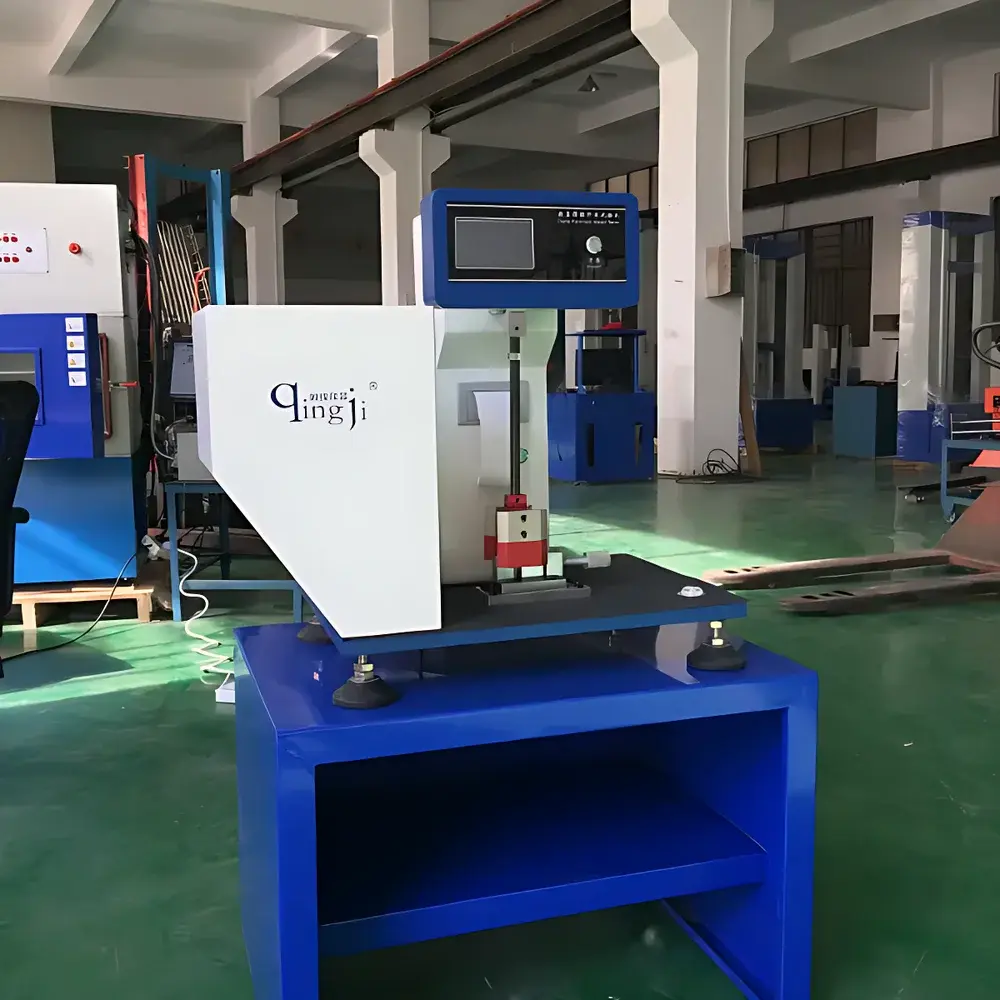
Qingji QJBCX Series Charpy/Izod Impact Testing Machine (5.5 J / 11 J / 22 J)
| Brand | Qingji |
|---|---|
| Origin | Shanghai, China |
| Model | QJBCX |
| Impact Energy Levels | 5.5 J, 11 J, 22 J |
| Impact Velocity | 3.5 m/s |
| Pendulum Constant (Torque) | 2.8355 N·m (5.5 J), 5.671 N·m (11 J), 11.3419 N·m (22 J) |
| Maximum Lifting Height | 22 mm |
| Impact Blade Radius | R = 0.8 mm |
| Support Span | 60 mm (per ISO 179/ISO 180) |
| Scale Resolution | 0.05 J (0–5.5 J range), 0.1 J (0–11 J), 0.2 J (0–22 J) |
| Pendulum Arm Length (from pivot to blade center) | 0.322 m |
| Blade-to-Anvil Distance (support height) | 22 mm |
| Power Supply | 220 V, 50 Hz |
| Net Weight | 80 kg |
| Compliance | GB/T 1043, GB/T 1843, ISO 179-1, ISO 180, ISO 9854-1, DIN 8078, DIN 53453 |
Overview
The Qingji QJBCX Series Charpy/Izod Impact Testing Machine is a precision-engineered mechanical impact tester designed for quantitative evaluation of the notched and unnotched impact toughness of non-metallic materials under standardized pendulum impact conditions. Based on the principle of conservation of mechanical energy, the instrument measures the energy absorbed by a specimen during fracture by calculating the difference between the initial potential energy of a calibrated pendulum and its residual kinetic energy after impact. This gravimetric method ensures high reproducibility and traceability in compliance with internationally recognized test standards. The QJBCX supports dual-mode operation—Charpy (three-point bending, supported at both ends) and Izod (cantilever beam, clamped at one end)—enabling laboratories to perform comparative assessments across material classes including thermosetting composites, engineering ceramics, reinforced polyamides, fiber-reinforced plastics (FRP), rigid PVC, polycarbonate sheets, and electrical insulating materials.
Key Features
- Triple-range calibrated pendulum system with selectable nominal impact energies: 5.5 J, 11 J, and 22 J — each with independently verified torque constants (2.8355 N·m, 5.671 N·m, and 11.3419 N·m respectively) for accurate energy calibration per ISO 148-1 and ISO 8256.
- Precision-machined hardened steel impact blade with certified radius (R = 0.8 ± 0.05 mm) and strict dimensional control of blade-to-anvil distance (22.0 ± 0.2 mm) to ensure repeatable notch engagement and minimal stress concentration variability.
- Optimized pendulum geometry: 0.322 m effective arm length and 160° release angle deliver a nominal impact velocity of 3.5 m/s — consistent with ISO 179-1 Annex A requirements for standard test conditions.
- High-resolution analog scale with three independent ranges: 0–5.5 J (0.05 J divisions), 0–11 J (0.1 J), and 0–22 J (0.2 J), enabling direct visual readout without digital interpolation or software dependency.
- Rigid cast-iron base and vibration-damped frame architecture minimize energy loss through structural flexure, ensuring measurement integrity even during high-energy impacts.
- Compliance-ready mechanical design: No embedded firmware or data storage; fully auditable manual operation suitable for GLP environments where electronic records are not mandated.
Sample Compatibility & Compliance
The QJBCX accommodates standard bar-shaped specimens conforming to GB/T 1843–1980 (equivalent to ISO 180:2000) and GB/T 1043–2008 (ISO 179-1:2010). Specimen dimensions include 80 × 10 × 4 mm (Charpy) and 63.5 × 12.7 × 3.2 mm (Izod), with optional notching fixtures available for ASTM D256-compliant V-groove preparation. The machine satisfies mandatory mechanical verification criteria outlined in ISO/IEC 17025:2017 Clause 6.4.3 for impact testing equipment, including periodic verification of pendulum period, blade geometry, support span (60 mm ± 0.2 mm), and energy calibration uncertainty ≤ ±0.5% of full scale. It is routinely deployed in quality control labs serving aerospace composites suppliers, polymer compounders, and ceramic manufacturers requiring certification to AS9100, IATF 16949, or ISO 9001.
Software & Data Management
The QJBCX operates as a fully manual, analog-readout instrument with no integrated electronics or proprietary software. All measurements are recorded directly from the engraved scale using calibrated visual interpolation. This architecture eliminates validation overhead associated with computerized systems and aligns with laboratories maintaining paper-based QC workflows under FDA 21 CFR Part 11 exemptions. For users requiring digital documentation, third-party USB microscopes or calibrated digital calipers may be employed to capture scale readings; raw data remains fully traceable to NIST-traceable pendulum calibration certificates supplied with each unit. Optional accessories include certified reference specimens (polycarbonate, PMMA) for daily performance verification per ISO 179-2 Annex B.
Applications
- Quality assurance of glass-fiber-reinforced polyester (GFRP) panels used in wind turbine nacelles and marine hulls.
- Evaluation of thermal aging effects on epoxy matrix composites per ASTM D3045.
- Comparative impact resistance screening of biodegradable polymers (e.g., PLA, PHA) against petroleum-based benchmarks.
- Validation of ceramic tile glaze adhesion strength following EN 14411 impact protocols.
- Research-grade fracture energy mapping in layered nanocomposites containing carbon nanotubes or graphene oxide.
- Teaching laboratories performing ASTM D256 and ISO 179 pedagogical experiments with full metrological transparency.
FAQ
What standards does the QJBCX comply with?
It meets GB/T 1043, GB/T 1843, ISO 179-1, ISO 180, ISO 9854-1, DIN 8078, and DIN 53453 for Charpy and Izod impact testing of rigid plastics and non-metals.
Can the machine be used for both Charpy and Izod configurations?
Yes — interchangeable anvil and clamp assemblies allow rapid reconfiguration between three-point bending (Charpy) and cantilever beam (Izod) modes without recalibration.
Is energy calibration traceable to national standards?
Each unit ships with a factory calibration certificate referencing NIM (National Institute of Metrology, China) traceable pendulum verification, including measured torque constants and scale linearity reports.
What maintenance is required for long-term accuracy?
Annual mechanical verification of blade radius, support span, and pendulum period is recommended; all consumables (blades, anvils, clamps) are replaceable with ISO-certified spare parts.
Does the system support GLP or GMP audit requirements?
As a purely mechanical analog instrument with no electronic data handling, it inherently satisfies GLP Annex 4 and EU GMP Annex 15 provisions for non-automated test equipment, provided operator training and calibration records are maintained.



