
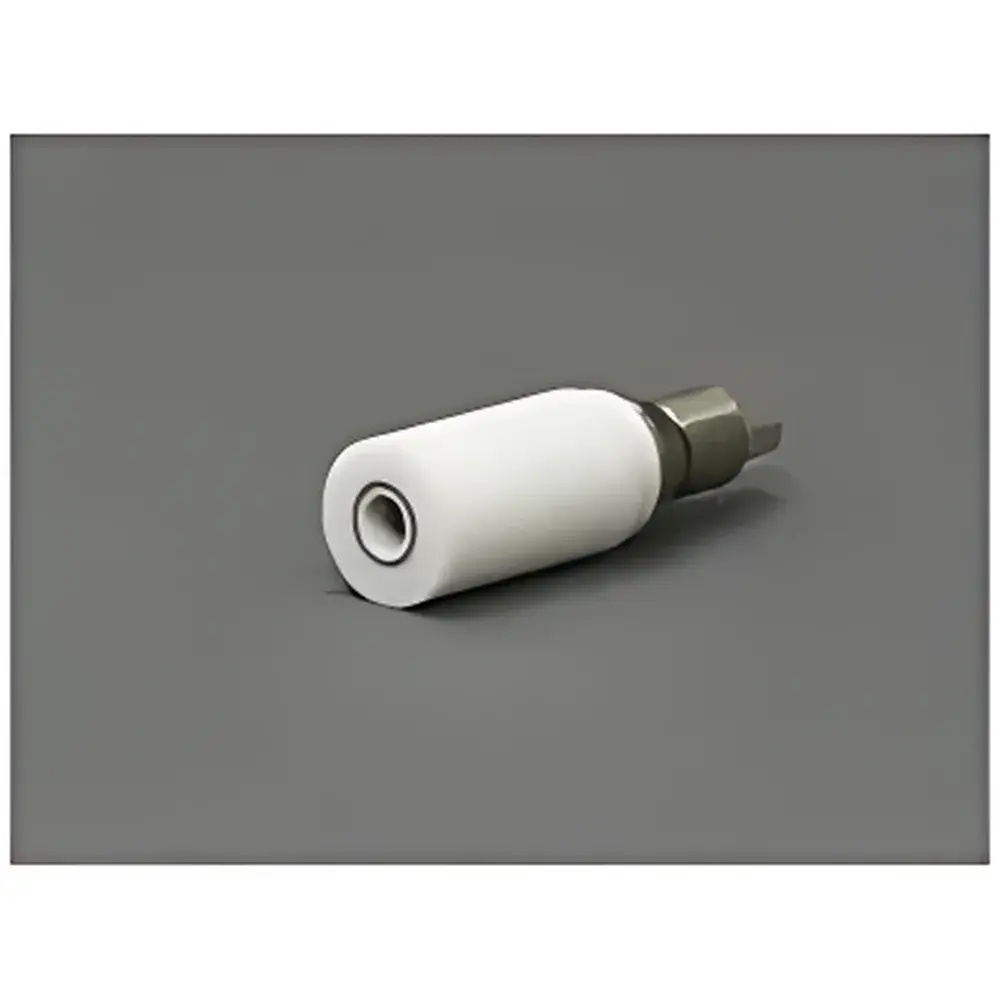
Rotating Ring-Disk Electrode (RRDE) with Interchangeable Disk – dc-energies
| Brand | dc-energies |
|---|---|
| Disk Diameter | 5.61 mm |
| Ring Outer Diameter | 15.0 mm |
| Material | Glassy Carbon Disk / Platinum Ring |
| Insulator | PTFE Shroud |
| Max Rotation Speed | 3000 rpm |
| Collection Efficiency | 37% |
| Operating Temperature | ≤25 °C |
| Origin | Hubei, China |
| Instrument Type | Electrochemical Working Electrode |
Overview
The dc-energies Rotating Ring-Disk Electrode (RRDE) with interchangeable disk is a precision-engineered electrochemical sensor designed for mechanistic studies of redox reaction intermediates, catalytic turnover, and electrode kinetics in controlled-hydrodynamic environments. Based on the classical Levich–Koutecký framework, this RRDE operates under well-defined laminar flow conditions governed by the rotating disk electrode (RDE) hydrodynamics, while the concentric platinum ring enables real-time detection or quantification of transient species generated at the glassy carbon disk surface. The 37% collection efficiency—calibrated and verified per standard electrochemical protocols—ensures quantitative reliability for coupled redox processes such as O2 reduction, hydrogen peroxide detection, and metal complex decomposition pathways. Its PTFE shroud provides chemical inertness, electrical insulation, and dimensional stability across aqueous and non-aqueous electrolytes, supporting reproducible rotation up to 3000 rpm with minimal vibration-induced noise.
Key Features
- Interchangeable disk design allows rapid substitution of glassy carbon, platinum, gold, or modified electrodes without recalibration of ring-disk geometry or alignment.
- Precision-machined coaxial configuration: 5.61 mm diameter glassy carbon disk centered within a 15.0 mm outer diameter platinum ring, ensuring consistent radial gap and hydrodynamic uniformity.
- PTFE insulating shroud engineered for low dielectric loss, thermal stability below 25 °C, and resistance to strong acids, bases, and organic solvents commonly used in electrocatalysis and battery research.
- Optimized mechanical balance supports stable rotation at speeds from 100 to 3000 rpm, compatible with commercial potentiostats equipped with rotation control modules (e.g., Pine Research, BASi, Metrohm Autolab).
- Electrode body constructed from corrosion-resistant stainless steel with standardized 6-mm OD threaded interface for seamless integration into common rotating electrode holders and electrochemical cells.
Sample Compatibility & Compliance
This RRDE is validated for use in standard three-electrode electrochemical cells containing aqueous electrolytes (e.g., 0.1 M H2SO4, 0.1 M KOH, phosphate-buffered saline) and aprotic media (e.g., acetonitrile + 0.1 M TBAPF6). It complies with fundamental requirements outlined in ASTM G102 (Standard Practice for Calculation of Corrosion Rates), ISO 16773-2 (Electrochemical impedance spectroscopy for coatings), and supports experimental workflows aligned with IUPAC recommendations for rotating electrode characterization. While not certified to GLP or GMP standards as a standalone component, its geometric consistency and material traceability enable full auditability in regulated R&D environments when paired with compliant instrumentation and SOPs.
Software & Data Management
The RRDE functions as a hardware transducer and does not include embedded firmware or proprietary software. Data acquisition is performed via external potentiostat systems supporting synchronized potential control, current measurement, and rotation speed input/output (e.g., analog tachometer signal or digital TTL trigger). Compatible platforms include EC-Lab (BioLogic), NOVA (Metrohm), GPES (Radiometer), and open-source tools such as PyChrono or custom Python-based scripts interfacing with NI DAQ or Arduino-based rotation controllers. All collected chronoamperometric, cyclic voltammetric, and ring-disk correlation data are stored in vendor-neutral formats (e.g., .txt, .csv, .mpt) suitable for post-processing in MATLAB, OriginPro, or Python (SciPy/Pandas) for Koutecký–Levich analysis, collection efficiency validation, and kinetic modeling.
Applications
- Quantitative detection of reactive oxygen species (e.g., H2O2) during oxygen reduction reaction (ORR) on fuel cell catalysts.
- Elucidation of reaction intermediates in electrochemical CO2 reduction, including adsorbed *CO and C2H4 precursors.
- Stability assessment of redox mediators in flow batteries and liquid-phase energy storage systems.
- Kinetic deconvolution of coupled chemical–electrochemical (EC) and electrochemical–chemical–electrochemical (ECE) mechanisms.
- Calibration and validation of rotating disk electrode theory in undergraduate and graduate electrochemistry laboratories.
FAQ
Is the disk truly interchangeable without affecting collection efficiency?
Yes—the mechanical interface ensures repeatable axial positioning and radial alignment. Provided the replacement disk maintains identical outer diameter and flush seating within the PTFE shroud, the 37% collection efficiency remains invariant.
Can this RRDE be used above 25 °C?
Operation above 25 °C is not recommended due to PTFE thermal expansion effects that may compromise seal integrity and hydrodynamic reproducibility.
What cleaning protocols are advised before reuse?
Mechanical polishing (0.05 µm alumina slurry on microcloth), followed by sonication in ethanol and Milli-Q water, then electrochemical activation in 0.5 M H2SO4 via cyclic voltammetry between −0.2 and +1.2 V vs. RHE.
Does dc-energies provide calibration certificates?
Geometric calibration data (disk/ring dimensions, gap distance) is supplied with each unit. Electrochemical collection efficiency verification must be performed in-house using standard redox couples (e.g., ferrocene/ferricenium in CH3CN).



