
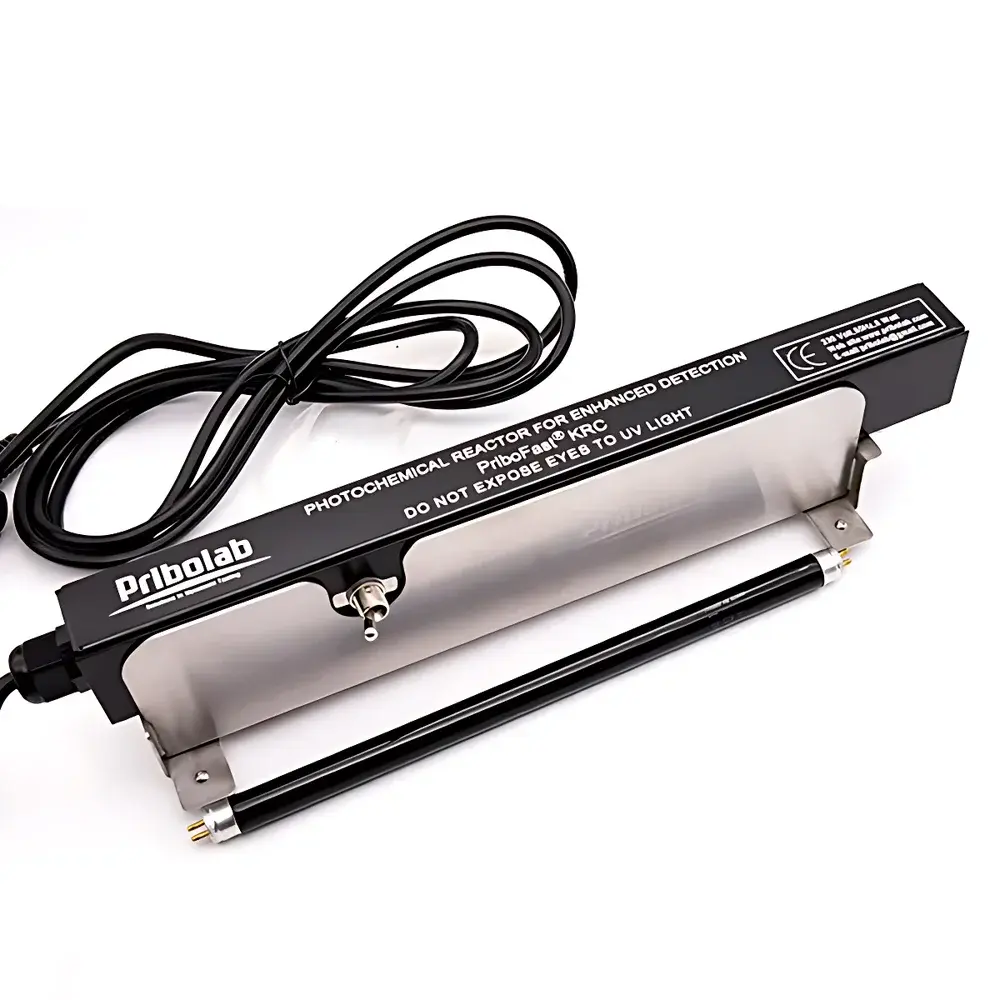
Pribolab KRC-200 Photochemical Post-Column Derivatization System
| Brand | Pribolab |
|---|---|
| Origin | Shandong, China |
| Model | KRC-200 |
| Derivatization Light Source | Dual-wavelength UV (254 nm / 352 nm) |
| Flow Rate Range | 0.6–2.0 mL/min |
| Optimal Flow Rate | 1.2 mL/min |
| Reaction Cell Volume | 1 mL |
| Maximum Pressure Rating | 10 MPa |
| Wavelength Accuracy | ±1 nm |
| Wavelength Repeatability | ±2 nm |
| Bandwidth | 2 nm |
| Light Source Lifetime | ≥8000 h |
| Dimensions (H×W×D) | 88 mm × 90 mm × 420 mm |
| Operating Temperature | 0–45 °C |
| Relative Humidity | 20–85 % RH |
| Power Supply | 220 V ±10 %, 50 Hz ±2 % |
| Compliance | AOAC 2005.08, AOCS Aa11-05, Ph. Eur. 2.8.18, Chinese National Standards & ChP Methods |
Overview
The Pribolab KRC-200 Photochemical Post-Column Derivatization System is an engineered solution for enhancing the fluorescence detection sensitivity of analytes that exhibit weak native fluorescence or lack fluorophore functionality under standard HPLC conditions. It operates on the principle of UV-mediated photochemical derivatization—specifically utilizing controlled 254 nm and 352 nm ultraviolet irradiation to induce structural rearrangement in target compounds, thereby generating strongly fluorescent derivatives without chemical reagents. This system is purpose-built for regulatory-compliant analysis of aflatoxins B₁ and G₁ in food, feed, and pharmaceutical matrices, where it delivers detection limits consistently below 0.1 ng/mL when coupled with high-sensitivity fluorescence detectors. Its design eliminates reliance on hazardous chemical derivatizing agents (e.g., bromine, iodine, or ortho-phthalaldehyde), reducing operator exposure risk, minimizing system contamination, and eliminating post-derivatization column flushing requirements. The KRC-200 integrates seamlessly into existing HPLC workflows as a modular inline component, supporting uninterrupted gradient elution and robust long-term operation.
Key Features
- Photochemical derivatization using dual-wavelength UV lamps (254 nm and 352 nm) with wavelength accuracy ±1 nm and bandwidth ≤2 nm—optimized for selective activation of aflatoxin B₁/G₁ and other photolabile analytes.
- Stainless steel chassis with matte black anodized coating ensures electromagnetic shielding, thermal stability, and resistance to solvent vapor corrosion in laboratory environments.
- 1 mL reaction coil housed in a pressure-rated flow cell (max. 10 MPa) enabling compatibility with UHPLC systems operating at elevated backpressures.
- No reagent delivery pumps, mixing tees, or waste lines—reducing failure points and eliminating routine maintenance associated with chemical derivatization modules.
- Compact footprint (88 × 90 × 420 mm) allows benchtop installation adjacent to HPLC detectors without requiring dedicated cabinets or ventilation.
- Compliance-ready architecture: fully supports audit trails, parameter logging, and instrument configuration records required under GLP and GMP frameworks.
Sample Compatibility & Compliance
The KRC-200 is validated for use with a broad spectrum of UV-responsive analytes beyond aflatoxins—including barbiturates, amino acids, peptides, vitamins (e.g., vitamin B₂, B₆), sulfonamides, and certain mycotoxins such as ochratoxin A under specific irradiation conditions. It conforms to internationally recognized analytical standards including AOAC Official Method 2005.08 and AOCS Official Method Aa 11-05 for aflatoxin determination in cereals and nuts, as well as European Pharmacopoeia monograph 2.8.18 for residual mycotoxin testing in herbal substances. In China, the system supports implementation of GB 5009.22–2016 (National Food Safety Standard for Determination of Aflatoxins in Foods) and Chinese Pharmacopoeia (ChP) 2020 Edition General Chapter 2351. All operational parameters—including lamp intensity, flow rate, and dwell time—are adjustable within defined ranges to meet method-specific validation criteria per ICH Q2(R2) guidelines.
Software & Data Management
While the KRC-200 operates as a standalone hardware module without embedded firmware or touchscreen interface, its performance parameters are fully traceable via external HPLC data systems. Lamp operating hours, incident UV intensity (monitored via integrated photodiode feedback), and real-time flow rate inputs can be logged through compatible chromatography data systems (CDS) such as Agilent OpenLab CDS, Waters Empower, or Shimadzu LabSolutions. The device supports 21 CFR Part 11-compliant electronic record generation when paired with validated CDS configurations, including user authentication, audit trail activation, and electronic signature capability. Instrument configuration files—including lamp calibration dates, replacement history, and maintenance logs—are maintained externally in accordance with ISO/IEC 17025 documentation requirements.
Applications
The KRC-200 serves critical roles across food safety laboratories, contract research organizations (CROs), and pharmaceutical quality control units performing regulated testing. Primary applications include quantitative determination of aflatoxin B₁ and G₁ in corn, peanuts, spices, dairy products, and infant formula; screening of sulfonamide antibiotics in animal-derived foods; and stability-indicating assays for light-sensitive APIs during forced degradation studies. Its reagent-free operation makes it especially suitable for cleanroom environments and laboratories implementing green chemistry principles. The system has been adopted in multi-laboratory collaborative trials coordinated by CNAS-accredited reference labs for interlaboratory method transfer and proficiency testing programs aligned with ILAC-G13.
FAQ
Does the KRC-200 require chemical reagents or consumables beyond UV lamps?
No. It performs derivatization solely via controlled UV irradiation; no derivatization reagents, pumps, or mixing hardware are needed.
Can the KRC-200 be used with UHPLC systems operating above 600 bar?
Yes. Its reaction cell is rated to 10 MPa (100 bar), and the stainless steel flow path accommodates typical UHPLC backpressures when installed post-column but pre-detector.
How is lamp performance monitored over time?
Integrated photodiode sensors provide real-time UV output feedback, and cumulative lamp hours are tracked externally via CDS or lab notebook entries per preventive maintenance schedules.
Is method validation support available from Pribolab?
Pribolab provides application notes, system suitability test protocols, and IQ/OQ documentation templates aligned with ISO/IEC 17025 and FDA guidance for instrument qualification.
What is the expected lifetime of the UV lamps under continuous operation?
Rated minimum lifetime is 8,000 hours at nominal output; actual service life depends on duty cycle, ambient temperature, and power supply stability.




