
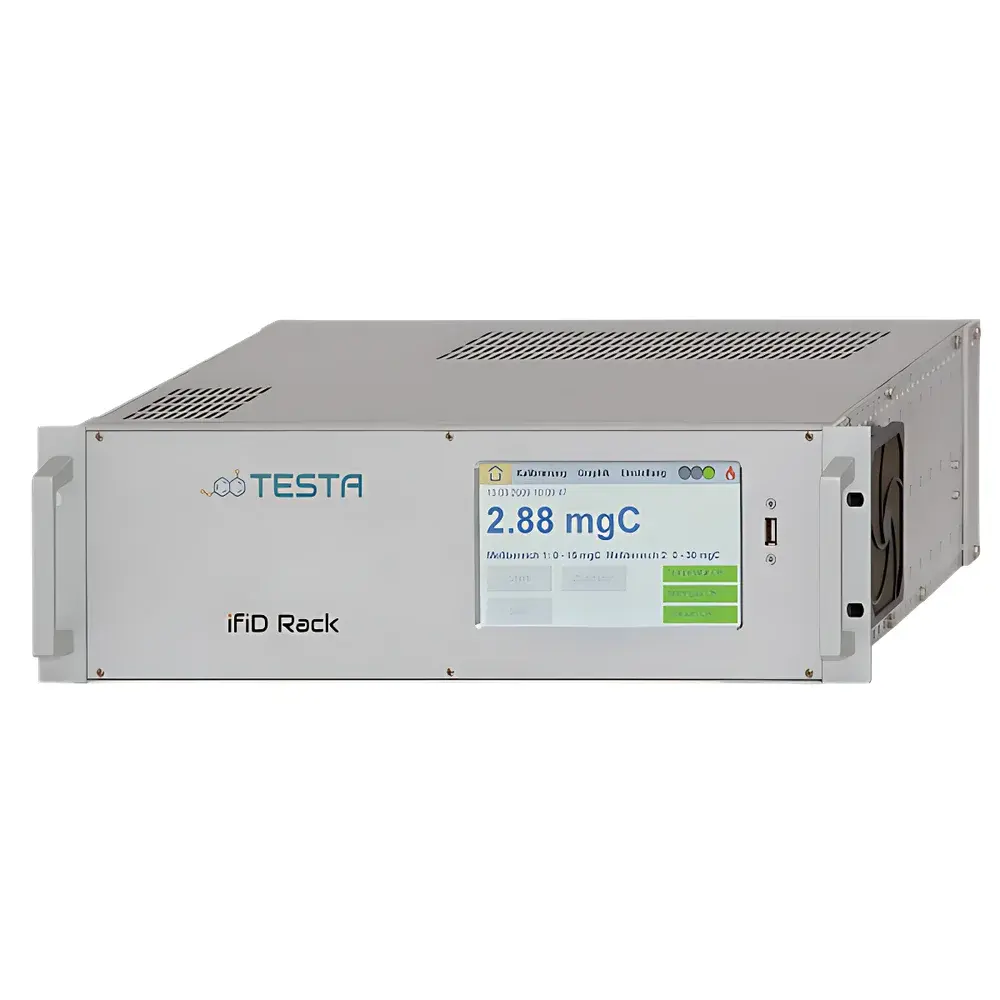
Testa iFiD Rack Online Total Hydrocarbon Analyzer
| Brand | Testa |
|---|---|
| Origin | Germany |
| Model | iFiD Rack |
| Detection Principle | Flame Ionization Detection (FID) |
| Instrument Type | Online Analyzer |
| Measurement Range | 0–10,000 ppmC₁ (as methane equivalent) |
| Response Time | 1 s (T₉₀) |
| Detector Temperature | 190 °C |
| Sample Line Heating | Up to 300 °C |
| Repeatability | ±1% of full scale |
| Zero Drift | ±1% FS over 24 h |
| Warm-up Time | 15 min |
| Analog Output | 0–20 mA / 0–10 V |
| Digital Interface | Ethernet, RS232 |
| Data Storage | USB |
| Remote Access | VNC-compatible |
| Power Supply | 100–240 V AC, 50–60 Hz, 350 W |
| Operating Ambient Temperature | 0–45 °C |
| Enclosure Rating | IP40 |
| Dimensions | 19″ Rack Mount (133 × 482 × 420 mm) |
| Weight | 15 kg |
| Fuel Gas | H₂ (Grade 5) or He/H₂ mixture |
| Carrier/Combustion Air | Internal pump, pressure-compensated (−150 to +500 hPa) |
| Calibration Gas | Propane (C₃H₈) |
| Zero Gas | N₂ or synthetic air |
| Fuel Consumption | 30 mL/min (H₂) |
| Calibration Flow | 1 L/min (iFiD Rack & iFiD NMHC), 2 L/min (iFiD Dual) |
Overview
The Testa iFiD Rack is a high-stability, rack-mounted online total hydrocarbon (THC) analyzer engineered for continuous, real-time measurement of volatile organic compounds (VOCs) in industrial and environmental emission streams. It employs flame ionization detection (FID), a well-established, linear, and highly sensitive technique standardized in ASTM D6348, ISO 12039, and EN 12619 for gaseous hydrocarbon quantification. Unlike photometric or PID-based systems, FID delivers consistent response across aliphatic, aromatic, and olefinic species — independent of molecular structure — making it the reference method for regulatory THC reporting. The iFiD Rack integrates heated sample conditioning (up to 300 °C), thermally stabilized detector operation at 190 °C, and active pressure compensation (−150 to +500 hPa) to ensure robust performance under fluctuating process conditions. Its compact 19″ rack form factor supports integration into existing control cabinets or centralized monitoring skids without requiring external enclosures.
Key Features
- Rack-mountable 19″ design (133 × 482 × 420 mm) with IP40-rated enclosure for laboratory and industrial control room deployment
- FID detector with 190 °C operating temperature and integrated high-temperature ceramic filter (300 °C rated) to prevent condensable interference and particulate fouling
- Sub-second response time (T₉₀ ≤ 1 s) enabled by optimized gas dynamics, low-dead-volume flow paths, and rapid flame stabilization
- Onboard pressure compensation system maintains measurement integrity across variable stack or duct static pressures
- Integrated fuel and combustion air management: internal pump, precise mass-flow-controlled H₂ (or He/H₂) delivery, and auto-regulated air supply
- Full analog (0–20 mA / 0–10 V) and digital (Ethernet + RS232) I/O with VNC-enabled remote interface for configuration, diagnostics, and live data viewing
- USB-local data logging (time-stamped concentration, status flags, calibration events) compliant with basic GLP audit-trail requirements
Sample Compatibility & Compliance
The iFiD Rack is validated for use with ambient air, flue gas, biogas, engine exhaust, and process vent streams containing C₁–C₁₂ hydrocarbons. Its heated sample train (up to 300 °C) prevents condensation of higher-boiling VOCs (e.g., xylenes, decane), ensuring representative sampling from humid or thermally unstable sources. Optional modules — including non-methane hydrocarbon (NMHC) subtraction via methane-specific catalytic oxidation and dual-channel sampling for parallel THC/NMHC analysis — extend compliance with EU IED (2010/75/EU), US EPA Method 25A, and China’s HJ 1012–2018. All firmware and calibration protocols support traceable documentation per ISO/IEC 17025 and are compatible with FDA 21 CFR Part 11 when deployed with validated third-party SCADA or LIMS interfaces.
Software & Data Management
The built-in 7″ TFT touchscreen provides intuitive local operation: real-time concentration display (mgC/m³ or ppmC₁), system health dashboard, alarm configuration (high/low limits, fault codes), and guided calibration workflows. Data export is supported via USB in CSV format with UTC timestamps, detector voltage, flow rates, and temperature logs. Ethernet connectivity enables seamless integration with Modbus TCP or OPC UA servers for plant-wide data aggregation. Firmware updates and remote troubleshooting are performed securely via VNC — eliminating the need for on-site technician visits. While the base unit does not include full 21 CFR Part 11 electronic signature functionality, its audit-log architecture (user login, parameter changes, calibration records) serves as a foundation for GMP/GLP-compliant validation when paired with enterprise-grade data historians.
Applications
- Continuous emissions monitoring (CEMS) of THC from thermal oxidizers, incinerators, and chemical reactors
- Real-time TVOC surveillance in automotive interior material off-gassing test chambers (aligned with VDA 278 and ISO 12219-4)
- Process optimization and safety interlock in biogas upgrading, landfill gas recovery, and syngas production
- Engine development testing — transient THC tracking during cold-start, load sweeps, and aftertreatment evaluation
- Quality assurance in hydrogen fuel production and purification lines where hydrocarbon impurities must remain below 0.1 ppmC₁
FAQ
What calibration gases are required for routine operation?
Propane (C₃H₈) in nitrogen at certified concentrations (e.g., 100 ppmC₁, 1000 ppmC₁) is recommended for span calibration; high-purity nitrogen or synthetic air serves as zero gas. Calibration frequency depends on application criticality but typically ranges from daily (emission compliance) to weekly (process monitoring).
Can the iFiD Rack measure methane separately?
The base iFiD Rack measures total hydrocarbons only. Methane-selective measurement requires the optional iFiD NMHC configuration, which incorporates a methanizer-catalyst bypass and dual-FID channel subtraction logic.
Is external sample conditioning required?
No — the integrated 300 °C heated filter and sample line eliminate the need for external chillers or coalescing filters in most applications. However, for streams containing >10 ppm H₂S or halogenated organics, an upstream stainless-steel scrubber is advised to protect detector longevity.
How is fuel gas supplied and monitored?
Hydrogen (Grade 5, ≤1 ppm O₂) is delivered via regulated inlet; consumption is actively metered (30 mL/min nominal). A low-fuel alarm triggers automatic shutdown to prevent detector damage. Optional He/H₂ blends are supported for specific regulatory or safety requirements.
Does the system support automated zero/span sequences?
Yes — programmable auto-calibration cycles can be scheduled via the touchscreen or external PLC trigger (digital input). All events are logged with metadata, supporting routine QA/QC documentation.







