
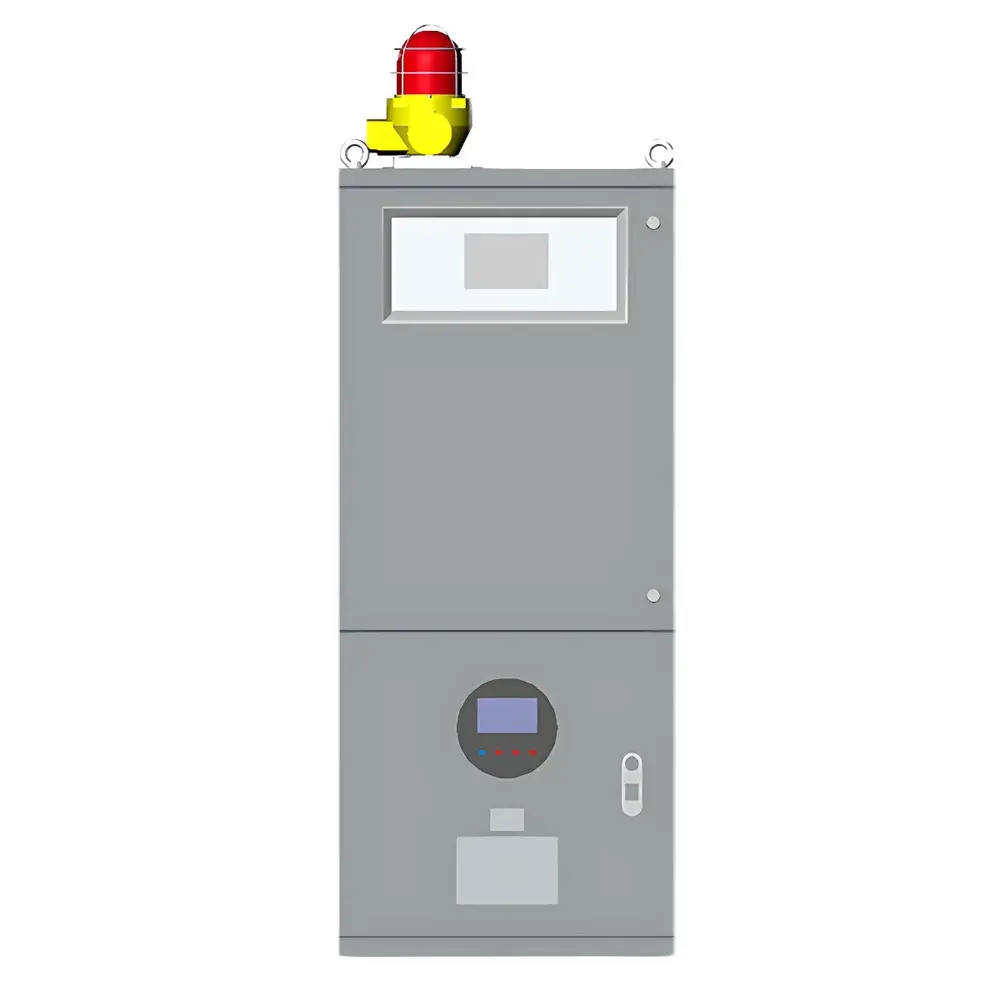
ONUEE UE55 Online Total Hydrocarbon Analyzer
| Brand | ONUEE |
|---|---|
| Origin | Guangdong, China |
| Manufacturer Type | Authorized Distributor |
| Product Origin | Domestic (China) |
| Model | UE55 |
| Detection Principle | Flame Ionization Detection (FID) |
| Instrument Type | Online Continuous Analyzer |
| Measurement Range | 5 selectable full-scale ranges with auto-ranging capability |
| Response Time (T90) | <1.5 s |
Overview
The ONUEE UE55 Online Total Hydrocarbon Analyzer is a robust, continuous-emission monitoring system engineered for precise quantification of total hydrocarbons (THC) — expressed as organic carbon (mg C/m³ or ppm C₃H₈-equivalent) — in industrial process and exhaust streams. Utilizing flame ionization detection (FID), the UE55 achieves high sensitivity, wide dynamic range, and exceptional stability under demanding field conditions. Unlike laboratory-based GC-FID systems, the UE55 operates as a fully integrated, real-time online analyzer with no chromatographic separation: all combustible hydrocarbons entering the detector are pyrolyzed in a hydrogen-air flame, generating ions proportional to carbon mass flow. This principle ensures linear response across volatile organic compounds (VOCs) regardless of molecular structure — making it ideal for regulatory compliance monitoring where compound-specific identification is not required, but total carbon mass concentration is mandated (e.g., EPA Method 25A, EN 12619, ISO 13845). The instrument’s heated sample path — maintained at 200 °C from probe inlet through detector — eliminates condensation-related bias, enabling reliable operation in high-humidity, low-temperature, or high-boiling-point VOC applications such as biogas upgrading, catalytic oxidizer effluent, and activated carbon regeneration off-gas.
Key Features
- Fully heated gas path (200 °C) including sampling probe, heated tubing (up to 5 m), filter housing, and FID chamber — prevents condensation and adsorption losses across C₁–C₁₂ hydrocarbons
- Five user-configurable measurement ranges (e.g., 0–10 ppm to 0–10 vol.% C₃H₈), with automatic range switching and on-the-fly span adjustment via embedded microprocessor
- Integrated pressure regulation and flow control (±0.1 bar stability) ensuring consistent detector response independent of upstream process fluctuations
- Modular architecture supporting optional add-ons: non-methane hydrocarbon (NMHC) bypass module (using catalytic methane removal), zero-air catalytic converter, and heated particulate filtration
- Low-power hydrogen consumption design (1.8 L/h at 3 bar) compliant with Class 5 purity standards (<0.5 ppm residual hydrocarbons); air supply provided by internal oil-free diaphragm pump with carbon or catalytic hydrocarbon scrubber
- Industrial-grade enclosure available in both non-explosion-proof (IP54) and pressurized explosion-proof (IP65, ATEX/IECEx Zone 1 certified) configurations
- Real-time diagnostics, self-calibration prompts, and event-logged maintenance alerts aligned with GLP/GMP traceability requirements
Sample Compatibility & Compliance
The UE55 accommodates gaseous samples with temperatures up to 300 °C and flow rates of ~50 L/h. It is compatible with standard 1/8″ OD or 6 mm stainless-steel pneumatic fittings or quick-connect couplings. All wetted materials — including FID jet, collector electrode, and sample line components — are passivated stainless steel or high-purity alumina ceramics. Oxygen interference is characterized at <1.8% relative error at 80 ppm C₃H₈, meeting EN 15267-3 performance criteria for continuous emission monitoring systems (CEMS). The analyzer supports calibration traceability to NIST-traceable propane-in-air standards (80% span) and meets key regulatory frameworks including EPA Performance Specification 8 (PS-8), EU Directive 2010/75/EU (IED), and China’s HJ 1012-2018 standard for online THC analyzers. Data integrity complies with ALCOA+ principles; audit trails, electronic signatures, and configuration change logs are retained onboard.
Software & Data Management
The UE55 runs a deterministic real-time OS with an embedded ARM-based controller. Its web-accessible interface (via built-in Ethernet port and VNC support) enables remote configuration, live trend visualization, alarm management, and firmware updates. Measurement data — including raw FID current, temperature/pressure readings, status flags, and diagnostic codes — are stored internally in XML format with timestamped UTC synchronization. Data export is performed via USB mass storage mode directly to Excel-compatible CSV or native XML files. Analog outputs (0/4–20 mA and 0–10 V) are fully isolated and configurable per channel; digital communication includes RS232 (ASCII protocol) and Modbus TCP. All data handling conforms to FDA 21 CFR Part 11 requirements when deployed in regulated pharmaceutical or fine chemical manufacturing environments.
Applications
- Continuous monitoring of THC in engine exhaust (diesel, natural gas, biogas-fueled) for RDE and PEMS validation
- Emission compliance tracking at catalytic oxidizers, thermal oxidizers (TO), and regenerative thermal oxidizers (RTO)
- Process optimization and catalyst health assessment in syngas cleaning, Fischer–Tropsch tail-gas, and coke oven gas purification
- Real-time NMHC monitoring (when paired with non-methane module) for ozone precursor reporting per EEA Air Quality Directive
- Leak detection and repair (LDAR) program support in petrochemical refineries and polymer production facilities
- Biological treatment off-gas analysis (e.g., biofilters, bioscrubbers) where rapid T90 response is critical for control loop integration
FAQ
What detection principle does the UE55 use, and why is FID preferred for total hydrocarbon measurement?
The UE55 employs flame ionization detection (FID), which responds nearly equally to all organic compounds containing C–H bonds. This uniformity — combined with wide linear dynamic range and insensitivity to water vapor — makes FID the reference method for regulatory THC quantification where compound-specific GC analysis is impractical.
Can the UE55 measure non-methane hydrocarbons (NMHC) out-of-the-box?
No. NMHC measurement requires the optional non-methane bypass module, which uses a selective catalytic converter to oxidize methane while preserving other hydrocarbons for differential FID quantification.
Is hydrogen fuel gas supplied externally, and what purity is required?
Yes — high-purity hydrogen (Grade 5, ≤0.5 ppm total hydrocarbons, 3.0 ±0.2 bar) must be supplied from an external source; onboard generation is not supported.
How often does the UE55 require calibration, and what gases are needed?
Initial calibration uses propane-in-air at 80% of selected range; zero gas is purified air or nitrogen. Under typical industrial conditions, calibration verification is recommended every 7–14 days, with full calibration every 4 weeks per EN 14181 QAL2 requirements.
Does the UE55 support integration into existing DCS or SCADA systems?
Yes — via isolated 4–20 mA analog outputs, Modbus TCP over Ethernet, or ASCII protocol over RS232; all signals are mapped to standardized process tags (e.g., “THC_ppm”, “FID_Temp_C”, “Alarm_Status”).







