
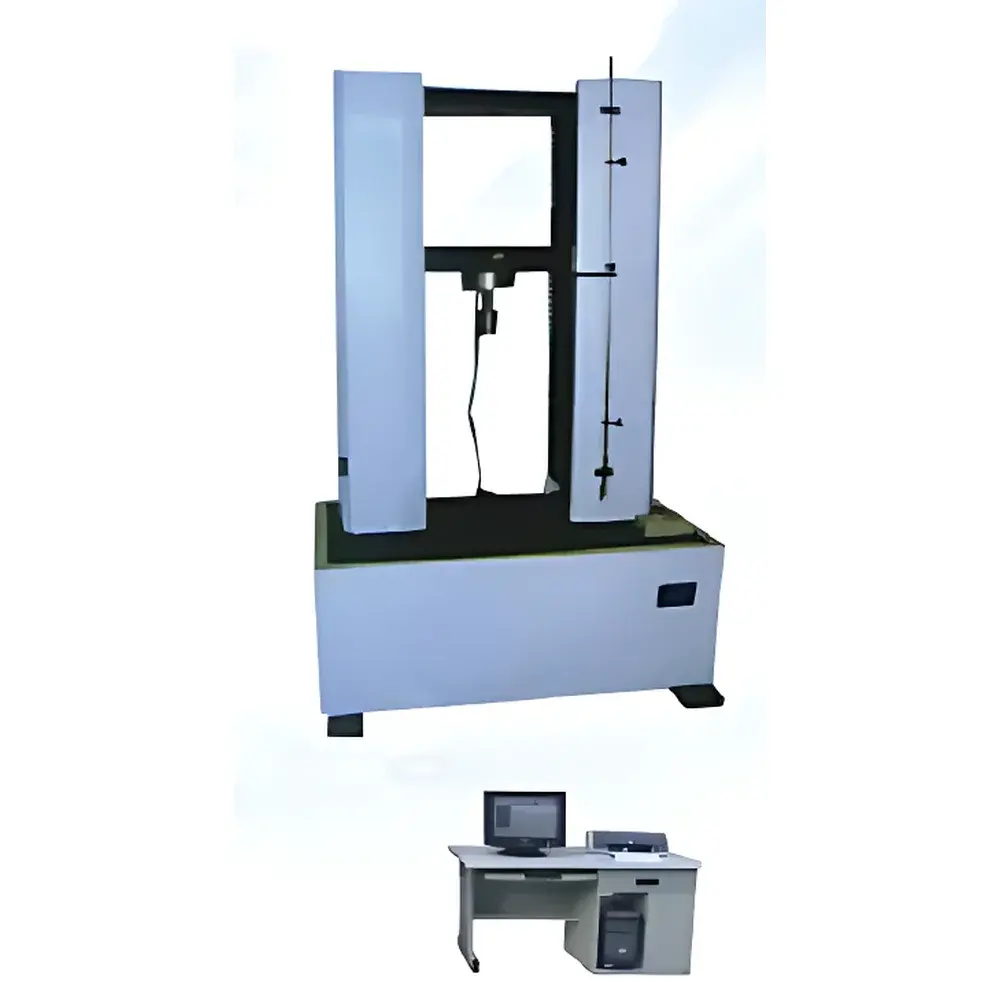
JuBin JB-124 Universal Testing Machine (UTM) – Taiwan-Made Electromechanical Tensile and Compression Tester
| Brand | JuBin |
|---|---|
| Origin | Taiwan |
| Model | JB-124A / JB-124B |
| Load Capacity | 0–5 ton (user-selectable) |
| Force Sensing | High-precision U.S.-sourced load cell |
| Force Accuracy | ≤0.5% of full scale |
| Effective Test Width | 380 mm |
| Max. Tensile Travel | 1000 mm |
| Drive System | Servo motor (Japan) + AC motor (Taiwan) |
| Mechanical Transmission | Precision ball screw (Taiwan) + High-strength backlash-free screw (Korea) |
| Test Speed Range | 0.001–500 mm/min (infinitely variable, dual-range options) |
| Displacement Accuracy | ±0.005% |
| Resolution | 1/200,000 |
| Safety Features | Upper/lower mechanical limits, emergency stop button |
| Display Interface | Dual-mode — PC-based software + embedded microcomputer display |
| Unit Options | g, kg, N, kN, lb, lbf |
| Power Supply | 220 V / 380 V, 50 Hz |
| Net Weight | 1080–1180 kg |
| Dimensions (W×D×H) | 1280 × 950 × 1800 mm |
| Fixture | One standard set (customizable per sample requirements) |
| Optional Accessories | PC host, desktop printer, extensometer, proprietary test software |
Overview
The JuBin JB-124 Series Universal Testing Machine (UTM) is a floor-standing, electromechanical static materials tester engineered for high-reproducibility tensile, compression, flexural (3-point bend), shear, peel, and tear testing across industrial R&D, quality control, and production environments. Based on classical Hookean force-displacement transduction principles, the system integrates a precision load cell (U.S.-manufactured), closed-loop servo-controlled actuation, and real-time digital signal acquisition to deliver traceable mechanical property data in compliance with ASTM E4, ISO 7500-1, and GB/T 228.1 standards. Designed and assembled in Taiwan, the JB-124 platform adheres to IEC 61000 electromagnetic compatibility requirements and meets CE machinery directive safety architecture (EN ISO 13857). Its modular construction—featuring plug-in subsystem interconnectivity between controller, drive, sensor, and PC interface—supports rapid maintenance, calibration traceability, and long-term operational stability under continuous duty cycles.
Key Features
- Bi-modal load capacity configuration: user-selectable 0–5 ton full-scale range, optimized for both low-force polymer characterization and high-load metal component validation.
- Dual-speed actuation architecture: infinitely variable speed control from 0.001 mm/min (for creep/stress-relaxation studies) to 500 mm/min (for dynamic failure analysis), with dedicated low-speed (0.001–5 mm/min) and high-speed (5–500 mm/min) operating modes.
- High-fidelity motion transmission: Taiwanese precision-ground ball screws coupled with Korean backlash-free lead screws ensure axial rigidity >1.2 × 10⁶ N/mm and positional repeatability <±0.005% of stroke.
- Redundant safety system: dual mechanical end-limit switches, hardware-level emergency stop circuitry, and software-enforced travel boundaries compliant with EN ISO 13850.
- Multi-unit measurement support: automatic unit conversion among metric (N, kN, kgf) and imperial (lbf, lb) systems without recalibration; resolution maintained at 1 part in 200,000 of full scale.
- Hybrid display architecture: synchronized real-time visualization via embedded microcomputer panel and Windows-based PC software—enabling simultaneous local monitoring and networked data logging.
Sample Compatibility & Compliance
The JB-124 accommodates specimens ranging from thin films (≥0.05 mm thickness) to structural steel coupons (up to 50 mm cross-section), with standard 380 mm test width accommodating ASTM D638 Type I–V, ISO 527-2, and GB/T 1040.1 specimen geometries. Clamp configurations—including wedge-action pneumatic grips, vise-type mechanical grips, and custom-designed fixtures—are fully interchangeable using ISO 26201-compliant mounting interfaces. All force and displacement measurements are calibrated per ISO/IEC 17025-accredited procedures, with certificate documentation supporting GLP/GMP audit readiness. The system satisfies FDA 21 CFR Part 11 requirements for electronic records when configured with optional audit-trail-enabled software and user-access controls.
Software & Data Management
The proprietary JB-TestSuite software provides ISO 17025-aligned test method templates (tensile, compression, bend, shear), automated parameter calculation (Young’s modulus, yield strength, elongation at break, secant modulus), and multi-curve overlay for batch comparison. Raw data export is supported in CSV, Excel (.xlsx), and XML formats compatible with LIMS integration. Built-in statistical tools enable Cp/Cpk analysis, Weibull distribution fitting, and SPC chart generation. All test events—including operator ID, timestamp, calibration status, and environmental metadata—are logged with immutable timestamps. Optional PDF report generation includes digital signature fields and configurable header/footer branding per organizational QA guidelines.
Applications
The JB-124 serves as a primary mechanical characterization tool in electronics manufacturing (connector crimp strength, PCB flexural endurance), automotive supply chains (rubber bushing compression set, brake pad shear resistance), medical device development (suture tensile integrity, catheter kink resistance), and textile QA (yarn tenacity, fabric tear propagation). It is routinely deployed for ASTM D882 (thin plastic films), ASTM D790 (flexural properties), ISO 6892-1 (metal tensile testing), and UL 94 vertical burn support fixture validation. Its 1000 mm vertical travel enables full-length testing of extruded profiles and composite laminates without sectioning.
FAQ
What standards does the JB-124 comply with for force calibration?
It conforms to ISO 7500-1 Class 0.5 accuracy requirements, with annual calibration traceable to NIST or NML-certified reference standards.
Can the system perform cyclic loading tests?
No—this is a static UTM; it does not support servo-hydraulic or high-frequency fatigue testing. For cyclic applications, consider JuBin’s JB-FAT series.
Is the software validated for regulated industries?
Yes—the optional 21 CFR Part 11-compliant version includes role-based access, electronic signatures, and full audit trail functionality.
What is the maximum specimen height that fits within the test zone?
With standard crosshead clearance, specimens up to 1000 mm in height may be tested under tension; compression testing allows up to 900 mm depending on base plate configuration.
Does the machine support third-party extensometry?
Yes—via analog voltage input (±10 V) and RS-232/USB interfaces, enabling integration with contactless video extensometers or clip-on strain gauges meeting ASTM E83 Class B requirements.



