
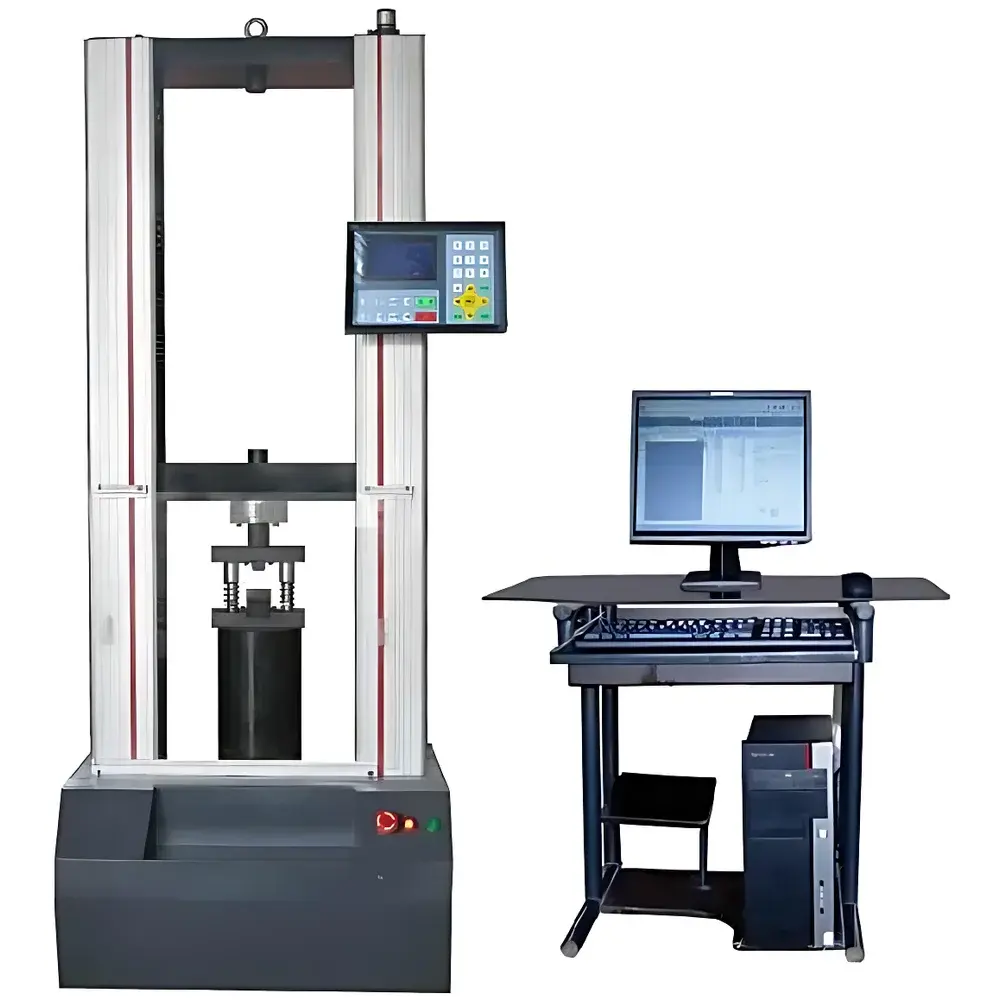
Jiubin Instruments JB-117Y Universal Testing Machine for Cemented Carbide Strength Evaluation
| Brand | Jiubin Instruments |
|---|---|
| Origin | Shanghai, China |
| Manufacturer Type | Authorized Distributor |
| Country of Origin | China |
| Model | JB-117Y |
| Price | Upon Request |
| Max Test Load | 50 kN |
| Force Accuracy | ±0.5% FS |
| Force Range | 0.25–50 kN (single-range, fully digital) |
| Displacement Resolution | 0.01 mm |
| Crosshead Speed | 0.01–200 mm/min (infinitely variable) |
| Tensile/Compression Test Space | 1000 mm |
| Test Width | 400 mm |
| Power Supply | 1.25 kW, 220 V, 50 Hz |
| Operating Environment | 10–35 °C, 20–80% RH |
Overview
The Jiubin Instruments JB-117Y Universal Testing Machine is an electromechanical static testing system engineered for high-precision mechanical property evaluation of cemented carbides and other high-strength engineering materials. It operates on the principle of controlled uniaxial loading—applying tensile, compressive, or flexural forces to standardized specimens while continuously measuring load, displacement, and deformation response. The system integrates a high-rigidity dual-space frame (tensile above, compression below), precision-ground ball screws, and a closed-loop AC servo drive with 1:5000 speed ratio, enabling stable, low-noise actuation across the full displacement and force spectrum. Designed in accordance with ISO 7500-1 (Class 0.5), ASTM E4, and GB/T 16491, the JB-117Y delivers traceable, reproducible results required for R&D validation, quality control, and regulatory documentation in advanced manufacturing environments.
Key Features
- Integrated PCI-based digital controller with real-time data acquisition, eliminating analog signal drift and enabling true hardware-level zeroing, gain calibration, and auto-ranging.
- High-fidelity 50 kN load cell (AC Sensors, USA) with ±0.5% full-scale accuracy, coupled to a 0.01 mm displacement encoder for sub-micron positional fidelity.
- Dual-space structural design: upper tensile zone and lower compression zone share a common crosshead, allowing rapid reconfiguration between test modes without recalibration.
- Intelligent speed control: programmable multi-step velocity profiles (e.g., pre-load at 1 mm/min, yield detection at 0.1 mm/min, post-fracture ramp-down) executed autonomously during test execution.
- Hardware-enforced safety architecture: dual-stage limit protection (mechanical stops + software-defined stroke boundaries), overload shutdown (>3–5% over range), and automatic halt upon specimen fracture.
- Fully digital force transduction path: no potentiometers or manual gain adjustments—calibration, zeroing, and range switching are performed algorithmically and stored in non-volatile memory.
Sample Compatibility & Compliance
The JB-117Y is supplied with dedicated cemented carbide bending fixtures (three-point and four-point configurations per ISO 3325 and GB/T 3851), optimized for brittle fracture characterization of WC-Co and TiC-based sintered alloys. It supports standardized specimen geometries per ASTM B528 (transverse rupture strength), ISO 4527 (bending strength of hardmetals), and DIN 50115. The system’s compliance extends to broader material classes—including metals, polymers, ceramics, composites, and thin films—via interchangeable grips and platens. All measurement algorithms adhere to ISO 5893 and ASTM E8/E9 for tensile/compression modulus, yield offset determination (0.2% proof stress), and strain-hardening exponent (n-value) derivation. Data integrity meets GLP/GMP requirements with audit-trail-enabled software; optional 21 CFR Part 11 compliance packages support FDA-regulated medical device and pharmaceutical packaging validation.
Software & Data Management
The Windows-native control software provides a role-based interface with configurable user permissions, multilingual support (English default), and intuitive mouse-driven operation. Real-time plotting displays synchronized force–displacement, stress–strain, and time-series curves with dynamic scaling. Post-test analysis includes curve traversal (point interrogation with interpolated values), comparative overlay of up to 12 datasets, and automated calculation of >25 mechanical parameters—including ultimate tensile strength (UTS), fracture toughness index (KIC approximation), elastic modulus (E), Poisson’s ratio (ν), and percentage elongation at break. Reports are exportable as PDF, Excel, or XML; raw ASCII data files include timestamped metadata (operator ID, environmental logs, calibration certificates). Network-ready Ethernet interface enables integration into centralized LIMS or MES platforms, supporting scheduled data push to SQL databases or cloud storage endpoints.
Applications
- Quality assurance of sintered tungsten carbide grades used in cutting tools, mining inserts, and wear-resistant components.
- Process development for binder-phase optimization (Co/Ni content, grain size distribution) via systematic bending strength correlation.
- Mechanical screening of PVD/CVD-coated carbide substrates under combined thermal–mechanical loading protocols.
- Validation of green-body strength prior to sintering, critical for powder metallurgy process control.
- Comparative evaluation of alternative hardmetal compositions (e.g., Cr3C2-Ni vs. WC-TiC-TaC) under identical test conditions.
- Supporting ISO/IEC 17025-accredited laboratory testing for third-party certification bodies.
FAQ
Does the JB-117Y comply with ISO 17025 calibration traceability requirements?
Yes—the system ships with NIST-traceable calibration certificates for both load cell and displacement encoder, valid for 12 months. Optional annual recalibration services include uncertainty budget documentation per ISO/IEC 17025 Annex A.
Can the machine perform cyclic loading or fatigue tests?
No—the JB-117Y is a static load frame only. For fatigue applications, Jiubin offers the JB-FAT series electrodynamic testers (ISO 1099 compliant).
Is the software compatible with Windows 11 and 64-bit architectures?
Yes—v5.3.2 and later versions support Windows 10/11 (64-bit), .NET Framework 4.8+, and DirectX 12 acceleration for high-refresh-rate curve rendering.
What is the lead time for custom fixture design?
Standard carbide bending fixtures ship with the system. Custom fixtures (e.g., micro-bend, ring-on-ring, or notched specimens) require 3–4 weeks from drawing approval.
Does the system support third-party data acquisition integration?
Yes—open TCP/IP and Modbus RTU APIs allow bidirectional communication with external DAQ systems, thermal chambers, or DIC optical strain measurement hardware.
Related Products



