
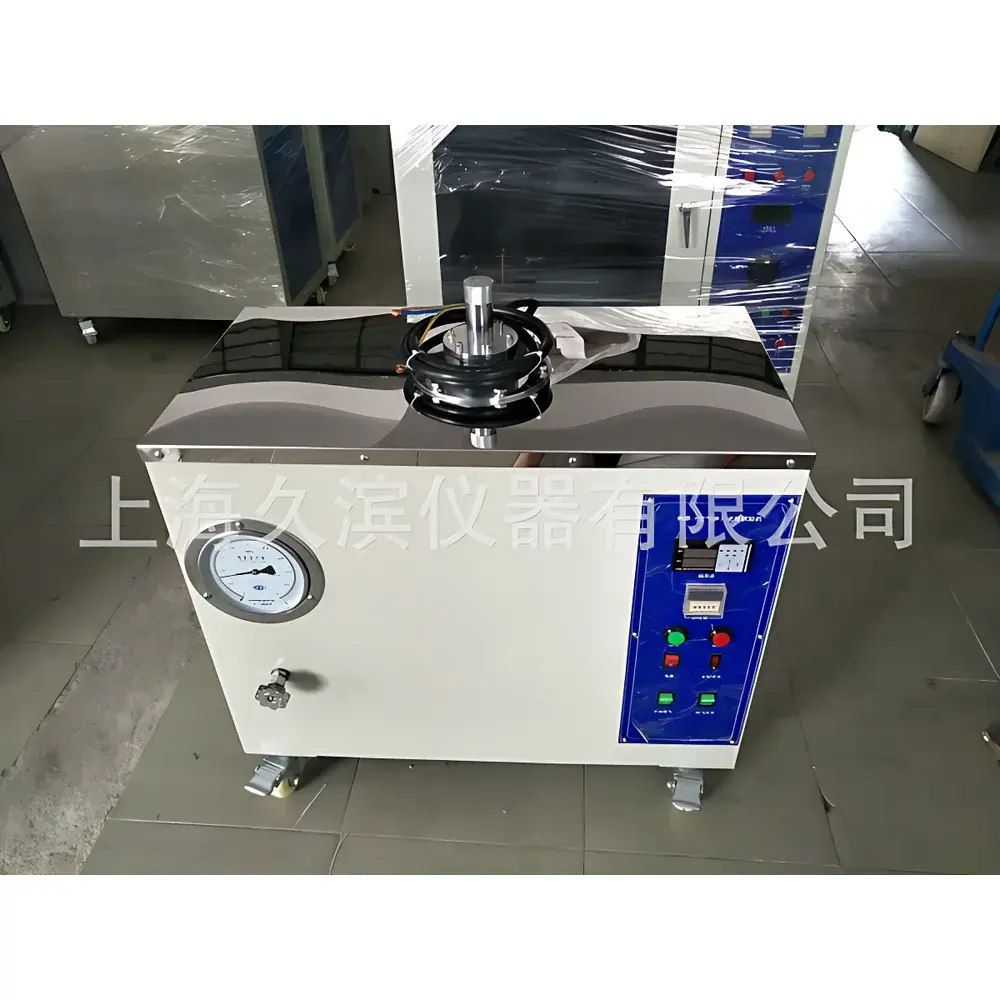
Jiubin JB-4000 Air Bomb & Oxygen Bomb Aging Chamber for Wire and Cable Materials
| Brand | Jiubin |
|---|---|
| Model | JB-4000 |
| Origin | Shanghai, China |
| Power Supply | 220 V AC ±10% |
| Max Working Pressure | 2.5 MPa |
| Burst Pressure | 2.7–3.3 MPa |
| Temperature Control Range | Ambient to 200 °C |
| Temperature Uniformity | ±0.5 °C |
| Chamber Volume | 4000 cm³ |
| External Dimensions | 560 × 420 × 670 mm |
| Heating Power | 2.4 kW |
| Temperature Display | Digital, Intelligent PID Control |
| Inner Vessel Material | Stainless Steel (AISI 304) |
| Outer Casing | Cold-Rolled Steel with Electrostatic Powder Coating |
| Compliance | GB/T 2951.12–2008, GB/T 5013–2008, VDE 0282 |
Overview
The Jiubin JB-4000 Air Bomb & Oxygen Bomb Aging Chamber is a precision-controlled accelerated aging system engineered for evaluating the thermal-oxidative stability of polymeric insulating and sheathing materials used in electrical wires and cables. It operates on the principle of pressurized oxidative aging—exposing specimens to elevated temperatures and controlled oxygen or compressed air atmospheres within a sealed, high-strength pressure vessel. This method accelerates degradation mechanisms such as chain scission, crosslinking, and oxidation-induced embrittlement, enabling predictive assessment of long-term service life under real-world operating conditions. Designed in accordance with internationally referenced test standards—including GB/T 2951.12–2008 (equivalent to IEC 60811-502), GB/T 5013–2008 (for rubber-insulated cables), and German VDE 0282 series—the JB-4000 supports standardized aging protocols required for type approval, quality control, and R&D validation in cable manufacturing and third-party testing laboratories.
Key Features
- High-integrity dual-mode pressure vessel: Internally constructed from AISI 304 stainless steel for corrosion resistance and long-term pressure integrity; externally finished with electrostatic powder-coated cold-rolled steel for mechanical durability and cleanroom-compatible surface finish.
- Precision temperature regulation: Digital PID controller with ±0.5 °C uniformity across the 4000 cm³ chamber volume; adjustable alarm threshold (0–200 °C) and real-time digital display ensure traceable thermal exposure.
- Robust safety architecture: Rated maximum working pressure of 2.5 MPa with certified burst pressure range of 2.7–3.3 MPa; integrated overpressure relief mechanism compliant with pressure equipment safety directives.
- Compact footprint and low-noise operation: Overall dimensions of 560 × 420 × 670 mm enable integration into constrained laboratory spaces; 2.4 kW heating system delivers rapid thermal ramping without excessive acoustic emission.
- Thermally optimized chamber geometry: Uniform heat distribution achieved via strategically positioned heating elements and insulated chamber walls, minimizing axial and radial temperature gradients during extended aging cycles.
Sample Compatibility & Compliance
The JB-4000 accommodates standard wire and cable specimens—including insulated conductors, jacketed assemblies, and raw elastomeric strips—as defined in GB/T 2951.12 and VDE 0282-11. Specimen holders are designed to prevent mechanical constraint while ensuring full exposure to the pressurized gaseous medium. The system meets essential requirements for GLP-compliant aging studies: calibrated temperature sensors (traceable to national standards), non-volatile parameter logging, and physical interlocks preventing lid opening under pressure. Its design aligns with ISO/IEC 17025 documentation expectations for accredited testing laboratories performing aging assessments per IEC 60544-1 and ASTM D573 (though not directly substituting for ASTM D3045 due to pressurized operation). All pressure components conform to Chinese Special Equipment Safety Law provisions for Class I pressure vessels.
Software & Data Management
While the JB-4000 operates via embedded intelligent PID hardware control (no PC dependency), its digital interface supports manual data recording with timestamped temperature setpoints and duration entries. For laboratories requiring audit-ready records, optional RS-485 serial output enables integration with SCADA or LIMS platforms for automated acquisition of temperature profiles, cycle start/stop timestamps, and alarm events. All operational parameters—including actual vs. setpoint deviation history—are retained in non-volatile memory for post-test review. The system does not implement FDA 21 CFR Part 11 electronic signature functionality; however, its deterministic control logic and physical logbook compatibility support GMP-aligned manual data handling per Annex 11 principles.
Applications
- Evaluation of thermal-oxidative resistance in PVC, PE, XLPE, EPR, and TPE insulation systems.
- Accelerated aging qualification of flame-retardant cable compounds prior to UL/CSA listing.
- Comparative lifetime modeling of halogen-free low-smoke (LSOH) materials under high-oxygen stress.
- QC release testing of batch-produced cable sheaths against shelf-life specifications.
- Failure analysis support—correlating embrittlement onset, tensile loss, and elongation decay with cumulative thermal-oxygen dose (°C·h·MPa).
FAQ
What gases can be used in the JB-4000 chamber?
Compressed air and pure oxygen are both supported; gas selection must comply with applicable safety regulations and material compatibility guidelines (e.g., oxygen service requires strict hydrocarbon-free cleaning per CGA G-4.1).
Is the chamber suitable for continuous unattended operation?
Yes—integrated overtemperature cutoff, pressure relief valves, and thermal fuses enable safe multi-hour runs; however, periodic visual inspection during extended cycles (>72 h) is recommended per preventive maintenance protocols.
How is temperature uniformity verified?
Uniformity is validated using three calibrated PT100 probes placed at geometric center, upper quadrant, and lower quadrant per GB/T 2951.12 Annex B; verification reports are provided with each unit shipment.
Can the JB-4000 be used for non-cable polymers?
Yes—rubber compounds, thermoplastic elastomers, and polyurethane foams may be evaluated if specimen geometry permits secure placement and does not obstruct gas circulation or pressure sensor access.
Does the system include calibration certificates?
Factory calibration certificates for temperature sensor and pressure transducer are included; users are responsible for periodic recalibration per ISO/IEC 17025 internal procedures or external accredited service.



