
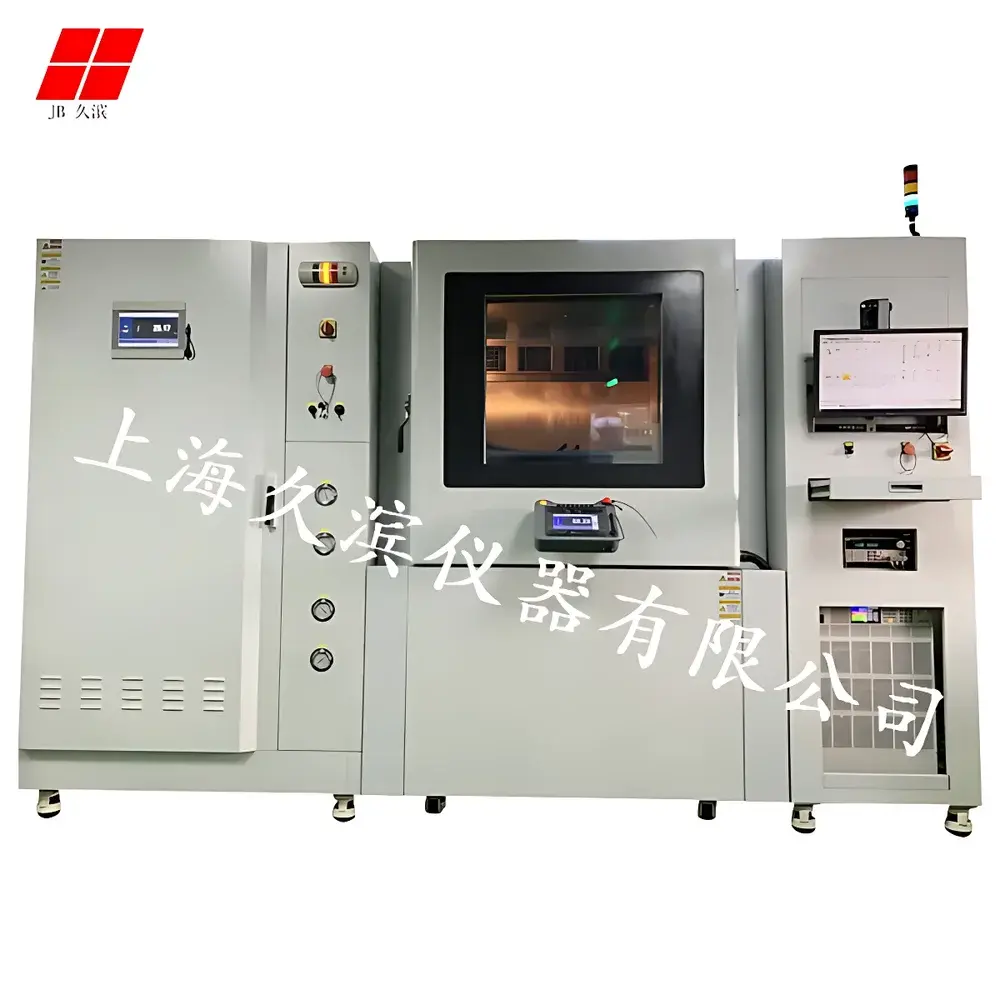
JB-Bin JB-99 Aircraft Hydraulic Hose Thermal Cycling & Pressure Pulse Test System
| Brand | JB-Bin |
|---|---|
| Origin | Shanghai, China |
| Model | JB-99 |
| Pressure Range | 0–70.0 MPa |
| Temperature Range | 40–150 °C |
| Pulse Frequency | 0.025–3.0 Hz |
| Waveform Options | Sine, Triangle, Square, Trapezoidal, Linear |
| Temperature Stability | ±1 °C |
| Temp Control Accuracy | ±3 °C |
| Pressure Control Accuracy | ±2% of setpoint or ±0.5 bar |
| Max Cycles | 1,000,000 |
| Test Medium | High-Temperature Hydraulic Oil |
| Compliance | GB/T 5568–2013, GB 16897–1997, GB/T 10544–2003 |
Overview
The JB-Bin JB-99 Aircraft Hydraulic Hose Thermal Cycling & Pressure Pulse Test System is an integrated environmental fatigue testing platform engineered for qualification and validation of aerospace-grade hydraulic conduits, flexible hose assemblies, and critical fluid-path components under combined thermal stress and dynamic pressure loading. It operates on a dual-axis test principle: synchronized high-frequency pressure pulsation (via servo-controlled intensifier pump) superimposed on programmable thermal cycling (via closed-loop oil-based heat exchange system), replicating in-service operational loads experienced by aircraft fuel, hydraulic, and pneumatic systems during takeoff, cruise, and landing cycles. The system conforms to the mechanical and thermodynamic boundary conditions defined in major aviation component certification protocols—including those referenced in EASA CS-25 Appendix H and FAA AC 20-154A—and serves as a core tool for structural durability assessment prior to DO-160 Section 22 (Fluid Pressure and Temperature Cycling) compliance verification.
Key Features
- Industrial-grade control architecture integrating IPC-based master controller, redundant secondary PLC logic unit, and real-time analog/digital I/O modules for deterministic response and fail-safe interlock enforcement.
- Electro-hydraulic intensifier pump with closed-loop pressure feedback, enabling precise ramp-rate control (0.1–100 MPa/s), programmable dwell periods, and pressure hold stability within ±0.5 bar or ±2% of setpoint.
- Thermal subsystem utilizing high-flash-point synthetic hydraulic oil circulated through jacketed test chamber and inline heater/cooler units; maintains temperature setpoints from 40 °C to 150 °C with ±1 °C stability and ±3 °C absolute accuracy over full range.
- Multi-waveform generation capability (sine, triangle, square, trapezoidal, linear) with independent frequency tuning (0.025–3.0 Hz), optimized for low-frequency fatigue regimes typical of aircraft hydraulic actuation profiles (≤1 Hz dominant).
- Comprehensive safety layering: door-mounted microswitches with forced-break monitoring, pressure-relief valve cascade, thermal runaway detection, and automatic emergency shutdown with event-logged fault tracing.
- Full-cycle data acquisition at ≥1 kHz sampling rate, supporting time-synchronized logging of pressure, temperature, cycle count, and system status flags—exportable to CSV, XML, or ASTM E1434-compliant binary formats.
Sample Compatibility & Compliance
The JB-99 accommodates rigid and flexible metallic tubes (e.g., Ti-6Al-4V, 316SS), reinforced rubber/hybrid composite hoses (SAE AS1385, MIL-DTL-8794), and brazed or flanged manifold subassemblies up to Ø100 mm OD and 2 m length. Fixture interfaces comply with ISO 6803 and SAE J1401 mounting standards. All test procedures align with national and international specifications including GB/T 5568–2013 (non-flexing hydraulic pulse), GB 16897–1997 (brake hose endurance), and GB/T 10544–2003 (rubber hose classification). While not certified to ISO/IEC 17025, the system’s traceable calibration paths support GLP-aligned test documentation required for civil aviation authority submissions.
Software & Data Management
JB-Bin TestSuite v4.2 software provides intuitive test sequence programming, real-time waveform visualization, and automated report generation in bilingual (English/Chinese) PDF format per test run. Audit trail functionality records operator login, parameter changes, manual overrides, and system alarms with timestamp and user ID—meeting foundational requirements of FDA 21 CFR Part 11 for electronic records integrity. Raw datasets are stored in hierarchical folder structures with SHA-256 checksum validation; export options include direct integration with LabVIEW, MATLAB, or enterprise LIMS via OPC UA 1.04 interface.
Applications
- Qualification testing of MIL-DTL-24657 and SAE AS1385 compliant aircraft brake and flight control hoses.
- Durability evaluation of engine-mounted oil cooler lines subjected to thermal shock + pressure ripple coupling.
- Validation of welded titanium tube joints under cyclic thermal expansion mismatch (CTEM) conditions.
- Accelerated life testing of electro-hydraulic actuator manifolds per RTCA DO-160G Section 22.
- Root cause analysis of blistering, delamination, or fitting leakage in composite-reinforced hydraulic lines.
- Supporting supplier PPAP submissions for Tier-1 aerospace OEMs requiring documented pulse-to-failure curves.
FAQ
Does the JB-99 support remote operation and unattended testing?
Yes—the system supports 24/7 autonomous execution with hardware-enforced safety interlocks, cycle completion notifications via SMTP/email, and optional SNMP-based network health monitoring.
Can custom waveforms be imported or synthesized beyond the five built-in types?
No native arbitrary waveform import is supported; however, user-defined multi-segment profiles (e.g., ramp-hold-decay sequences) can be constructed using the step-programming module within TestSuite v4.2.
What maintenance intervals are recommended for the hydraulic intensifier pump?
Per JB-Bin Technical Bulletin TB-JB99-07, intensifier seals require inspection every 500 operational hours or 25,000 pressure cycles—whichever occurs first—with full rebuild recommended at 2,000 hours or 100,000 cycles.
Is third-party calibration certification available for pressure and temperature sensors?
Yes—NIST-traceable calibration certificates (per ISO/IEC 17025 accredited labs) can be arranged at time of order or during annual service visits; calibration uncertainty budgets are provided upon request.
How is thermal uniformity verified across the test chamber volume?
JB-Bin performs chamber mapping per ASTM E2203 using nine calibrated PT100 probes at predefined spatial coordinates; uniformity deviation must remain ≤±2 °C at all setpoints before system release.



