
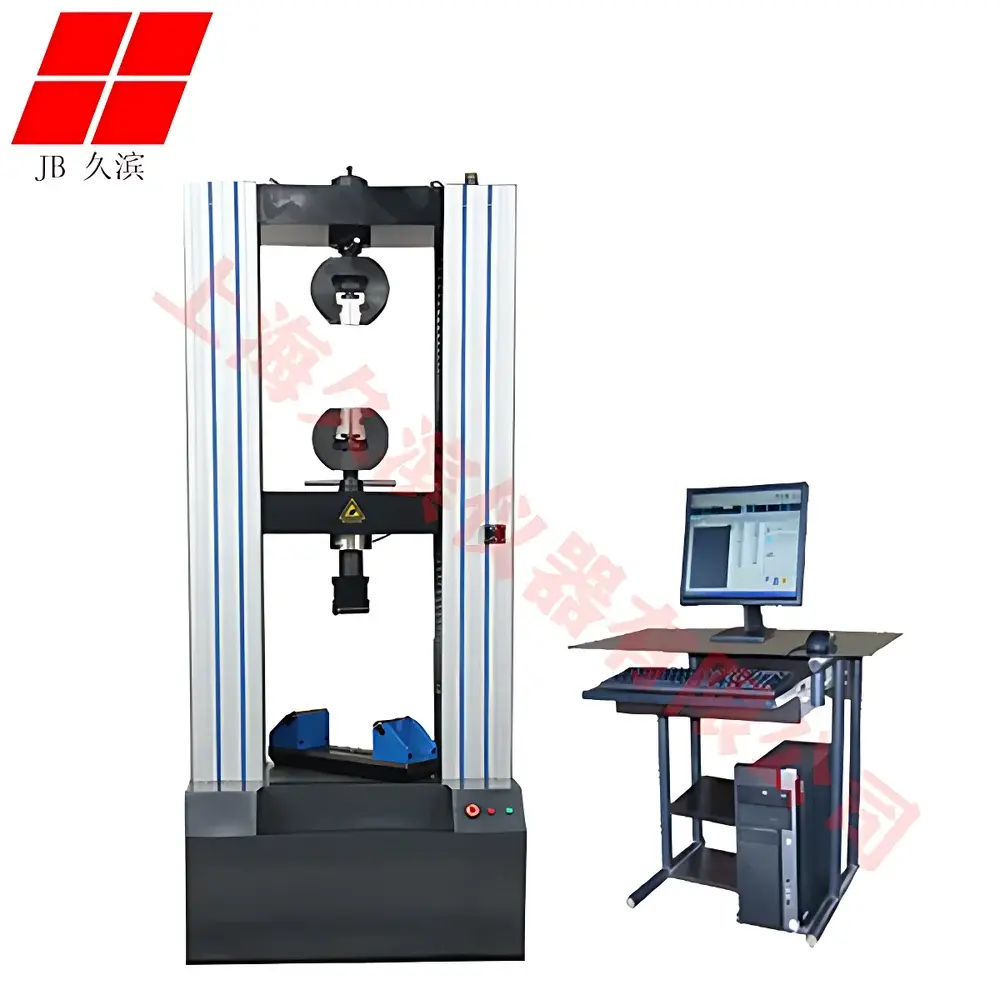
JB-117A Electronic Universal Testing Machine by Jiubin Instruments
| Brand | Jiubin Instruments |
|---|---|
| Origin | Shanghai, China |
| Model | JB-117A |
| Type | Electronic Universal Testing Machine |
| Category | Tensile & Mechanical Property Tester for Metallic Rods and Wires |
Overview
The JB-117A Electronic Universal Testing Machine is a precision-engineered mechanical property testing system designed specifically for uniaxial tensile, compression, and bending evaluation of metallic rods—including steel-magnesium (Mg–steel) alloy specimens—under controlled quasi-static loading conditions. Built upon a dual-column servo-controlled electromechanical architecture, the system implements closed-loop load and displacement feedback via high-resolution load cells and linear variable differential transformers (LVDTs), ensuring traceable force measurement in accordance with ISO 7500-1 Class 1 accuracy requirements. The machine operates within standardized test environments compliant with ASTM E8/E8M (tension testing of metallic materials), ISO 6892-1 (metallic materials — tensile testing — part 1: method at room temperature), and GB/T 228.1–2021 (Chinese national standard equivalent). Its rigid frame design minimizes deflection under load, supporting reproducible stress–strain curve acquisition up to ultimate tensile strength (UTS), yield point (Rp0.2), elongation at break, and modulus of elasticity (E) for Mg–Fe–Al–Zn-based composite alloys.
Key Features
- High-stiffness dual-column steel frame with preloaded ball-screw drive system for minimal axial play and long-term dimensional stability
- Digital servo motor control enabling precise crosshead speed regulation from 0.001 mm/min to 500 mm/min, programmable in logarithmic or linear ramp profiles
- Integrated overload protection and emergency stop circuitry meeting IEC 61800-5-2 functional safety standards
- Modular grip system accommodating cylindrical rods (Ø3–32 mm), flat strips, and threaded specimens via wedge-action or pneumatic clamping options
- Real-time data acquisition at ≥1 kHz sampling rate, synchronized with load, displacement, and extensometer signals
- Compliance with ISO 17025 documentation requirements for calibration traceability; factory-calibrated load cells certified to ±0.5% full-scale accuracy
Sample Compatibility & Compliance
The JB-117A is optimized for tensile characterization of wrought and extruded steel–magnesium alloy rods (e.g., AZ31B, ZK60, WE43 variants with Fe/Mn/Ni impurity control), as well as stainless steels, aluminum alloys, and high-strength copper wires. Specimen geometries conform to ASTM E8 sub-size or full-size round bar configurations (gauge length 50 mm or 25 mm, parallel section Ø6–12 mm). The system supports both contact (clip-on axial extensometers per ISO 9513 Class 1) and non-contact (digital image correlation optional) strain measurement. All firmware and mechanical configurations meet GLP audit readiness criteria, including user-accessible calibration logs, electronic signature support, and audit trail generation for regulatory submissions under FDA 21 CFR Part 11 (when paired with validated software modules).
Software & Data Management
Control and analysis are executed via proprietary PC-based software compliant with Windows 10/11 (64-bit), featuring intuitive test method templates aligned with ASTM, ISO, and GB standards. The platform provides real-time stress–strain visualization, automatic yield point detection (0.2% offset method), and post-test reporting in PDF/XLSX formats with embedded metadata (operator ID, timestamp, environmental conditions, calibration status). Raw binary data files (.tdms) retain full-resolution sensor streams for third-party reanalysis. Software validation documentation—including IQ/OQ protocols and risk assessment reports—is available upon request for GMP-regulated laboratories.
Applications
- Mechanical qualification of Mg–steel hybrid rods for lightweight automotive structural components (e.g., suspension bushings, chassis inserts)
- Quality assurance testing of drawn wire products in battery current collector manufacturing
- Research-grade tensile behavior mapping across temperature-controlled stages (−40°C to +150°C, with external chamber integration)
- Evaluation of interfacial bonding integrity in clad or co-extruded bimetallic rods
- Validation of heat treatment effects (T4/T6 aging) on ductility and strain hardening exponent (n-value)
- Supporting DOE-driven material development programs in academic metallurgy labs and industrial R&D centers
FAQ
What is the maximum tensile force capacity of the JB-117A?
The standard configuration supports up to 100 kN nominal load capacity; higher-capacity variants (200 kN, 300 kN) are available upon request with reinforced load train and recalibrated transducers.
Does the system include extensometer compatibility?
Yes—both automatic clip-on axial extensometers (50 mm gauge length, ±0.5% accuracy per ISO 9513) and video-based DIC systems can be integrated via standardized analog/digital I/O interfaces.
Is the software compliant with 21 CFR Part 11 for pharmaceutical applications?
When deployed with optional 21 CFR Part 11 add-on module (including electronic signatures, role-based access control, and immutable audit logs), the software meets baseline requirements for regulated environments.
Can the JB-117A perform cyclic or fatigue testing?
No—the JB-117A is configured exclusively for static and quasi-static mechanical tests. For low-cycle fatigue or S–N curve generation, a dedicated electrodynamic fatigue testing system is recommended.
What calibration certificates are provided with delivery?
Each unit ships with a factory calibration certificate traceable to NIM (National Institute of Metrology, China) and includes load cell, displacement encoder, and speed verification reports valid for 12 months.



