
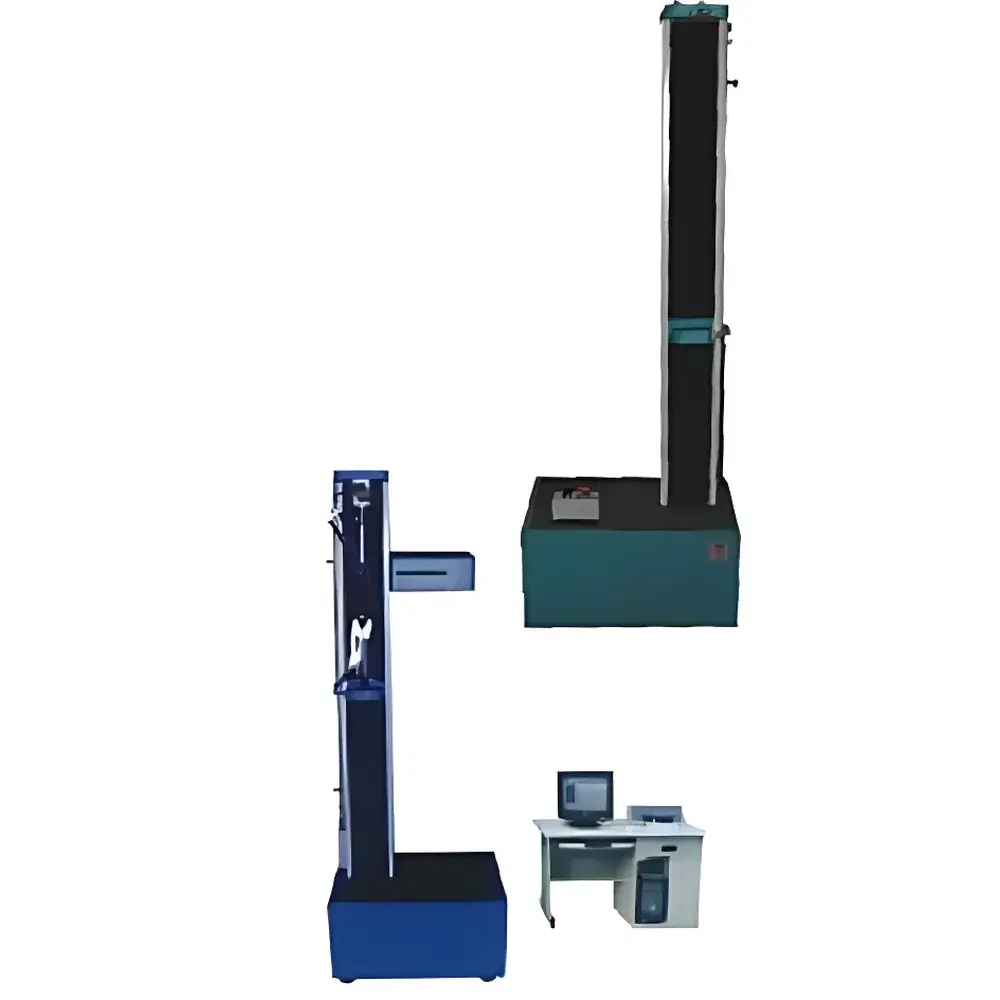
Jiubin JB-125 Universal Tensile Testing Machine for Plastics
| Brand | Jiubin |
|---|---|
| Model | JB-125 |
| Type | Electromechanical Universal Testing Machine |
| Load Capacity | 0–200 kg (user-selectable) |
| Load Cell Accuracy | ±0.5% FS |
| Effective Test Width | 380 mm |
| Max. Travel Distance | 900 mm |
| Test Speed Range | 0.001–500 mm/min (infinitely variable) |
| Displacement Resolution | 1/200,000 |
| Displacement Accuracy | ±0.005% of full scale |
| Drive System | Servo motor (Japan) + AC motor (Taiwan) |
| Mechanical Transmission | Precision ball screw (Taiwan) + High-strength backlash-free lead screw (Korea) |
| Safety Features | Upper/lower mechanical limits, emergency stop button |
| Display Interface | Dual-mode — PC-based software + embedded microcomputer display |
| Power Supply | 220 V, 50 Hz |
| Net Weight | 180 kg |
| Dimensions (W×D×H) | 450 × 450 × 1200 mm |
| Unit Options | g, kg, N, kN, lb, lbf |
Overview
The Jiubin JB-125 Universal Tensile Testing Machine is an electromechanical static testing system engineered for precision mechanical property evaluation of polymeric materials—including thermoplastics, elastomers, composites, and engineering resins—under uniaxial loading conditions. It operates on the principle of controlled displacement-driven force measurement, utilizing a high-fidelity load cell and closed-loop servo-controlled actuation to deliver repeatable tensile, compression, flexural (3-point bend), and shear testing in accordance with standardized test methods such as ASTM D638, ISO 527-1, ISO 604, ASTM D790, and ASTM D732. Designed for laboratory and quality control environments, the JB-125 integrates structural rigidity, metrological traceability, and compliance-ready data architecture to support material qualification, process validation, and incoming inspection workflows.
Key Features
- Modular electromechanical architecture combining Japanese servo motors, Taiwanese AC drive units, and dual-source precision transmission systems (ball screw + backlash-free lead screw) for stable, low-noise, high-reproducibility motion control.
- High-accuracy load measurement via U.S.-sourced precision load cell with ±0.5% full-scale accuracy and 1/200,000 internal resolution—calibration-compatible with ISO 7500-1 Class 1 requirements.
- Infinitely variable speed control from 0.001 to 500 mm/min, supporting both constant-rate-of-traverse (CRT) and constant-rate-of-loading (CRL) test modes per ASTM E4 and ISO 5893.
- Dual-display interface: real-time synchronized operation between embedded microcomputer controller and Windows-based PC software—enabling local monitoring and remote data logging without dependency on external hardware.
- Comprehensive safety framework including mechanical upper/lower travel limits, hardware-triggered emergency stop circuitry, and automatic overload cut-off—fully compliant with EN ISO 12100 and IEC 61800-5-2 functional safety guidelines.
- Ergonomic floor-standing design (450 × 450 × 1200 mm) with powder-coated steel frame, optimized for long-term stability and minimal vibration coupling during high-sensitivity measurements.
Sample Compatibility & Compliance
The JB-125 accommodates a wide range of specimen geometries through customizable fixture sets—including pneumatic wedge grips, roller grips, compression platens, and 3-point bend fixtures—supporting ASTM D638 Type I–V, ISO 527 multipurpose bars, and custom-profile samples up to 380 mm wide and 900 mm active stroke length. All test configurations are validated against international standards for mechanical testing of plastics, including ISO 178 (flexural properties), ISO 604 (compressive properties), and ISO 7500-1 (static calibration of force-proving instruments). The system supports GLP/GMP-aligned audit trails when paired with optional software modules compliant with FDA 21 CFR Part 11 for electronic records and signatures.
Software & Data Management
The integrated testing software provides full control over test parameter definition, real-time curve visualization (force vs. displacement, stress vs. strain), automatic yield point detection (0.2% offset method), modulus calculation (tangent/secant), and fracture energy integration. Raw data export is supported in CSV, XML, and PDF formats—with configurable report templates meeting ISO/IEC 17025 documentation requirements. Optional features include multi-curve overlay analysis, batch statistical reporting (mean, SD, CV%), and time-stamped audit logs with user-level access control. Software calibration routines maintain traceability to NIST-traceable reference standards and allow periodic verification without third-party intervention.
Applications
- Quality assurance of injection-molded, extruded, and thermoformed plastic components across automotive, medical device, packaging, and consumer electronics sectors.
- Material development labs evaluating tensile strength, elongation at break, Young’s modulus, Poisson’s ratio, and creep behavior under controlled environmental conditions.
- Supplier qualification programs requiring conformance to OEM-specific material specifications (e.g., Ford WSS-M99P1111-A, GMW15624, VW TL52250).
- Regulatory submission support for ISO 10993 biocompatibility testing (mechanical characterization of polymer substrates) and USP / extractables studies.
- Failure analysis workflows integrating mechanical test data with SEM imaging, FTIR spectroscopy, or DSC thermal profiling for root-cause investigation.
FAQ
What standards does the JB-125 comply with for plastics testing?
The system meets core requirements of ASTM D638, ISO 527-1/-2, ISO 604, ISO 178, and ISO 7500-1; full compliance documentation and calibration certificates are provided upon delivery.
Can the JB-125 perform cyclic or fatigue testing?
No—the JB-125 is designed exclusively for quasi-static mechanical tests; dynamic or high-cycle fatigue capability requires a dedicated servo-hydraulic or electromagnetic fatigue testing system.
Is the software 21 CFR Part 11 compliant?
Base software includes audit trail, electronic signature, and user permission controls; optional Part 11 validation package (IQ/OQ/PQ protocols, configuration management) is available for regulated environments.
What is the recommended calibration interval?
Annual calibration is advised per ISO/IEC 17025; however, frequency may be adjusted based on usage intensity, criticality of application, and internal quality procedures.
Does the system support environmental chamber integration?
Yes—standardized mounting interfaces and analog/digital I/O ports enable seamless synchronization with temperature- and humidity-controlled chambers (e.g., -70°C to +300°C range) for conditioned mechanical testing.



