
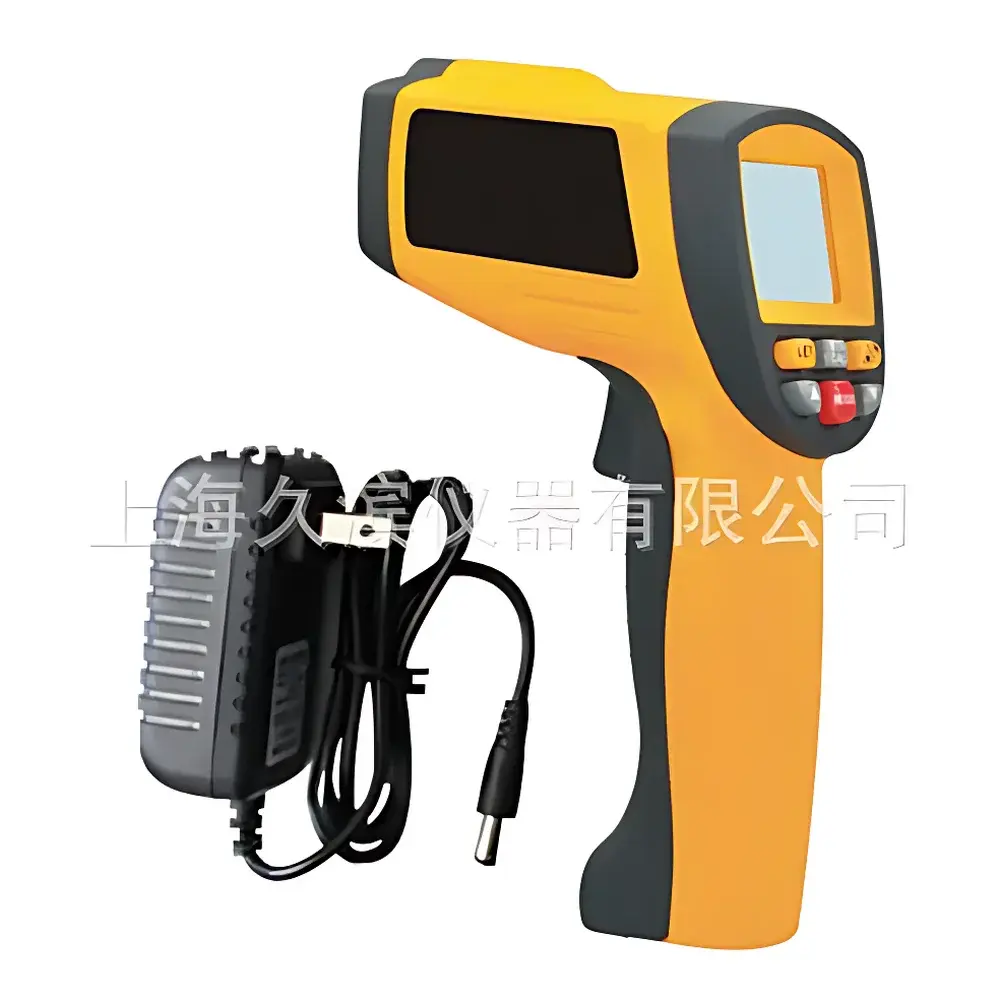
Jiubin JB-106 Retroreflectometer
| Brand | Jiubin |
|---|---|
| Origin | Shanghai, China |
| Manufacturer Type | Authorized Distributor |
| Country of Origin | China |
| Model | JB-106 |
| Price | Upon Request |
| Measurement Range | 0–1999 cd/lx/m² |
| Uncertainty | <5% |
| Observation Angle | 0.2° |
| Entrance Angle | −4° |
| Light Source | Warm White LED |
| Detector | V(λ)-Corrected Photoreceptor |
| Operating Temperature | −10°C to +40°C |
| Relative Humidity | ≤80% RH |
| Dimensions | 200 × 155 × 59 mm |
| Power Supply | Rechargeable 9 V / 800 mAh Li-ion Battery |
Overview
The Jiubin JB-106 Retroreflectometer is a precision optical instrument engineered for the quantitative measurement of retroreflective performance in road safety signage, traffic delineators, high-visibility garments, and vehicle retroreflective sheeting. It operates on the fundamental photometric principle of retroreflection—defined as the ratio of luminance (cd/m²) produced by a material under standardized illumination to the illuminance (lx) incident upon it—expressed in units of cd/lx/m². The JB-106 implements a fixed-geometry configuration compliant with internationally recognized retroreflection test protocols: an observation angle of 0.2° and an entrance angle of −4°, replicating real-world driver-view conditions at highway speeds. This geometry ensures metrological consistency across field inspections, quality control laboratories, and third-party certification testing. Unlike variable-angle systems, the JB-106’s fixed optical path eliminates alignment variability, enhancing repeatability and reducing operator dependency—critical attributes for regulatory compliance and inter-laboratory comparability.
Key Features
- Fixed-angle optical architecture optimized for standardized retroreflectance assessment: 0.2° observation angle and −4° entrance angle per GB/T 26377–2010 and ASTM E808.
- V(λ)-corrected silicon photodetector calibrated to the CIE photopic luminosity function, ensuring spectral response alignment with human visual sensitivity.
- Stable warm-white LED light source with controlled spectral output and thermal management, eliminating lamp aging drift common in tungsten-halogen systems.
- Embedded 32-bit microcontroller enabling real-time signal processing, auto-zero compensation, and linearization of detector response across the full 0–1999 cd/lx/m² dynamic range.
- High-contrast color LCD interface with Chinese-language prompts and intuitive menu navigation—designed for field technicians and QA personnel without specialized optics training.
- Integrated rechargeable 9 V / 800 mAh lithium-ion battery with hot-swap capability; supports continuous operation for >8 hours under typical measurement cycles.
- Onboard data storage (≥1,000 records) with timestamp, sample ID, and operator tag; exportable via USB or optional Wi-Fi module (IEEE 802.11 b/g/n).
Sample Compatibility & Compliance
The JB-106 accommodates flat, curved, and textured retroreflective surfaces—including engineering-grade, high-intensity, and diamond-grade prismatic sheeting; glass-bead-based paints; and retroreflective fabrics meeting EN ISO 20471 requirements. Its compact form factor (200 × 155 × 59 mm) enables handheld use on roadside signage, pavement markers, and vehicle-mounted reflectors. The instrument conforms to national metrological verification regulation JJG 059–2004, general specification GB/T 26377–2010 for retroreflectometers, and mandatory standard GB 23254–2009 for retroreflective materials used in road traffic signs. While not certified to ISO/IEC 17025, its uncertainty budget (<5% at mid-range) meets the performance threshold required for in-house QC verification under GLP-aligned quality systems. Traceability is supported via factory calibration certificates referenced to NIM (National Institute of Metrology, China) standards.
Software & Data Management
The JB-106 includes embedded firmware supporting configurable test protocols, pass/fail thresholds, and statistical summary (mean, min, max, SD) per batch. Optional PC software (JB-DataLink v3.x) provides full audit trail functionality—including user login logs, parameter change history, and immutable record timestamps—aligned with FDA 21 CFR Part 11 expectations for electronic records in regulated environments. Data exports are generated in CSV and PDF formats compatible with LIMS integration. Wi-Fi-enabled units support secure TLS 1.2 encrypted uploads to cloud-hosted QA dashboards, enabling centralized monitoring of reflectivity decay trends across multi-site infrastructure portfolios.
Applications
- Routine inspection of roadside signage conformity prior to installation and during service life (e.g., post-storm damage assessment).
- Factory acceptance testing (FAT) of retroreflective sheeting batches against contractual photometric specifications.
- Verification of retroreflective performance in personal protective equipment (PPE) for railway, construction, and emergency response sectors.
- Research and development of novel retroreflective materials, including angularly stable microprismatic films and UV-stabilized acrylic coatings.
- Supporting municipal DOT asset management programs through longitudinal reflectivity tracking correlated with environmental exposure metrics.
FAQ
What geometric configuration does the JB-106 use, and why is it standardized?
The JB-106 employs a fixed observation angle of 0.2° and entrance angle of −4°, matching the geometry specified in GB/T 26377–2010 and widely adopted in global road safety standards to simulate headlight-to-driver line-of-sight at 30 m distance and 1.2 m eye height.
Is the instrument suitable for outdoor use in varying weather conditions?
Yes—the operating temperature range (−10°C to +40°C) and ≤80% RH tolerance enable reliable field deployment; however, direct solar exposure during measurement is discouraged to avoid thermal drift and stray-light interference.
How is calibration maintained over time?
The unit ships with a NIM-traceable calibration certificate. Users perform daily zero checks using the built-in dark cap; annual recalibration by an accredited metrology lab is recommended to maintain uncertainty compliance.
Can measurement data be integrated into enterprise quality management systems?
Yes—via optional Wi-Fi or USB, raw and summarized data export to CSV/PDF supports ingestion into SAP QM, TrackWise, or custom LIMS platforms with configurable metadata mapping.
Does the JB-106 meet international transportation authority requirements beyond Chinese standards?
Its geometry and photometric methodology align with ASTM E808, EN 12899–1, and AS/NZS 1906.1; however, formal type approval from EU Notified Bodies or U.S. FHWA requires additional documentation and witnessed testing per local regulatory pathways.
Related Products





