
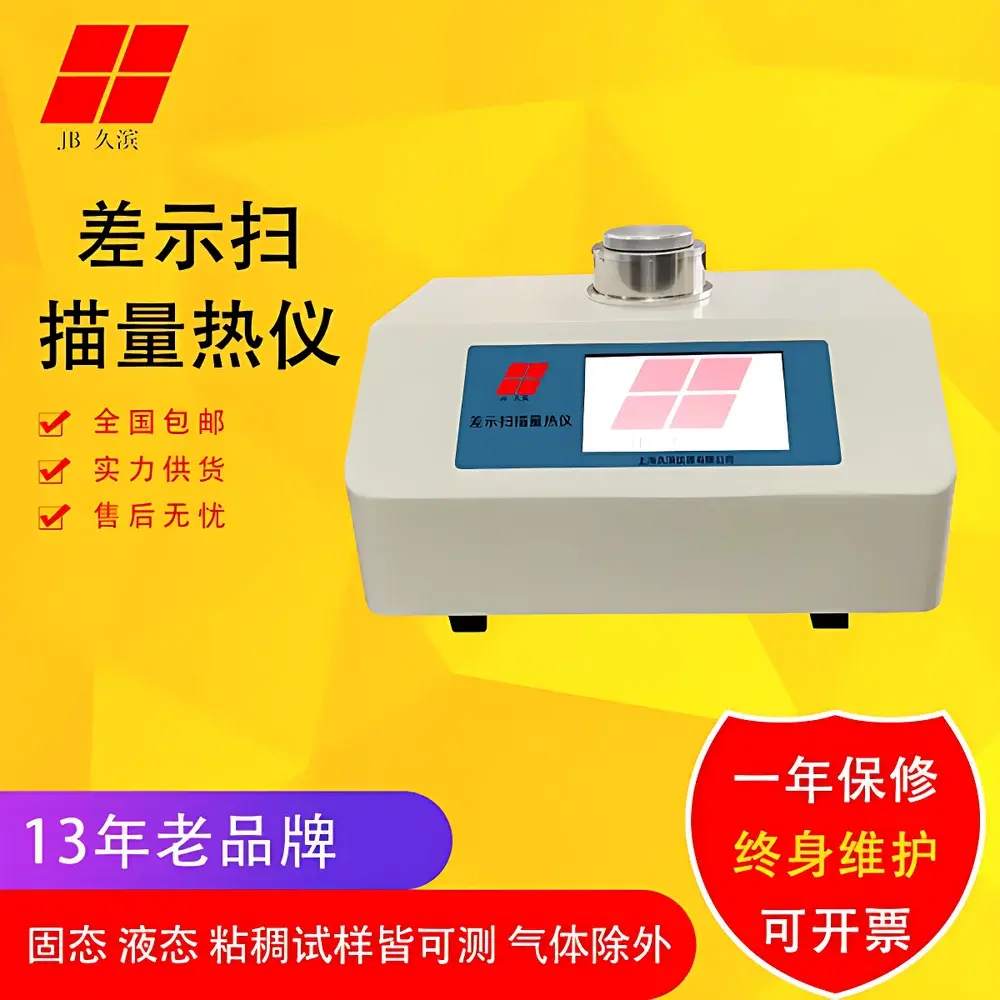
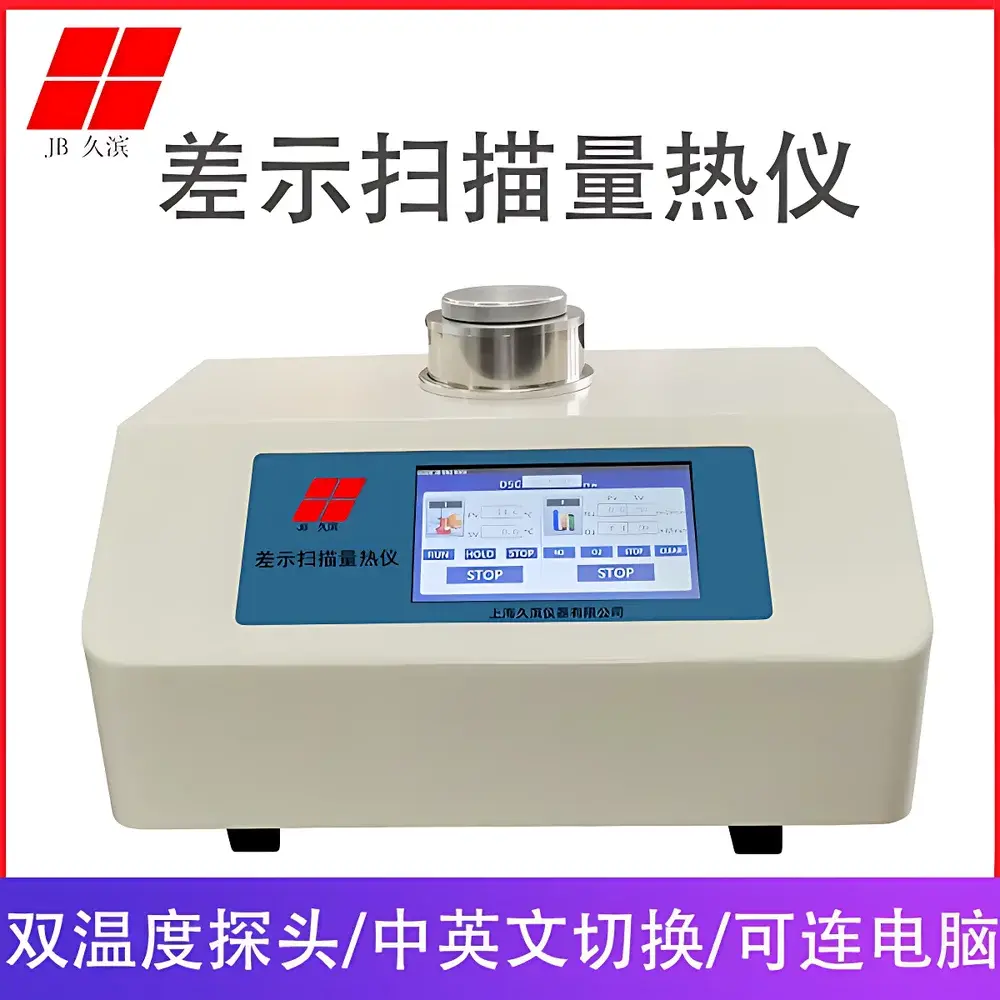
JB-DSC-350L Differential Scanning Calorimeter (DSC) by Jiubin Instruments
| Brand | Jiubin Instruments |
|---|---|
| Origin | Shanghai, China |
| Model | JB-DSC-350L |
| Temperature Range | −30 °C to 350 °C |
| Temperature Accuracy | ±0.1 °C |
| Heating/Cooling Rate | 0.1–50 K/min |
| DSC Heat Flow Range | ±500 mW |
| Thermal Resolution | 0.01 μW |
| Baseline Noise | 0.01 μW |
| Temperature Repeatability | ±0.1 °C |
| Gas Flow Control | Digital Mass Flow Controller |
| Interface | 7-inch LCD Touchscreen + USB Data Export |
| Calibration Standard | Certified Tin Reference Material |
| Dimensions (L×W×H) | 500 × 393 × 154 mm |
Overview
The JB-DSC-350L Differential Scanning Calorimeter is a precision thermal analysis instrument engineered for quantitative measurement of heat flow differences between a sample and inert reference as a function of temperature or time. Operating on the principle of symmetric heat-flux DSC, it delivers high-fidelity thermograms essential for characterizing endothermic and exothermic transitions in pharmaceutical solids, polymeric resins, amorphous intermediates, and formulated excipients. Its design supports rigorous regulatory workflows—particularly in drug substance development, polymorph screening, thermal stability assessment, and glass transition (Tg) determination of amorphous dispersions and cured thermosets. The system’s thermal stability, low baseline noise, and reproducible calibration traceability align with fundamental requirements for GLP-compliant thermal characterization in QC laboratories and formulation R&D settings.
Key Features
- Optimized symmetric furnace architecture delivering enhanced baseline flatness and improved peak resolution for overlapping transitions (e.g., cold crystallization followed by melting in semi-crystalline APIs)
- Digital mass flow controller for purge gas (N2, air, or synthetic air), enabling precise, logged, and repeatable atmosphere management across multi-step temperature programs
- Dual-mode operation: fully functional standalone control via 7-inch capacitive touchscreen interface, or full remote orchestration via PC-based software with real-time data streaming
- High-sensitivity microcalorimetric sensor with 0.01 μW thermal resolution and sub-microwatt baseline noise—critical for detecting subtle enthalpic events such as secondary relaxations near Tg
- Integrated temperature calibration routine using certified tin reference material (melting point 231.928 °C, ΔHfus = 60.1 J/g), supporting user-performed verification per ISO 11357-1 and ASTM E794
- Programmable linear and stepwise temperature ramps (0.1–50 K/min), isothermal holds, and multi-segment heating/cooling cycles—all stored with metadata including gas flow rate, dwell time, and sensor status
Sample Compatibility & Compliance
The JB-DSC-350L accommodates standard aluminum, gold-plated aluminum, and hermetic high-pressure pans—suitable for volatile, hygroscopic, or oxidation-sensitive samples including active pharmaceutical ingredients (APIs), polymer blends, crosslinking resins, and lyophilized formulations. Its −30 °C to 350 °C operating range covers critical thermal events: glass transitions of PVPVA and HPMC-AS matrices, curing exotherms of epoxy-acrylate systems, oxidative induction times (OIT) per ASTM D3895, and desolvation/decomposition kinetics. The instrument meets core mechanical and electrical safety requirements per IEC 61010-1 and supports audit-ready data integrity when used with compliant software—enabling alignment with FDA 21 CFR Part 11 principles (electronic signatures, change control, and secure audit trails) when deployed in validated environments.
Software & Data Management
Data acquisition and analysis are performed via dedicated Windows-compatible software supporting ASTM E1356 and ISO 11357-compliant peak integration, baseline construction (tangent, linear, or spline), and kinetic modeling (e.g., Ozawa-Flynn-Wall for decomposition activation energy). Raw thermograms export in ASCII (.txt) and universal .csv formats; processed reports include annotated transition temperatures (onset, peak, endset), enthalpy values (J/g), and uncertainty estimates derived from replicate calibration runs. All instrument parameters—including gas flow setpoints, temperature ramp profiles, and sensor diagnostics—are embedded in metadata headers, ensuring full traceability for internal SOPs or external regulatory submissions.
Applications
- Pharmaceutical solid-state characterization: identification and quantification of polymorphic forms, hydrate/anhydrate transitions, and amorphous content via residual enthalpy of cold crystallization
- Resin and coating development: determination of glass transition temperature (Tg) for acrylic, epoxy, and polyester systems—correlating with storage modulus, film formation, and long-term aging behavior
- Thermal stability profiling: onset of degradation, oxidative induction time (OIT), and decomposition kinetics under inert or oxidative atmospheres
- Process validation support: qualification of lyophilization cycle endpoints, hot-melt extrusion residence time effects, and tablet coating curing uniformity
- Quality control release testing: verification of Tg consistency batch-to-batch for polymer-based delivery systems per USP and Ph. Eur. 2.2.42
FAQ
What reference materials are supplied for calibration?
Certified tin (Sn) is included for temperature calibration; indium and zinc standards may be added optionally for extended range verification.
Can the instrument operate under controlled humidity conditions?
No—this model does not integrate humidity control; for moisture-sensitive analyses, use sealed high-pressure pans with pre-conditioned samples.
Is the software compliant with 21 CFR Part 11 requirements?
The base software provides audit trail logging and user access controls; full Part 11 compliance requires supplementary validation documentation and IT infrastructure controls implemented at the site level.
What cooling method is used for sub-ambient measurements?
The JB-DSC-350L employs forced-air cooling only; for sub-zero operation down to −30 °C, no liquid nitrogen or mechanical refrigeration is required.
How is baseline drift corrected during long-duration isothermal holds?
Automatic baseline correction algorithms apply dynamic polynomial fitting over user-defined pre- and post-transition regions, minimizing integration error in low-signal regimes.



