
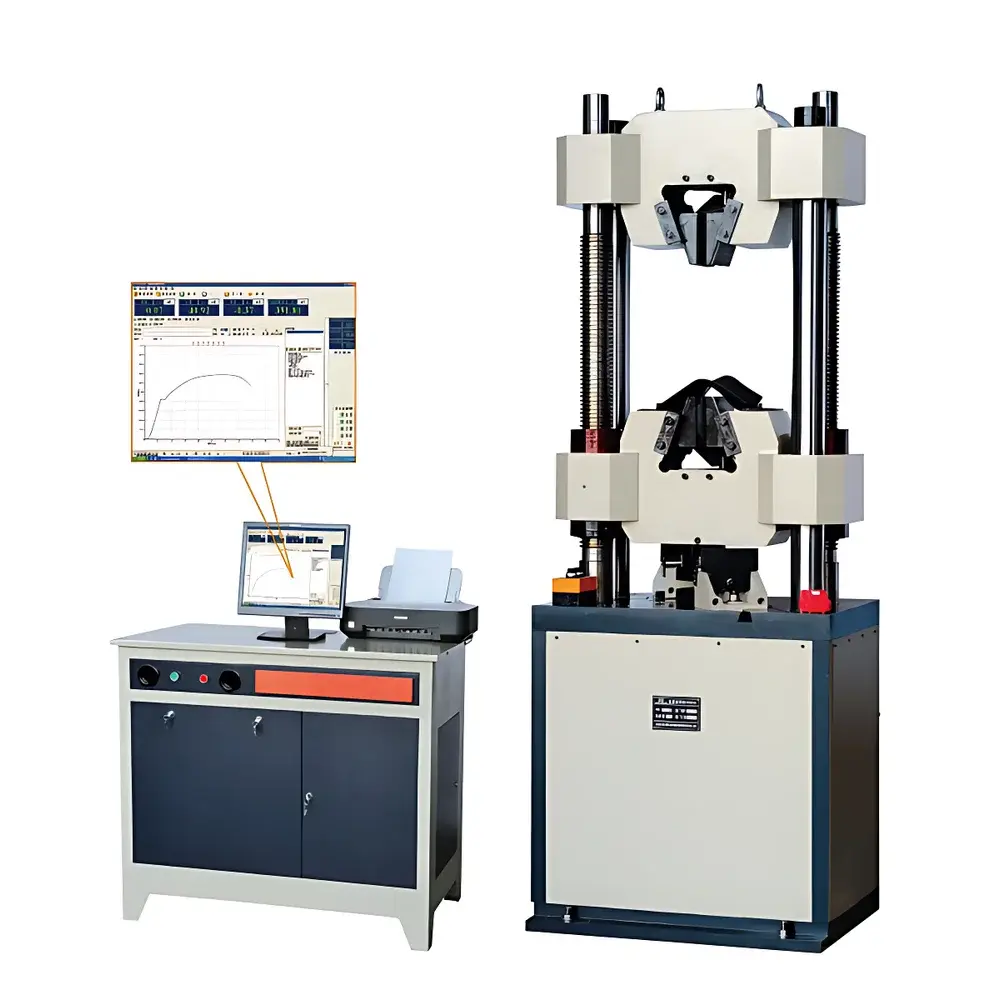
JB/WEW-300B Hydraulic Universal Testing Machine by Jiubin Instruments
| Brand | Jiubin Instruments |
|---|---|
| Origin | Shanghai, China |
| Model | JB/WEW-300B |
| Type | Hydraulic Universal Testing Machine |
| Max Test Force | 300 kN |
| Force Measurement Range | 4–100% FS |
| Force Accuracy | ≤ ±1% of reading |
| Force Resolution | 0.01 kN |
| Displacement Resolution | 0.01 mm |
| Deformation Accuracy (2–100% FS) | 0.01 |
| Tensile Space | 550 mm |
| Compression Space | 380 mm |
| Piston Stroke | 150 mm |
| Round Specimen Grip Range | Φ6–Φ26 mm |
| Flat Specimen Thickness Capacity | 0–15 mm |
| Flat Specimen Jaw Width | 75 mm |
| Compression Platen Diameter | φ160 mm |
| Bend Span | 450 mm |
| Bend Roller Width | 120 mm |
| Bend Roller Diameter | Φ30 mm |
| Piston Speed | 50 mm/min |
| Clamping Method | Automatic Hydraulic Clamping |
| Host Dimensions (W×D×H) | 720×580×1950 mm |
| Control Console Dimensions (W×D×H) | 1000×700×1400 mm |
Overview
The JB/WEW-300B Hydraulic Universal Testing Machine is a floor-standing, oil-cylinder-underneath universal testing system engineered for high-reproducibility mechanical property evaluation of metallic and non-metallic materials under quasi-static loading conditions. It operates on the principle of controlled hydraulic actuation, where a servo-regulated piston applies axial force to specimens mounted between upper and lower crossheads. The machine complies with fundamental mechanical testing standards including ASTM E4, ASTM E8/E8M (tension), ASTM E9 (compression), ASTM E290 (bend), and ISO 6892-1, enabling standardized determination of yield strength (Rp0.2), ultimate tensile strength (Rm), modulus of elasticity (E), elongation at break (A%), and proof strength at specified non-proportional extension (e.g., Rp0.1). Its dual-load-path architecture—separating force measurement (via calibrated load cell) from displacement sensing (via optical encoder)—ensures traceable, low-drift data acquisition suitable for quality control, R&D validation, and third-party certification workflows.
Key Features
- 300 kN nominal capacity with 4–100% full-scale force measurement range and ≤ ±1% indication error per ISO 7500-1 Class 1 requirements
- High-resolution digital force transduction (0.01 kN resolution) and displacement tracking (0.01 mm resolution) synchronized in real time
- Automatic hydraulic clamping system with adjustable jaw pressure, minimizing slippage and pre-load scatter during tensile initiation
- Dual-mode deformation measurement support: extensometer input (YYU-25/50 compliant, 25 mm gauge length, 50 mm max travel) and encoder-based crosshead displacement
- Modular fixture interface accommodating round specimens (Φ6–Φ26 mm), flat specimens (0–15 mm thickness, 75 mm width), compression platens (φ160 mm), and three-point bend assemblies (450 mm span, Φ30 mm rollers)
- Integrated PC-based control console featuring industrial-grade embedded controller, Lenovo workstation, color inkjet printer, and proprietary test software with audit-trail-capable user management
Sample Compatibility & Compliance
The JB/WEW-300B supports standardized specimen geometries per ASTM E8, ISO 6892-1, and GB/T 228.1. Round bar specimens (diameters Φ6–Φ26 mm) and flat strips (up to 15 mm thick × 75 mm wide) are accommodated via interchangeable jaw sets. Compression tests utilize a φ160 mm hardened steel platen; bending tests employ hardened roller supports with 450 mm center-to-center spacing and 120 mm roller width—fully compliant with ASTM E290 geometry tolerances. All force and displacement channels are calibrated against national metrological standards traceable to CNAS-accredited laboratories. The system meets mechanical safety requirements per EN 61000-6-2 (EMC) and EN ISO 12100 (machinery safety), and its software architecture supports GLP-compliant operation through dual-level user access (administrator and operator), electronic signature prompts, and immutable test log archiving.
Software & Data Management
The embedded Windows-based test software provides ISO/IEC 17025-aligned data integrity features: full parameter configurability (strain rate, hold steps, load limits), customizable multi-step test protocols, and export-ready Excel-formatted reporting templates. Users may import/export test definitions, standard configurations (e.g., ASTM A370-compliant sequences), and stepwise procedures across instruments. Real-time plotting includes six dual-axis graphs: Force vs. Displacement, Force vs. Strain, Stress vs. Displacement, Stress vs. Strain, Force vs. Time, and Displacement vs. Time. All raw data files are saved in binary+CSV hybrid format with embedded metadata (operator ID, timestamp, environmental notes, calibration expiry). Software self-diagnosis detects hardware communication faults, sensor saturation, or out-of-range encoder signals and logs them with UTC timestamps for root-cause analysis.
Applications
This system serves as a primary mechanical characterization platform in metallurgical QC labs, construction materials testing centers, university mechanics laboratories, and aerospace component suppliers. Typical use cases include: verification of structural steel grade compliance (e.g., Q345, S355JR); validation of aluminum alloy extrusion tensile properties per AMS 4027; compressive strength assessment of concrete cores per ASTM C39; flexural modulus determination of polymer composites (ASTM D790); and shear strength evaluation of adhesive joints using custom shear fixtures. Its robust frame design (720×580×1950 mm), 150 mm piston stroke, and 50 mm/min crosshead speed support both high-force low-speed ductility testing and rapid qualification runs.
FAQ
What standards does the JB/WEW-300B comply with for force calibration?
It conforms to ISO 7500-1 Class 1 accuracy requirements, with force verification traceable to national standards via accredited calibration certificates.
Can the system perform closed-loop strain control?
Yes—when used with the supplied YYU-25/50 extensometer, the controller enables displacement- or strain-controlled ramp-and-hold profiles per ASTM E8 Annex A3.
Is the software compliant with FDA 21 CFR Part 11?
While not validated for regulated pharmaceutical environments, it supports audit trails, electronic signatures, and role-based access—foundational elements for Part 11 alignment when deployed within a documented validation framework.
What maintenance intervals are recommended for hydraulic components?
Oil filtration and system pressure checks are advised every 500 operational hours; full hydraulic fluid replacement and seal inspection every 2,000 hours or annually, whichever occurs first.
Does the machine support third-party transducer integration?
Yes—the analog input module accepts standard ±10 V or 4–20 mA signals from external load cells, LVDTs, or acoustic emission sensors, with configurable scaling and filtering.



