
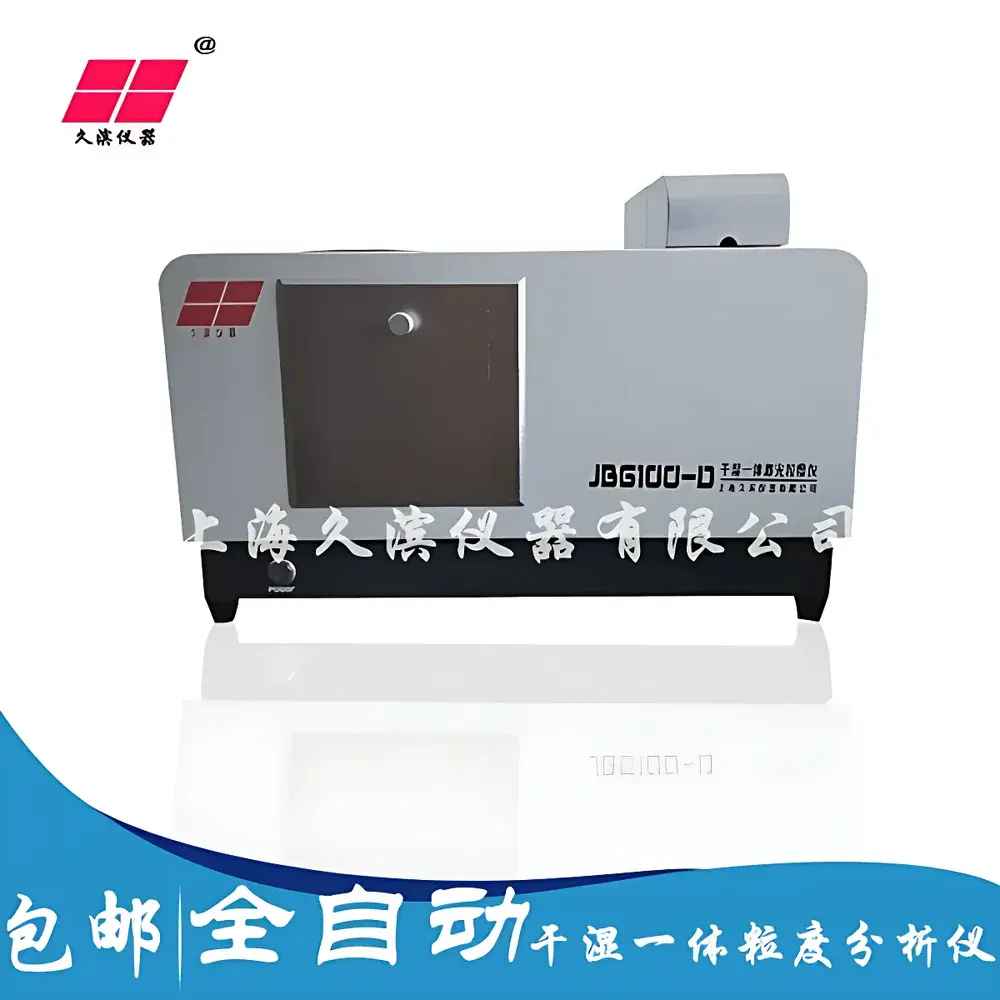
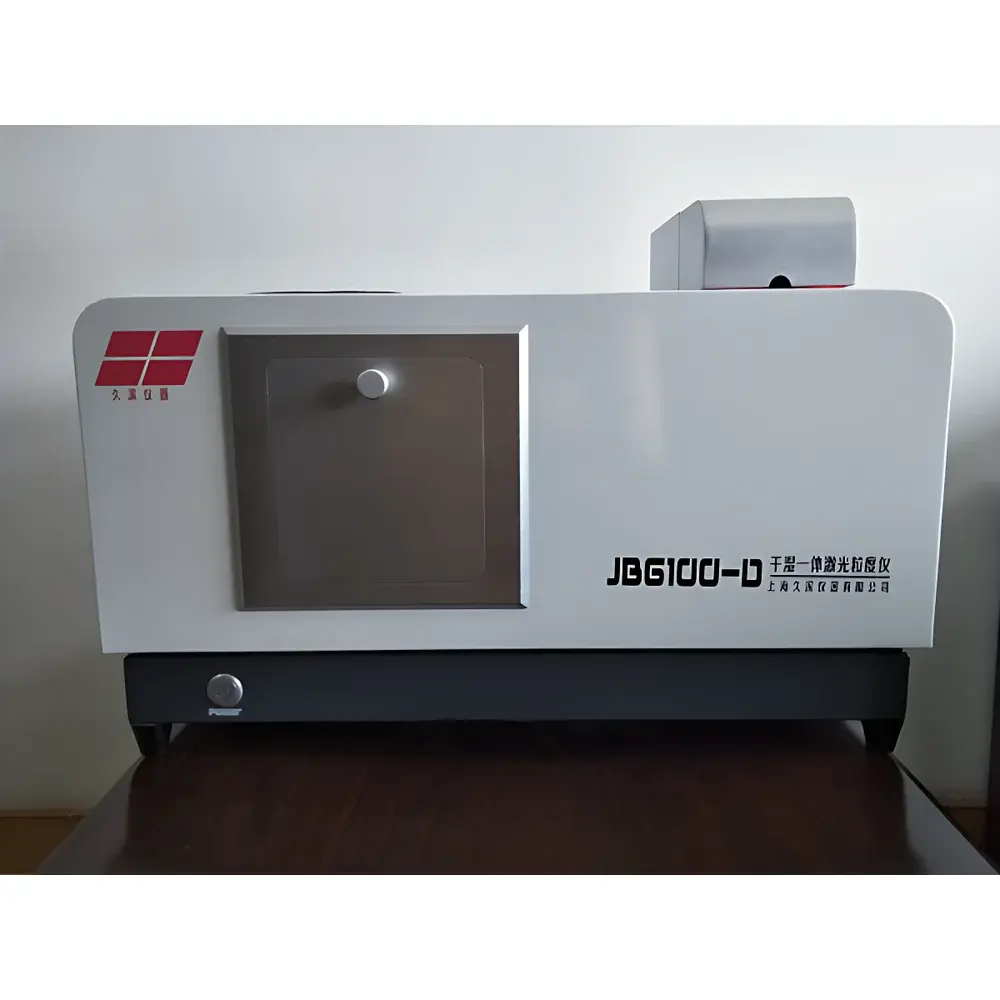
Jiubin JB6100-D Dry/Wet Integrated Fully Automatic Laser Particle Size Analyzer
| Brand | Jiubin |
|---|---|
| Origin | Shanghai, China |
| Model | JB6100-D |
| Dispersion Method | Dry & Wet |
| Measurement Range | 0.01 µm – 1250 µm |
| Repeatability | <1% |
| Measurement Time | 60 s per test |
Overview
The Jiubin JB6100-D is a dry/wet integrated, fully automatic laser particle size analyzer engineered for high-precision, routine particle size distribution (PSD) analysis across diverse industrial and research laboratories. It operates on the Mie scattering theory—rigorously applied to spherical and near-spherical particles—and incorporates a convergent beam Fourier transform optical design to maximize signal-to-noise ratio and angular detection fidelity. Unlike conventional backscattering or fixed-focus systems, the JB6100-D employs a high-density photodetector array with seamless full-range angular coverage (0.01°–175°), enabling accurate resolution of sub-micron nanoparticles and coarse granules within a single measurement without range switching or interpolation artifacts. Its optical path is dynamically self-aligned via an integrated auto-calibration module, ensuring long-term stability and eliminating manual alignment drift—a critical requirement for GLP-compliant quality control environments.
Key Features
- Fully automated dual-mode operation: one-click transition between wet dispersion and dry dispersion modes without hardware reconfiguration or optical realignment.
- Wet dispersion system featuring a recirculating peristaltic pump, ultrasonic probe (20–40 kHz, adjustable power), and vortex-assisted flow cell—designed to prevent sedimentation, minimize sample carryover, and eliminate residual liquid retention post-drainage.
- Dry dispersion module utilizing axial jet dispersion: sample is accelerated vertically through a high-velocity gas stream (0–4 bar, digitally regulated), minimizing particle re-agglomeration; feed rate controlled remotely via PC with programmable stepwise dosing.
- Zero-residue pneumatic transport pathway: all wet and dry sample pathways employ smooth-bore, electro-polished stainless-steel tubing with optimized bend radii and laminar-flow geometry to prevent particle adhesion or cross-contamination between runs.
- Real-time optical diagnostics: built-in laser power monitoring, detector baseline validation, and scatter intensity profiling ensure data integrity before, during, and after each measurement cycle.
Sample Compatibility & Compliance
The JB6100-D accommodates a broad spectrum of particulate materials—including metal powders, ceramic precursors, pharmaceutical actives, catalysts, pigments, and emulsions—without requiring method revalidation for most standard formulations. Wet mode supports aqueous and organic dispersions (e.g., ethanol, isopropanol); dry mode handles free-flowing, low-cohesivity powders with bulk densities ≥0.2 g/cm³. The instrument complies with ISO 13320:2020 (Laser diffraction particle size analysis) and aligns with ASTM E799-22 guidelines for instrument qualification. Data acquisition and reporting modules support audit trails, electronic signatures, and user-access-level permissions—facilitating adherence to FDA 21 CFR Part 11 and EU Annex 11 requirements when deployed in regulated QC/QA workflows.
Software & Data Management
JB6100-D is operated via Jiubin Particle Analysis Suite (JPAS) v4.2—a Windows-based application supporting multi-language UI, customizable report templates (PDF/CSV/XLSX), and batch processing of up to 999 sequential measurements. JPAS implements ISO-standard PSD calculation algorithms (including Fraunhofer approximation for coarse particles and Mie inversion with refractive index input for fine/nanoscale materials). All raw scatter patterns are archived with metadata (timestamp, operator ID, dispersion parameters, environmental conditions), and software includes built-in statistical comparison tools (t-test, ANOVA) for inter-lot or inter-shift variance assessment. Raw data export is compatible with third-party statistical platforms (e.g., JMP, MATLAB, Python pandas) via standardized HDF5 format.
Applications
- Pharmaceutical development: monitoring micronization efficiency of API powders and excipient blending uniformity.
- Advanced ceramics manufacturing: verifying green-body powder consistency prior to sintering and detecting agglomerate formation in colloidal suspensions.
- Battery materials R&D: characterizing cathode/anode active material particle size distributions and assessing slurry stability via time-resolved PSD tracking.
- Food & beverage QA: validating grinding performance of spices, cocoa powders, and dairy aggregates under both dry and reconstituted conditions.
- Environmental testing labs: analyzing airborne particulate matter (PM₁₀/PM₂.₅ surrogates) and sediment suspension dynamics using standardized wet dispersion protocols.
FAQ
What refractive index values should I input for Mie calculations?
Default settings assume 1.59 (TiO₂) for unknown materials; users must specify real and imaginary components for accurate sub-1 µm analysis—JPAS includes a library of >120 common materials with verified optical constants.
Can the JB6100-D measure particles larger than 1250 µm?
No—the optical design and detector geometry are optimized for the stated 0.01–1250 µm range; particles >1 mm require sieve analysis or dynamic image analysis as complementary techniques.
Is cleaning validation supported for GMP environments?
Yes—JPAS includes a dedicated cleaning verification protocol that records baseline scatter profiles pre- and post-cleaning, with pass/fail thresholds configurable per SOP.
Does the instrument support external trigger synchronization?
Yes—TTL-compatible trigger I/O allows synchronization with upstream process equipment (e.g., spray dryers, fluidized beds) for in-line representative sampling.
How often does the optical calibration require verification?
Auto-calibration runs at startup and every 8 hours during continuous operation; NIST-traceable polystyrene latex standards (e.g., 100 nm, 1 µm, 10 µm) are recommended for quarterly performance qualification.



