
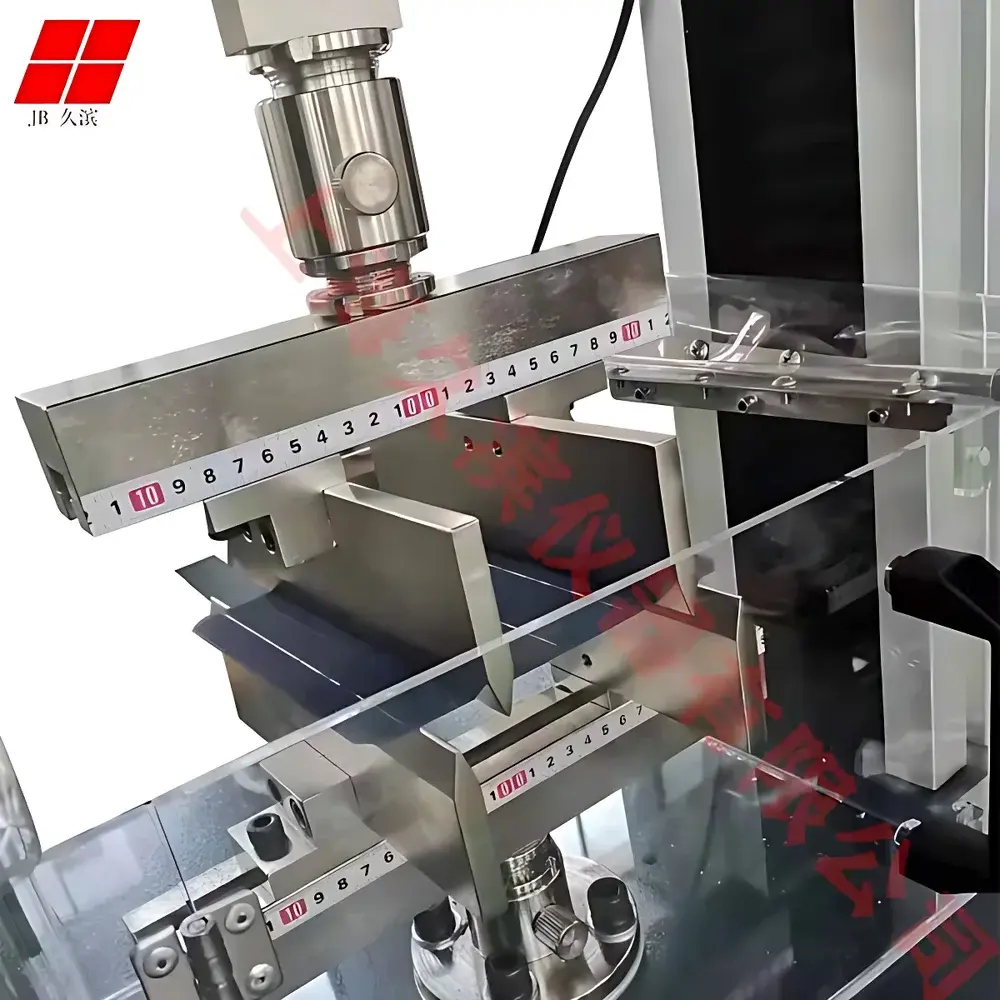
JB Instruments JB Series Four-Point Bending Tester for Smartphone Glass
| Brand | JB Instruments |
|---|---|
| Origin | Shanghai, China |
| Model | JB |
| Instrument Type | Electromechanical Universal Testing Machine |
| Load Capacity | 10 kN |
| Accuracy Class | 0.5 |
| Effective Test Width | 370 mm |
| Effective Test Height | 800 mm |
| Speed Range | 0.001–500 mm/min |
| Drive System | Panasonic Full-Digital AC Servo Controller |
| Mechanical Transmission | TBI Ball Screw (Taiwan) |
| Load Cell | U.S.-Sourced 10 kN Precision Load Cell |
| Force Resolution | 0.02% of full scale |
| Displacement Resolution | ≤ 0.001 mm |
| Control Interface | Color TFT Touchscreen + USB PC Connectivity |
| Fixture | Dedicated Four-Point Bending Fixture for Flat Panel Glass |
| Compliance | ASTM D6109, ISO 178, GB/T 9341, GB/T 1449, JC/T 676, CT 2130, BS EN 1288-3 |
Overview
The JB Instruments JB Series Four-Point Bending Tester is a precision electromechanical universal testing machine engineered specifically for mechanical characterization of brittle and semi-brittle planar materials—primarily smartphone cover glass, tablet display substrates, touch panel laminates, photovoltaic glass, and rigid polymer sheets. Unlike three-point bending, which induces non-uniform stress distribution with a single high-stress peak at the center, four-point bending generates a uniform bending moment between the two inner loading points, enabling highly reproducible measurement of flexural strength, modulus of rupture (MOR), and flexural modulus under controlled displacement or load control. This configuration closely replicates real-world impact scenarios where screen edges are supported (e.g., when a phone rests on a surface) while the central region experiences localized downward force—making it the preferred method for evaluating drop resistance and structural integrity in modern flat-panel electronics.
Key Features
- High-accuracy 0.5-class load measurement system, certified per ISO 7500-1 and ASTM E4, featuring a U.S.-sourced 10 kN load cell with <0.02% full-scale resolution and thermal drift compensation.
- Full-digital AC servo drive system (Panasonic MN series) delivering precise speed control across an ultra-wide range of 0.001–500 mm/min, with closed-loop position feedback and <±0.2% speed accuracy.
- Rigid dual-column frame with TBI preloaded ball screw transmission (Taiwan), ensuring minimal axial play (<5 µm) and long-term geometric stability during repeated high-cycle testing.
- Dedicated four-point bending fixture with hardened steel rollers (Ø6 mm, ±0.01 mm roundness tolerance), adjustable span ratios (support span L = 40–100 mm; loading span a = 10–40 mm) compliant with ASTM D6109 and CT 2130-2012 requirements.
- Integrated 7-inch color TFT touchscreen controller supporting real-time force–displacement curve plotting, automatic peak detection, and on-device data storage (CSV format) with timestamp and operator ID tagging.
- USB 2.0 interface enables direct communication with Windows-based PCs running third-party or custom-developed test software, supporting raw data export, batch report generation, and GLP-compliant audit trail logging.
- Multi-layer safety architecture including dual mechanical end stops, programmable electronic limit switches, emergency stop circuitry (EN 60204-1), and optional interlocked safety enclosure (IEC 61496-1).
Sample Compatibility & Compliance
The JB Four-Point Bending Tester accommodates specimens up to 370 mm wide and 800 mm tall, supporting standardized rectangular coupons (e.g., 100 × 25 mm, 80 × 20 mm) as well as full-size cutouts from production-grade cover glass (Gorilla Glass, Dragontrail, sapphire-coated variants). It meets metrological and procedural requirements of multiple international standards: ASTM D6109 (flexural properties of plastics and wood composites), ISO 178 (plastics—determination of flexural properties), GB/T 9341 (Chinese national standard for plastic flexure), GB/T 1449 (fiber-reinforced polymer composites), JC/T 676 (glass bending strength), CT 2130-2012 (specification for mobile device cover glass), and BS EN 1288-3 (structural glass for buildings). All calibration certificates traceable to NIM (National Institute of Metrology, China) and compatible with ISO/IEC 17025 internal audit protocols.
Software & Data Management
While the embedded touchscreen provides standalone operation—including preset test methods, pass/fail criteria definition, and statistical summary (mean, SD, CV%)—the system supports external PC integration via USB CDC class drivers. Compatible software environments include MATLAB-based custom scripts, LabVIEW VIs, and vendor-neutral ASCII/CSV import into Excel or Minitab. For regulated environments, optional software modules provide 21 CFR Part 11 compliance features: electronic signatures, role-based access control, immutable audit trails, and encrypted database logging. All test reports include metadata such as environmental temperature/humidity (when interfaced with external sensors), calibration validity dates, fixture configuration parameters, and operator verification logs.
Applications
- Quality assurance of chemically strengthened aluminosilicate glass used in flagship smartphones and foldable displays.
- Comparative evaluation of edge-reinforcement techniques (e.g., laser-induced compressive stress zones) via controlled span-length variation.
- R&D validation of new substrate materials including ultra-thin glass (UTG), hybrid polymer-glass laminates, and ceramic composites.
- Process qualification for lamination adhesion strength by measuring interfacial delamination onset during progressive four-point loading.
- Failure mode analysis through synchronized high-speed imaging (up to 10,000 fps) coupled with acoustic emission monitoring (optional add-on).
- Supplier qualification testing per OEM technical specifications (e.g., Apple Spec QD-102, Samsung TS-G-001).
FAQ
What is the difference between three-point and four-point bending in glass testing?
Three-point bending applies load at a single central point, generating maximum stress only at that location; four-point bending uses two inner loading points to create a uniform stress field between them—critical for detecting bulk flaws rather than surface defects.
Can this tester be used for dynamic fatigue testing?
Yes—when paired with optional sinusoidal waveform control firmware and high-frequency load cell (≥5 kHz bandwidth), it supports cyclic flexural fatigue tests per ASTM D7771 and ISO 13003.
Is the fixture compatible with curved or 3D-glass samples?
Standard fixtures are designed for flat specimens; however, custom mandrel-based fixtures with conformal contact surfaces are available upon request for 2.5D and 3D cover glass geometries.
Does the system support automated sample loading/unloading?
Not natively—but the machine’s RS-485 and digital I/O ports enable integration with pneumatic handling systems and robotic arms for unattended batch testing in production-line environments.
How often does the load cell require recalibration?
Per ISO 7500-1, annual recalibration is recommended; however, internal verification using certified reference weights (Class M1, ±50 ppm) can be performed daily or per shift in high-throughput QA labs.



