
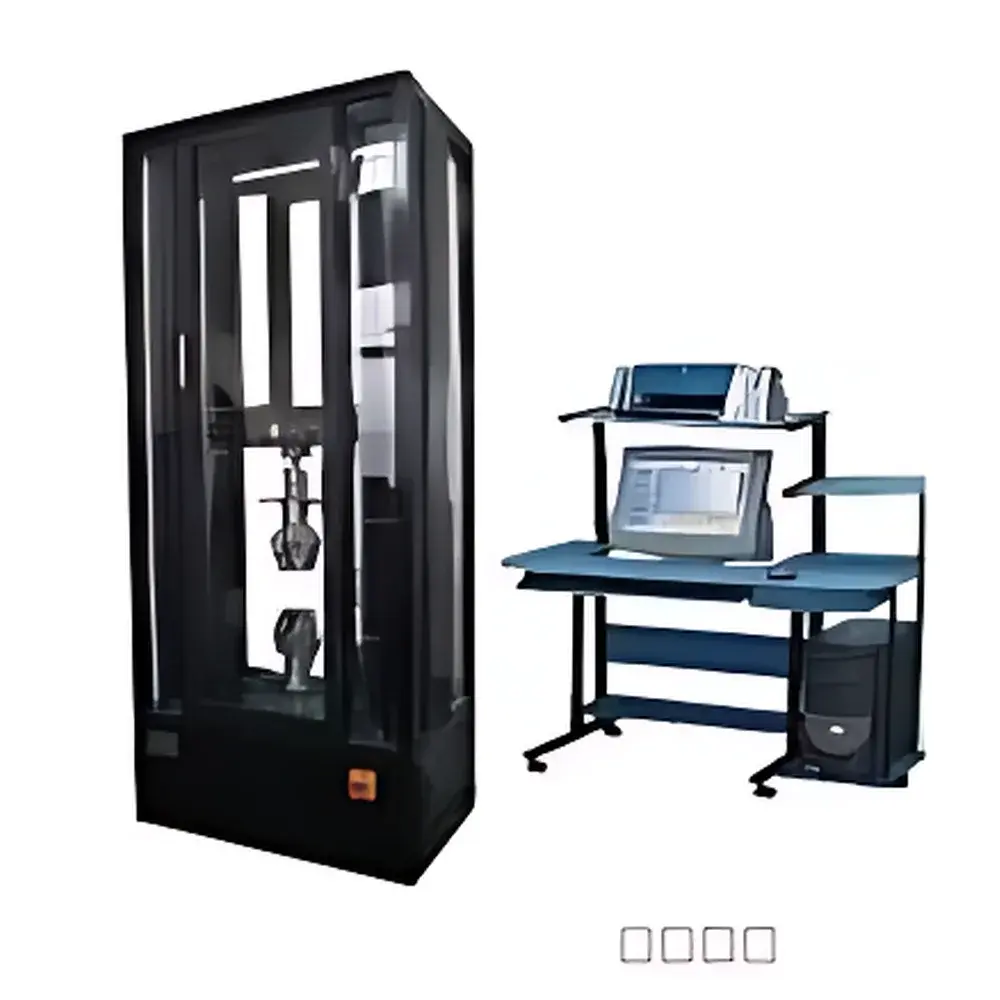
QJ212 Stainless Steel Flexural Strength Testing Machine
| Brand | Qinsun |
|---|---|
| Origin | Shanghai, China |
| Manufacturer Type | Authorized Distributor |
| Country of Origin | China |
| Model | QJ212 |
| Price | USD 21,000 (FOB Shanghai) |
| Max Load Capacity | 500 kN |
| Load Resolution | ±1/250,000 full scale |
| Effective Test Width | 500 mm |
| Effective Tensile Travel | 600 / 800 mm |
| Speed Range | 0.001–1000 mm/min |
| Speed Accuracy | ±1% of reading |
| Displacement Accuracy | ±0.5% of reading |
| Strain Measurement Accuracy | ±0.5% of reading |
| Safety Features | Electronic limit switches, overload protection (110% FS), emergency stop |
| Dimensions (W×D×H) | 1000 × 680 × 2450 mm |
| Weight | 1250 kg |
Overview
The QJ212 Stainless Steel Flexural Strength Testing Machine is a high-capacity universal electromechanical testing system engineered for precision mechanical characterization of metallic and composite materials under static and quasi-static loading conditions. Designed in accordance with ISO 7438, ASTM E290, ISO 178, and EN 10002-1 standards, the system employs closed-loop servo-controlled actuation to perform flexural strength, yield strength, modulus of elasticity, and fracture behavior evaluation on stainless steel specimens—including flat bars, round rods, welded joints, and cold-formed sections. Its rigid four-column load frame, reinforced crosshead guidance, and high-stiffness base ensure minimal deflection during 500 kN bending tests, enabling repeatable measurements of load-deflection curves with sub-micron displacement resolution and force linearity maintained across the full dynamic range.
Key Features
- High-force capacity up to 500 kN with dual-range load cell options (10–500 kN), supporting both three-point and four-point bending configurations per ASTM D790 and ISO 178.
- True digital servo control architecture delivering speed stability of ±1% over the full 0.001–1000 mm/min range, with programmable ramp-hold cycles for fatigue-relevant low-cycle bending protocols.
- Integrated electronic limit protection at upper/lower crosshead positions, complemented by hardware-based overload cutoff (110% of full-scale load) and redundant emergency stop circuitry compliant with IEC 60204-1.
- Motorized crosshead with dual-speed jog mode (fast positioning + fine adjustment) and programmable return-to-start functionality—reducing operator intervention between sequential tests.
- Thermally stable aluminum alloy test chamber enclosure minimizes thermal drift during extended-duration tests; optional environmental chamber integration supports testing from –40 °C to +200 °C.
- Modular fixture interface compatible with standard wedge-grip, pin-bearing, and roller-support assemblies per ISO 7438 Annex A for standardized stainless steel beam testing.
Sample Compatibility & Compliance
The QJ212 accommodates specimens conforming to common stainless steel product forms: hot-rolled plates (EN 10088-2), cold-drawn wires (ISO 16120), seamless tubes (ASTM A269), and laser-welded joints per ISO 14327. Specimen widths up to 500 mm and thicknesses up to 120 mm are supported within the effective test zone. All measurement subsystems—including load transducers, encoder-based displacement sensors, and strain gauges—are calibrated traceable to NIM (National Institute of Metrology, China) and certified to ISO/IEC 17025 requirements. System validation documentation includes as-delivered calibration certificates, uncertainty budgets, and verification reports aligned with ASTM E4 and ISO 7500-1 Class 1 accuracy criteria.
Software & Data Management
Control and analysis are executed via Qinsun’s proprietary WinTest v5.3 software suite, running natively on Windows 10 IoT Enterprise. The application provides real-time synchronized plotting of force–displacement, stress–strain, and moment–deflection curves with user-defined axes scaling and multi-curve overlay. Raw data export is available in CSV, XML, and ASTM E1228-compliant .tdms formats. Audit trail functionality records all operator actions—including method edits, calibration events, and result approvals—with timestamped digital signatures meeting FDA 21 CFR Part 11 requirements for regulated environments. Data integrity safeguards include write-protected archive folders, automatic backup to network drives, and role-based access control (RBAC) with configurable user permissions.
Applications
- Determination of flexural yield strength (σfy) and ultimate flexural strength (σfu) of austenitic (e.g., AISI 304, 316) and duplex stainless steels per EN 10002-1.
- Evaluation of weld joint ductility and notch sensitivity in butt-welded stainless steel plates using three-point bend testing (ISO 5173).
- Quality assurance of cold-bent structural profiles per EN 10080, including measurement of residual curvature and springback behavior.
- Validation of heat-treated condition effects on bending stiffness (EI) and plastic hinge formation in martensitic grades (e.g., 1.4057).
- Support for R&D programs targeting high-strength lean duplex alloys (e.g., UNS S32101), where precise moment-rotation hysteresis data informs finite element model calibration.
FAQ
Does the QJ212 support ASTM E290-compliant bend testing of stainless steel sheet?
Yes—the system meets all geometric and loading requirements specified in ASTM E290 for material thicknesses between 0.1 mm and 12.7 mm, including support span-to-thickness ratios and roller diameter specifications.
Is third-party calibration certification included with delivery?
Each unit ships with an ISO/IEC 17025-accredited calibration certificate issued by a CNAS-recognized laboratory, covering load, displacement, and speed channels.
Can the machine be integrated into an existing LIMS or MES environment?
WinTest v5.3 supports OPC UA server mode and RESTful API endpoints for bidirectional data exchange with enterprise systems, including sample ID synchronization and automated pass/fail flagging.
What is the typical lead time for installation and commissioning?
Standard delivery and on-site commissioning—including mechanical alignment verification, software validation, and operator training—requires 6–8 weeks after order confirmation.



