
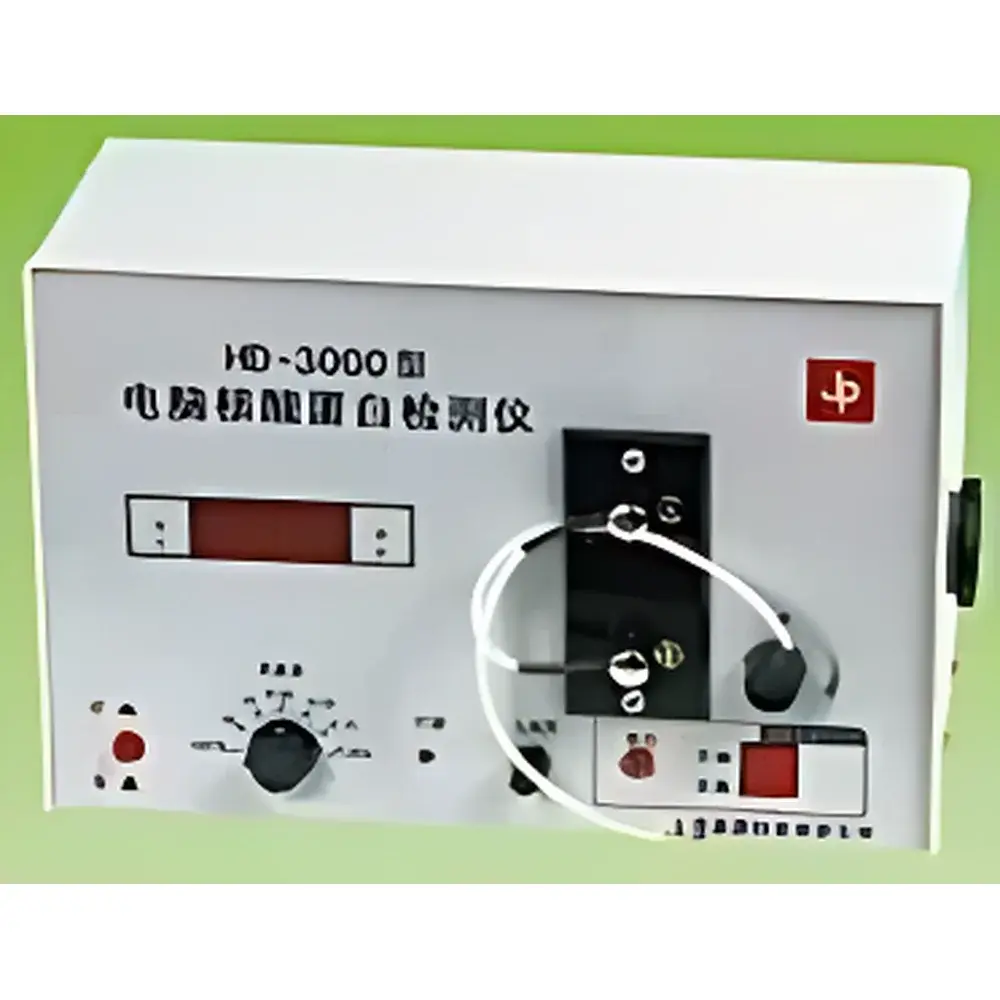
Chu Ding Technology HD-3000 Computer-Controlled UV Detector
| Brand | Chu Ding Technology |
|---|---|
| Model | HD-3000 |
| Detection Principle | Absorbance at Fixed UV Wavelengths (220, 254, 280, 340 nm) |
| Optical Path Length | 3 mm |
| Sample Cell Volume | 80 µL |
| Transmittance Range | 0–100 %T |
| Absorbance Range | 0–2 A |
| Dimensions (W×D×H) | 285 × 170 × 190 mm |
| Display | LED Digital |
| Interface | RS-232 Serial Port for PC Data Acquisition and Plotting |
| Output Signals | 10 mV Recorder Output, Integrator-Compatible Analog Output |
| Photodetector | Imported IP28 Photomultiplier Tube (PMT) |
| Construction | Dark-Box Design |
| Compliance | Designed for GLP-compliant lab environments |
Overview
The Chu Ding Technology HD-3000 Computer-Controlled UV Detector is a precision absorbance-based analytical instrument engineered for real-time detection and quantification of UV-absorbing biomolecules in liquid chromatography (LC) and fast protein liquid chromatography (FPLC) applications. It operates on the principle of Beer–Lambert law-based photometric measurement at four fixed ultraviolet wavelengths—220 nm (peptide bond), 254 nm (nucleic acid aromatic bases), 280 nm (tryptophan/tyrosine), and 340 nm (background reference or low-interference monitoring). The detector integrates a high-stability IP28 photomultiplier tube and optimized optical path geometry (3 mm path length) to deliver consistent signal-to-noise performance across its 0–2 A absorbance range. Its dark-box architecture minimizes ambient light interference, ensuring reproducible baseline stability during extended gradient elutions. Unlike imaging transilluminators, the HD-3000 is not a gel visualization tool; it is a flow-through detector intended for inline integration with peristaltic or syringe pumps, fraction collectors, and chromatographic columns—making it suitable for nucleic acid purification, protein elution profiling, and small-molecule assay development in academic, pharmaceutical, and quality control laboratories.
Key Features
- Four-user-selectable fixed-wavelength UV detection (220, 254, 280, 340 nm) optimized for nucleic acid and protein analysis
- High-sensitivity IP28 photomultiplier tube with low dark current and thermal drift compensation
- 3 mm optical path length flow cell accommodating 80 µL sample volume—compatible with standard microbore LC tubing and low-flow FPLC systems
- Dual-mode digital LED display showing simultaneous % transmittance (0–100 %T) and absorbance (0–2 A) values
- RS-232 serial interface enabling direct connection to Windows-based PCs for real-time chromatogram acquisition, peak integration, and export to CSV or Excel formats
- Standard analog outputs: 10 mV full-scale recorder signal and integrator-compatible voltage output for legacy data systems
- Robust dark-box housing with front-accessible flow cell and sealed optical compartment for long-term operational integrity
Sample Compatibility & Compliance
The HD-3000 is compatible with aqueous and mildly organic mobile phases commonly used in ion-exchange, size-exclusion, and reversed-phase chromatography of proteins, oligonucleotides, and natural product extracts. It supports continuous flow rates up to 5 mL/min (dependent on system backpressure and tubing ID) and exhibits linear response over its specified absorbance range under ISO 6508-1–compliant calibration conditions. While not certified to IEC 61010-1 as a standalone medical device, the instrument conforms to general laboratory equipment safety requirements for Class II electrical appliances. When operated with validated acquisition software and documented calibration procedures, it meets foundational data integrity expectations outlined in FDA 21 CFR Part 11 for non-GMP research use and supports traceable record-keeping for GLP audits.
Software & Data Management
The HD-3000 does not include proprietary software but functions seamlessly with third-party chromatography data systems (CDS) supporting RS-232 ASCII protocol—including open-source tools such as CHROMA, LabChart (with appropriate interface module), and custom Python/Python-based acquisition scripts using PySerial. Raw data streams include timestamped absorbance values at user-defined sampling intervals (default: 0.5 s), allowing reconstruction of retention time vs. signal intensity profiles. Exported CSV files contain headers compliant with ASTM E1947-22 standards for chromatographic data exchange. Audit trails—such as parameter changes, zero/baseline adjustments, and file save events—are maintained externally by the host PC’s operating system and file metadata, provided the acquisition environment follows institutional IT governance policies.
Applications
- Monitoring elution profiles during affinity and ion-exchange purification of recombinant proteins
- Quantifying DNA/RNA concentration and purity (A260/A280 ratio) in column effluents post-extraction
- Tracking labeled metabolites or drug candidates in preparative HPLC fractionation
- Validating column packing homogeneity and buffer exchange efficiency in SEC-MALS workflows
- Educational use in undergraduate biochemistry labs for hands-on LC theory and detector calibration exercises
FAQ
Is the HD-3000 compatible with modern USB-based data acquisition systems?
No—it features only an RS-232 serial port. A USB-to-RS232 adapter (FTDI chipset recommended) is required for connection to contemporary laptops.
Can the instrument be calibrated using NIST-traceable standards?
Yes—absorbance calibration is performed using neutral density filters or potassium dichromate solutions per ISO 6059:2017 guidelines; users must supply certified reference materials.
Does the HD-3000 support variable wavelength scanning?
No—it is a fixed-wavelength detector. Wavelength selection is manual via front-panel switch; no spectral scanning capability is included.
What maintenance is required for the photomultiplier tube?
The IP28 PMT is sealed and requires no routine servicing; however, periodic verification of dark current (< 1 pA at 25°C) and gain stability is recommended annually.
Is the flow cell replaceable by the end user?
Yes—the quartz flow cell is mechanically retained and can be removed and cleaned with 70% ethanol or 0.1 M NaOH (avoid prolonged exposure); replacement cells are available as spare part CD-HD3000-FC.




