
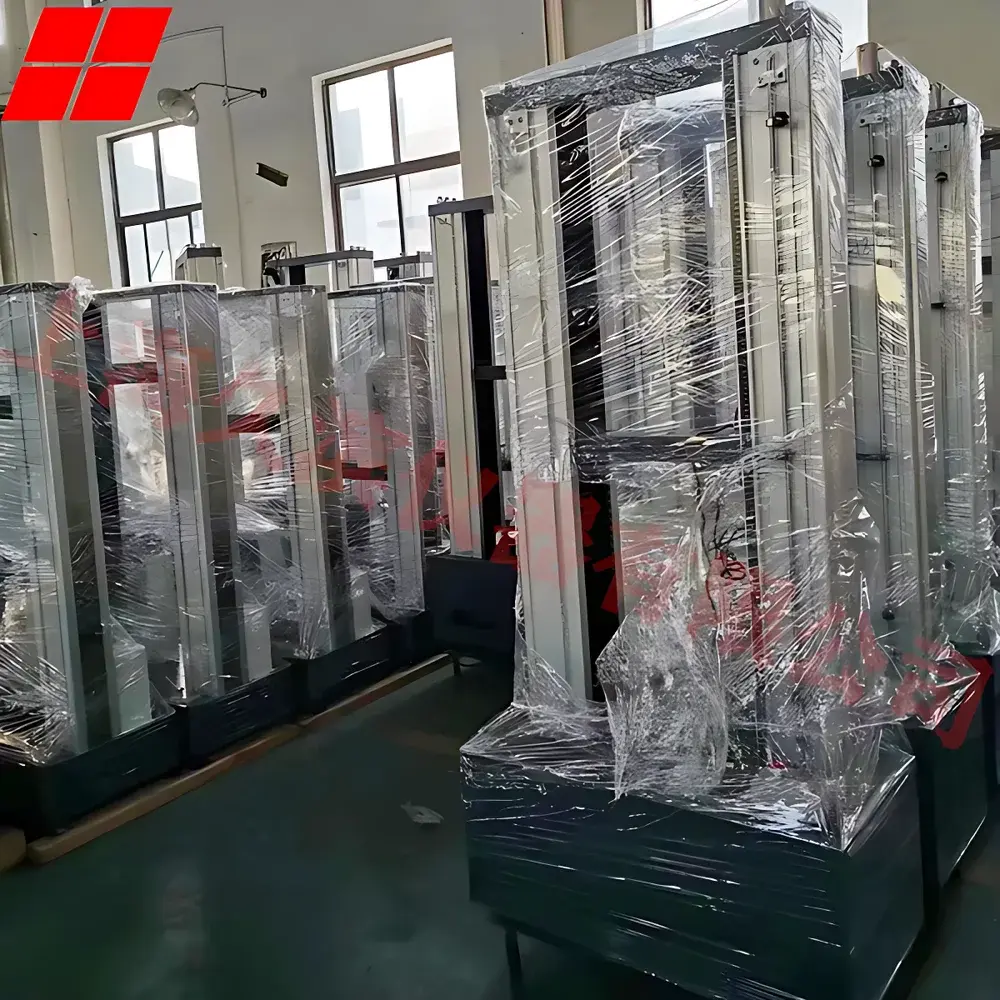
JB-121 High-Temperature 180° Peel Strength Tester for Solar PV Module EVA Encapsulant
| Brand | Jiubin Instruments |
|---|---|
| Model | JB-121 |
| Max Load Capacity | 20 kN |
| Test Temperature | Up to 180 °C |
| Compliance | GB/T 2790–1995, ASTM D903, ISO 8510-2 |
| Force Sensor | Transcell (USA), 20 kN |
| Drive System | Panasonic AC Servo Motor & Controller |
| Force Resolution | ±1/500,000 FS |
| Force Accuracy | ±0.5% of reading |
| Displacement Resolution | 0.05 mm |
| Displacement Accuracy | ±0.5% of reading |
| Strain Measurement | Built-in extensometer, range 0.2–100% FS, accuracy ±0.5% |
| Speed Range | 0.001–500 mm/min (infinitely variable, segmented control) |
| Speed Accuracy | ±1% (<0.01 mm/min), ±0.5% (≥0.01 mm/min) |
| Power Supply | AC 220 V, 50 Hz |
| Dimensions (W×D×H) | 800 × 400 × 1800 mm |
| Weight | ~300 kg |
| Software | Dedicated bilingual (EN/CN) test platform with GLP-compliant audit trail, customizable report templates, and real-time curve overlay |
Overview
The JB-121 High-Temperature 180° Peel Strength Tester is a precision electromechanical testing system engineered specifically for evaluating the interfacial adhesion integrity of ethylene-vinyl acetate (EVA) encapsulants in photovoltaic (PV) module manufacturing. It operates on the standardized 180° peel geometry defined in GB/T 2790–1995 and aligned with ASTM D903 and ISO 8510-2, where a flexible adherend (EVA film) is peeled from a rigid substrate (tempered glass or polymer backsheet) at a controlled rate and constant angle. Unlike ambient-only peel testers, the JB-121 integrates thermal conditioning capability up to 180 °C—enabling simulation of accelerated aging conditions and post-lamination thermal stress states critical to field reliability assessment. Its dual-axis force-displacement architecture, coupled with high-fidelity Transcell load cells and Panasonic servo motion control, ensures traceable, repeatable quantification of peel force (N), peel strength (N/mm), and energy dissipation profiles across the entire debonding front.
Key Features
- Thermally stabilized test chamber with programmable temperature control up to 180 °C, supporting preconditioning and in-situ hot-peel testing per IEC 61215 thermal cycling pre-test protocols.
- 20 kN high-capacity load frame with rigid C-frame construction and low-deflection crosshead design, minimizing parasitic bending moments during high-force peel initiation.
- Integrated high-resolution extensometer (±1/300,000 FS) enabling concurrent measurement of EVA elongation, necking behavior, and plastic deformation—critical for distinguishing cohesive vs. interfacial failure modes.
- Panasonic AC servo drive system delivering ultra-stable velocity control across the full 0.001–500 mm/min range, with closed-loop feedback ensuring compliance with GB/T 2790’s ±10 mm/min tolerance at 100 mm/min nominal speed.
- Multi-unit display and calculation engine supporting direct output in N, kN, kgf, lbf, MPa, and gf—automatically normalized to specimen width (e.g., N/15 mm) per standard reporting conventions.
- Modular grip system with pneumatic-assisted clamping and micro-adjustable alignment fixtures to ensure zero angular deviation at the peel front, eliminating torque-induced measurement artifacts.
Sample Compatibility & Compliance
The JB-121 accommodates standard PV laminate specimens per GB/T 2790–1995: 15 mm wide × ≥300 mm long strips cut from laminated assemblies of 3.2 mm tempered glass/EVA or backsheet/EVA. It supports both single- and double-layer EVA configurations, as well as alternative encapsulants (POE, silicone). All mechanical and thermal subsystems are calibrated and verified against national metrological standards (JJG 139–2014 for tensile testers). The system satisfies essential requirements for ISO/IEC 17025-accredited laboratories, including documented uncertainty budgets for force (≤0.78% k=2) and displacement (≤0.85% k=2). Thermal uniformity within the test zone is validated per ASTM E2203, with ≤±2 °C deviation across the 15 mm specimen width at 180 °C.
Software & Data Management
The bundled JB-TestSuite software provides fully compliant data acquisition, visualization, and reporting under Good Laboratory Practice (GLP) principles. It features electronic signature support, role-based user access control, and immutable audit trails meeting FDA 21 CFR Part 11 requirements. Real-time force–displacement curves are overlaid with automatic detection of onset peel force, plateau region, and maximum peak—all annotated with timestamped metadata (temperature, speed, operator ID, calibration certificate ID). Reports export to PDF, Excel, and XML formats, with configurable templates aligned to internal QA workflows or third-party certification bodies (TÜV Rheinland, UL, CSA). Firmware and application updates are delivered remotely without licensing fees, ensuring continuous regulatory alignment.
Applications
- Quantitative evaluation of EVA–glass and EVA–backsheet interfacial bond strength before and after damp heat (DH1000), thermal cycling (TC200), and humidity freeze (HF10) stress sequences.
- Comparative screening of EVA formulations (VA content, crosslink density, additive packages) under elevated temperature conditions mimicking module operating temperatures.
- Root cause analysis of delamination failures via peel energy integral (J/m²) and failure mode classification (adhesive, cohesive, mixed).
- Validation of lamination process parameters—including dwell time, pressure profile, and ramp rates—against adhesion performance targets.
- Supporting qualification testing per IEC 61215-2 MQT 19 (adhesion) and UL 1703 Section 14 (bond strength).
FAQ
Does the JB-121 meet international peel testing standards beyond GB/T 2790?
Yes. Its mechanical configuration, sensor accuracy, and software algorithms are validated against ASTM D903 (peel resistance of adhesive bonds) and ISO 8510-2 (180° peel test for flexible-to-rigid joints), enabling cross-border test equivalence.
Can the system perform boiling water pretreatment followed by hot peel testing?
While the JB-121 itself does not include a built-in boiling bath, its thermal chamber accepts pre-conditioned specimens. Users routinely conduct 3-hour boil tests per internal SOPs, then transfer specimens to the heated test zone at 100 °C for immediate peel evaluation—maintaining thermal history integrity.
Is strain measurement mandatory for EVA peel testing?
Not required by GB/T 2790, but highly recommended. The integrated extensometer captures EVA’s viscoelastic elongation prior to debonding—a key indicator of crosslink maturity and network integrity that correlates strongly with long-term field performance.
How is traceability ensured for calibration and maintenance records?
All calibration events (load cell, encoder, thermal sensor) are logged with digital certificates embedded in the software database. Maintenance logs—including bearing replacement, grip refurbishment, and thermal sensor verification—are time-stamped, signed, and archived with version-controlled backups.
What level of technical support is provided for method validation?
Jiubin Instruments supplies application notes, uncertainty calculation worksheets, and remote assistance for IQ/OQ/PQ protocol development—free of charge, with no subscription or renewal fees.



