
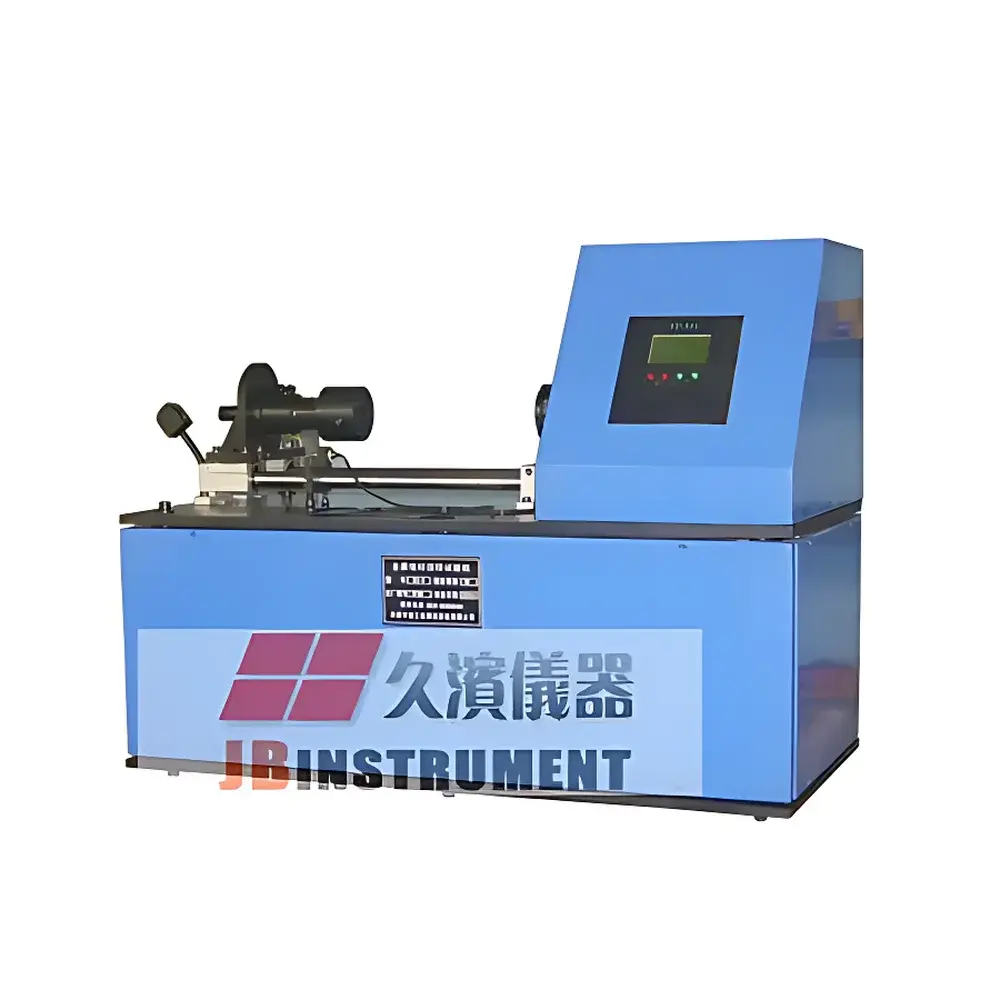
JB-Brookfield JB-X6 Metal and Non-Metal Wire Torsion Testing Machine
| Brand | JB-Brookfield |
|---|---|
| Origin | Shanghai, China |
| Model | JB-X6 |
| Specimen Diameter Range | 0.1–10.0 mm |
| Gauge Length | 500 mm |
| Clamping Options | Flat Jaw (0–3 mm), Round Jaw 1 (3–6 mm), Round Jaw 2 (6–10 mm) |
| Torsion Speeds | 30 / 60 / 90 / 120 rpm |
| Speed Accuracy | ±10% |
| Minimum Count Resolution | 0.1 turn |
| Coaxiality of Grips | < 0.4 mm |
| Guide Rail Parallelism | < 0.2 mm |
| Jaw Hardness | 50–65 HRC |
| Dimensions (L×W×H) | 1360 × 430 × 600 mm |
| Weight | 200 kg |
| Power Supply | 220 V, 50 Hz |
| Sound Pressure Level | < 70 dB(A) |
| Compliance | GB/T 239–1999, ISO 7800:1984, ISO 9649:1990 |
Overview
The JB-Brookfield JB-X6 Metal and Non-Metal Wire Torsion Testing Machine is a precision-engineered mechanical testing system designed to evaluate the torsional deformation behavior of metallic and non-metallic wire specimens under controlled unidirectional or bidirectional rotational loading. Based on the principle of pure torsion—where torque is applied coaxially about the specimen’s longitudinal axis—the JB-X6 quantifies ductility, surface integrity, and subsurface defect sensitivity through standardized twist-count failure analysis. It operates in accordance with fundamental mechanics of materials theory, where angular displacement, rotational speed, and cumulative twist cycles are rigorously monitored to assess resistance to shear-induced plastic flow and fracture initiation. This instrument serves as a critical quality assurance tool in wire drawing, fastener manufacturing, medical device component production, and aerospace-grade alloy validation workflows.
Key Features
- Automated torsion actuation via high-torque, low-backlash geared motor (TaiChuang brand) with digitally regulated speed control (Delixi variable-frequency drive), enabling repeatable selection among four discrete rotational speeds: 30, 60, 90, and 120 rpm.
- Dual-mode operation supporting both unidirectional and bidirectional torsion protocols per ISO 7800 and ISO 9649, respectively—each cycle defined as one full 360° rotation about the specimen’s central axis.
- Modular jaw assembly with three interchangeable gripping configurations: flat jaws for fine wires (0–3 mm), round jaw set #1 (3–6 mm), and round jaw set #2 (6–10 mm), all hardened to 50–65 HRC for wear resistance and consistent clamping force distribution.
- Optical encoder-based counting system (dual photoelectric sensors) delivering 0.1-turn resolution for precise cycle registration and endpoint detection at either preset twist count or catastrophic failure.
- Rigid cast-iron base frame with precision-machined linear guide rails (parallelism < 0.2 mm) and dynamically aligned grip spindles (coaxiality < 0.4 mm) ensuring minimal parasitic bending moments during test execution.
- Integrated LCD interface with Chinese-language menu navigation—designed for intuitive parameter entry, real-time status display, and pass/fail result logging without external PC dependency.
Sample Compatibility & Compliance
The JB-X6 accommodates wire specimens with nominal diameters ranging from 0.1 mm to 10.0 mm, covering common grades including copper, aluminum, stainless steel (e.g., 304, 316), titanium alloys, piano wire, and polymer monofilaments. Its 500 mm gauge length provides sufficient span for stable torsional moment development while minimizing end-effects. The system conforms to national and international torsion testing standards: GB/T 239–1999 (China), ISO 7800:1984 (unidirectional), and ISO 9649:1990 (bidirectional). Mechanical construction complies with GB/T 2611 for general requirements of testing machines, and packaging meets JB/T 614 for export-grade mechanical equipment handling. While not inherently 21 CFR Part 11 compliant, raw test data—including twist count, direction sequence, and failure mode annotation—can be manually transcribed into validated LIMS or ELN systems for GLP/GMP traceability.
Software & Data Management
The JB-X6 operates as a standalone electromechanical platform with embedded firmware controlling motion sequencing, sensor signal acquisition, and on-device result visualization. No proprietary software installation is required; however, all test parameters and outcomes—including start/stop timestamps, selected speed mode, total twist count, and observed failure type (e.g., necking, helical cracking, or complete separation)—are retained in non-volatile memory and displayed on the front-panel LCD. For laboratory integration, users may export results via manual transcription or optional RS-232/USB data logging modules (available as field-upgrade kits). Audit trails are maintained through physical logbooks or externally managed electronic records, supporting basic ISO/IEC 17025 documentation requirements for calibration and test procedure adherence.
Applications
- Quality control of drawn copper wire used in magnet coil winding and automotive harnesses.
- Evaluation of stainless-steel suture wire fatigue resistance prior to sterilization and packaging.
- Verification of titanium alloy orthodontic archwire torsional resilience across clinical bending angles.
- Comparative assessment of galvanized steel wire ductility after zinc-coating process variations.
- Research into torsional fracture mechanisms in shape-memory NiTi alloys under cyclic loading.
- Validation of polymer monofilament twist stability for fishing line and textile reinforcement applications.
FAQ
What standards does the JB-X6 officially support?
The JB-X6 is fully aligned with GB/T 239–1999, ISO 7800:1984, and ISO 9649:1990 for torsion testing methodology, specimen preparation, and result reporting.
Can the machine test non-circular cross-sections?
No—it is optimized for cylindrical or near-cylindrical wire geometries; flat or rectangular strips require alternative torsion fixtures not supplied with the base configuration.
Is calibration certification included?
A factory-issued calibration report is provided with each unit, referencing traceable torque and angular displacement standards; annual recalibration is recommended per ISO/IEC 17025 guidelines.
What maintenance is required for long-term accuracy?
Monthly inspection of jaw surfaces for wear or debris, biannual lubrication of guide rails and gearboxes, and periodic verification of optical sensor alignment using certified reference specimens.
Does the JB-X6 meet CE or UL safety directives?
It complies with Chinese GB safety standards (GB 5226.1) and carries CCC marking; CE/UL certification requires additional regional conformity assessment and is available upon request for export orders.



