
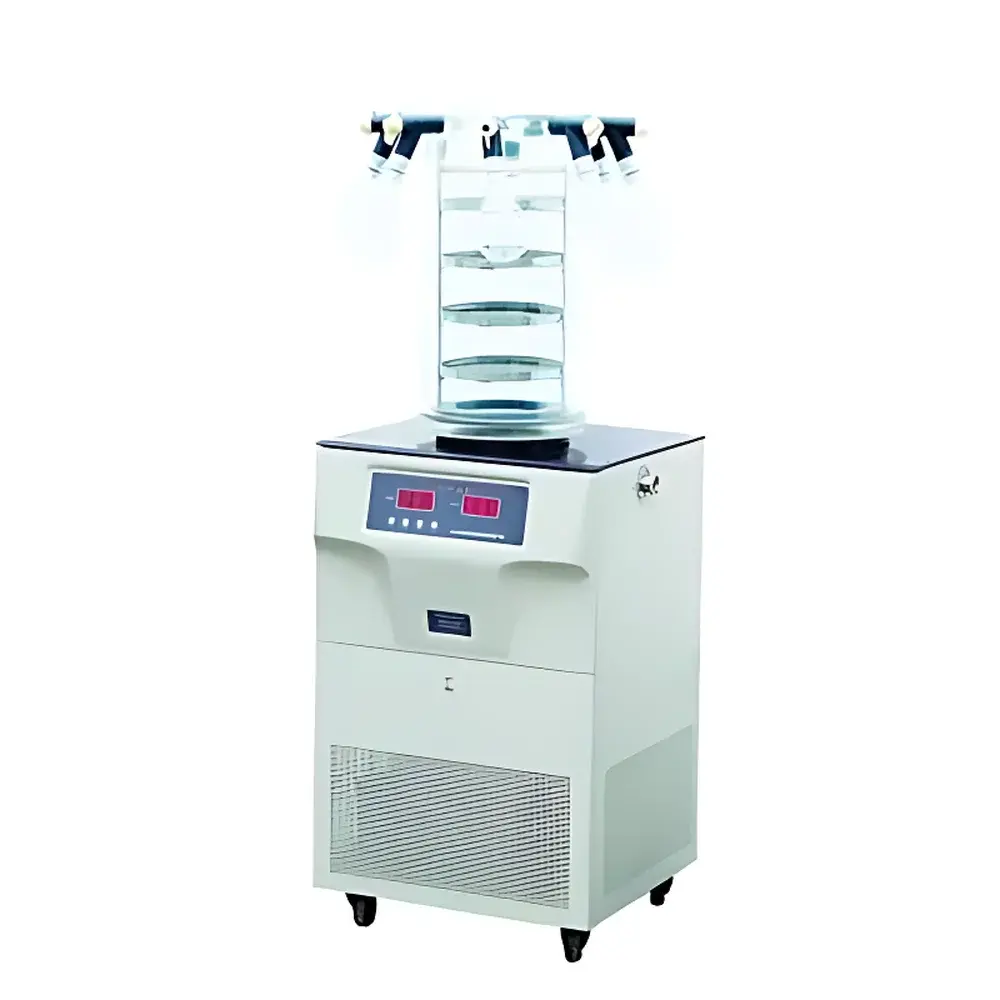
Lab Companion FD-1C-80 Vertical Benchtop Freeze Dryer with Manifold and Bottle Suspension
| Origin | Shanghai, China |
|---|---|
| Manufacturer Type | Authorized Distributor |
| Regional Origin | Domestic (China) |
| Model | FD-1C-80 |
| Price | USD 7,600 (FOB Shanghai) |
| Condenser Temperature | ≤ −80 °C |
| Ultimate Vacuum | < 20 Pa |
| Ice Capacity | 4 kg/24 h |
| Condenser Dimensions | Φ200 × 200 mm |
| Sample Tray Diameter | Φ200 mm |
| Bottle Capacity | 24 × standard 10–50 mL vials |
| Power Supply | 220 V, 50 Hz, 1300 W |
| Overall Dimensions | 492 × 540 × 800 mm |
| Net Weight | ~78 kg |
Overview
The Lab Companion FD-1C-80 is a vertically configured, benchtop freeze dryer engineered for laboratory-scale lyophilization of heat-sensitive biological and pharmaceutical samples. It operates on the principle of sublimation under high vacuum: frozen water is removed directly from the solid to vapor phase without passing through the liquid state, preserving structural integrity, bioactivity, and long-term stability of labile compounds. Designed specifically for solvent-containing formulations—including those with low-boiling-point organic solvents such as acetone, methanol, or ethyl acetate—the FD-1C-80 integrates a dual-stage cascade refrigeration system capable of sustaining condenser temperatures ≤ −80 °C. This ultra-low temperature enables efficient trapping of volatile solvents that would otherwise bypass conventional −50 °C condensers, significantly expanding compatibility beyond aqueous systems. Its modular architecture supports interchangeable drying configurations—manifold-mounted vials, glass bell jar assemblies, and optional stoppering mechanisms—making it suitable for method development, QC batch processing, and small-batch GMP-aligned pilot runs in academic, biotech, and contract research laboratories.
Key Features
- Vertical footprint design minimizes floor space requirements while maintaining ergonomic access to all operational zones.
- Dual-stage cascade refrigeration system with imported hermetic compressors ensures stable condenser temperatures ≤ −80 °C and low acoustic emission (< 58 dB(A)).
- Stainless-steel condenser chamber with smooth, weld-free interior surface and no internal coil obstructions—enhancing cleanability and corrosion resistance per ISO 14644-1 Class 7 cleanroom maintenance protocols.
- Patented air-guiding cylinder structure increases effective condensing surface area by up to 22%, accelerating ice capture kinetics during primary drying.
- Large-diameter condenser port (Φ200 mm) permits direct pre-freezing of small-volume samples inside the chamber, eliminating separate ultra-low freezer dependency.
- Integrated inert gas backfill valve (standard stainless-steel diaphragm type) supports controlled nitrogen or argon purging post-drying to prevent oxidation and moisture reabsorption.
- Optically clear polymethyl methacrylate (PMMA) bell jar with reinforced safety ring provides real-time process visibility while meeting EN 61000-6-3 EMC and EN 61000-6-4 immunity standards.
- Digital PID controller with dual-channel display shows real-time condenser temperature and chamber pressure (0–100 Pa range, ±0.5 Pa accuracy), with data logging via RS-485 interface.
Sample Compatibility & Compliance
The FD-1C-80 accommodates a broad spectrum of sample formats: 24× standard serum vials (10–50 mL), custom glassware via universal KF-25 vacuum flanges, and tray-based formulations up to 1.2 L total volume. Its −80 °C condenser reliably captures solvents with vapor pressures exceeding 100 mbar at −40 °C—enabling lyophilization of formulations containing acetonitrile, THF, DMSO, and chloroform mixtures. The system complies with core design and safety references including IEC 61010-1 (electrical safety), ISO 22000 (food-grade applicability), and ASTM F2337-04 (lyophilizer performance verification). While not certified for full 21 CFR Part 11 compliance out-of-box, its digital controller supports audit-trail-ready data export when paired with validated third-party SCADA software—facilitating GLP/GMP documentation workflows in regulated environments.
Software & Data Management
The FD-1C-80 features a built-in microprocessor-based control panel with non-volatile memory storing up to 10 user-defined drying protocols. Real-time temperature and pressure values are displayed on a 4.3-inch TFT LCD with backlight. Process data (time-stamped condenser temp, chamber pressure, and elapsed time) can be exported via USB or RS-485 to external PCs running Windows-compatible CSV-loggers. Optional LabView-compatible drivers enable integration into centralized lab informatics platforms. All parameter changes are timestamped and logged locally, supporting traceability requirements aligned with ISO/IEC 17025 clause 7.7 (result reporting) and FDA guidance on electronic records (21 CFR Part 11 Subpart B).
Applications
- Lyophilization of monoclonal antibodies, recombinant proteins, and plasmid DNA in buffer systems containing tertiary butanol or ethanol co-solvents.
- Stabilization of diagnostic enzyme conjugates and ELISA reagents requiring residual moisture < 1.5% w/w.
- Preparation of reference standards for LC-MS quantitation where solvent removal must avoid thermal degradation.
- Routine drying of microbial cultures, probiotic suspensions, and plant extract concentrates for shelf-life extension.
- Method optimization for parenteral drug product development—particularly for amorphous solid dispersions and nanoparticle formulations.
FAQ
Can the FD-1C-80 handle samples containing >10% organic solvent by volume?
Yes—its −80 °C condenser achieves >92% solvent capture efficiency for common polar organics (e.g., methanol, acetonitrile) at feed concentrations up to 25% v/v, provided chamber pressure remains below 15 Pa during primary drying.
Is pre-freezing in a separate ultra-low temperature freezer required?
No—small-volume samples (≤ 50 mL total) may be frozen directly inside the condenser chamber using the integrated pre-freeze mode, reducing cross-contamination risk and workflow complexity.
What vacuum pump compatibility does the system support?
The unit uses standardized KF-25 vacuum ports and is compatible with dual-stage rotary vane pumps (≥ 4 m³/h capacity) and oil-free scroll pumps meeting ISO 8573-1 Class 0 purity requirements.
Does the system include validation documentation (IQ/OQ)?
Factory-issued IQ templates and OQ test protocols (covering vacuum decay, temperature uniformity, and condenser recovery) are available upon request; final site-specific qualification remains the responsibility of the end user per ISO 13485:2016 clause 7.5.2.
How often does the condenser require defrosting during continuous operation?
Under typical 24-hour cycling with ≤ 3 kg ice load, manual defrost is required every 48–72 hours; automated defrost cycles are not included but can be retrofitted via third-party PLC modules.



