
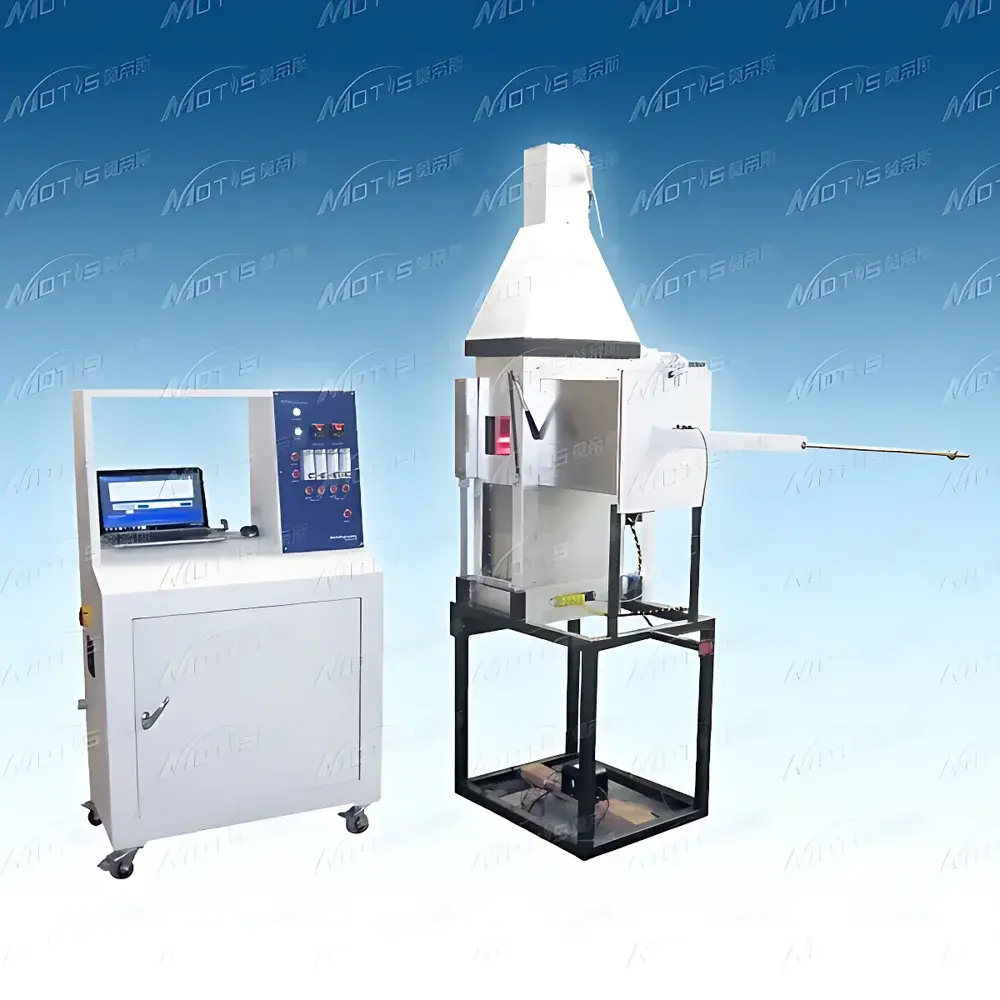
Marlin Engineering ME 1200-1 OSU Heat Release Rate Calorimeter
| Brand | Marlin Engineering (MEI) |
|---|---|
| Origin | USA |
| Model | ME 1200-1 |
| Compliance | FAA-Approved OSU Apparatus |
| Standards | FAR Part 25 Appendix F Part IV, Airbus AITM 2.0006, Boeing BSS 7322, ASTM E906 |
| Sample Size | 15 cm × 15 cm (vertical orientation) |
| Radiant Heat Flux | 35 kW/m² (adjustable: 20–50 kW/m²) |
| Test Duration | Up to 15 min |
| Output Metrics | Peak Heat Release Rate (PHRR), Total Heat Release at 15 min (THR₁₅), Time-to-Flashover Estimation |
| Calibration | Water-cooled thermopile with mass flow-controlled calibration burner |
| Airflow Control | Orifice plate flowmeter + PID-regulated constant-temperature/constant-flow supply |
| Data Acquisition | Integrated high-speed DAQ system with NIST-traceable thermal sensors |
Overview
The Marlin Engineering ME 1200-1 OSU Heat Release Rate Calorimeter is a federally certified, FAA-recognized apparatus engineered for precise quantification of heat release kinetics during the early-stage combustion of aerospace and transportation materials. Based on the original Ohio State University (OSU) design developed by Dr. Smith in 1972, this instrument implements the oxygen consumption calorimetry principle—where heat release rate (HRR) is derived from the measured depletion of oxygen in the exhaust stream, combined with real-time airflow, temperature, and enthalpy differential calculations across the insulated test chamber. Unlike cone calorimeters that rely on radiant exposure at a defined angle, the OSU method employs a vertically oriented specimen subjected to a controlled, spatially uniform radiant flux (standardized at 35 kW/m²) from glow-bar emitters, simulating critical fire exposure conditions encountered in aircraft cabin interiors, railcar composites, and military vehicle linings. Its primary output—peak HRR (PHRR)—serves as a key regulatory pass/fail metric under FAR 25.853 and related airworthiness directives.
Key Features
- Stainless steel test chamber with high-temperature borosilicate viewing window for real-time flame propagation observation and optical diagnostics integration
- Four independently controlled glow-bar radiant heaters delivering stable, uniform 35 kW/m² flux (calibratable to 20–50 kW/m² for extended material screening)
- Dual independent PID temperature controllers for precise regulation of radiant source and chamber ambient conditions
- Automated pneumatic specimen insertion mechanism with interlocked shield door to ensure operator safety and thermal boundary integrity
- Modular burner configuration: fixed upper burner + motorized lower burner for optimized ignition positioning and repeatability
- Calibration-grade T-type burner assembly with integrated mass flow controller for thermopile validation per ASTM E1354 and ISO 5660-1 traceability protocols
- Water-cooled thermopile sensor for direct incident radiant flux measurement, actively maintained at <50 °C surface temperature during operation
- Constant-temperature, constant-flow air supply system regulated via orifice plate flowmeter and feedback-controlled heating elements
- High-resolution data acquisition system sampling thermocouples (inlet/outlet air, chamber wall), pressure transducers, and gas analyzers at ≥10 Hz
Sample Compatibility & Compliance
The ME 1200-1 accommodates rigid and semi-rigid flat specimens measuring exactly 15 cm × 15 cm, mounted vertically in a non-ventilated, insulated enclosure. Specimen thickness is retained at as-used condition—no machining or thickness normalization is applied, preserving real-world installation fidelity. The system fully complies with FAA-mandated test procedures outlined in FAR Part 25 Appendix F Part IV, and is formally accepted by major OEMs including Airbus (AITM 2.0006) and Boeing (BSS 7322). It also satisfies ASTM E906 (“Standard Test Method for Heat and Visible Smoke Release Rates for Materials and Products”) for comparative fire performance benchmarking. All hardware, firmware, and software components are designed to support GLP-compliant audit trails, with timestamped raw data storage, user-access logs, and electronic signature capability aligned with FDA 21 CFR Part 11 requirements where applicable.
Software & Data Management
The instrument operates with proprietary OSU TestSuite™ software, providing real-time visualization of HRR, mass loss rate, smoke obscuration (via optional laser extinction module), and gas-phase species concentration (when interfaced with FTIR or electrochemical gas analyzers). Data files are saved in ASCII-delimited format with embedded metadata (operator ID, calibration date, ambient RH/T, specimen ID), ensuring full traceability. Software includes automated PHRR detection algorithms, THR₁₅ integration, time-to-sustained-flaming calculation, and customizable reporting templates compliant with OEM submission formats. Raw sensor outputs are stored without interpolation, enabling third-party reanalysis using alternative enthalpy models or correction factors per ISO TR 15659 guidelines.
Applications
This calorimeter is routinely deployed in aerospace material qualification labs for seat cushion foams, decorative laminates, insulation blankets, and wire jacketing. It supports developmental fire modeling by generating HRR curves used as input for CFD-based fire simulation tools such as FDS and SMARTFIRE. In regulatory contexts, it delivers the definitive PHRR value required for FAA Form 8110-9 certification packages. Additional applications include comparative screening of intumescent coatings, evaluation of flame-retardant synergists in polymer blends, and validation of reduced-hazard material substitutions under MIL-STD-2031 and NFPA 409 Annex D. When coupled with FTIR spectroscopy, it enables concurrent quantification of CO, CO₂, HCN, HCl, HBr, and NOx yields—supporting toxicity hazard assessment per ISO 13344 and ASTM E1678.
FAQ
What standards does the ME 1200-1 validate against?
It is FAA-approved for FAR Part 25 Appendix F Part IV and meets Airbus AITM 2.0006, Boeing BSS 7322, and ASTM E906 requirements.
Can the radiant heat flux be adjusted during testing?
Yes—default 35 kW/m² is configurable between 20 and 50 kW/m² using calibrated glow-bar power modulation and thermopile verification.
Is the system compatible with FTIR gas analysis?
Yes; dedicated flanged exhaust port and heated transfer line interface enable seamless integration with commercial FTIR systems for real-time toxicant speciation.
How is thermal calibration performed?
A motorized T-type calibration burner with NIST-traceable mass flow controller delivers known energy input to the water-cooled thermopile, validating response linearity prior to each test series.
Does the software support 21 CFR Part 11 compliance?
Yes—electronic signatures, audit trail logging, role-based access control, and immutable raw data archiving are implemented per Part 11 Subpart C specifications.



