
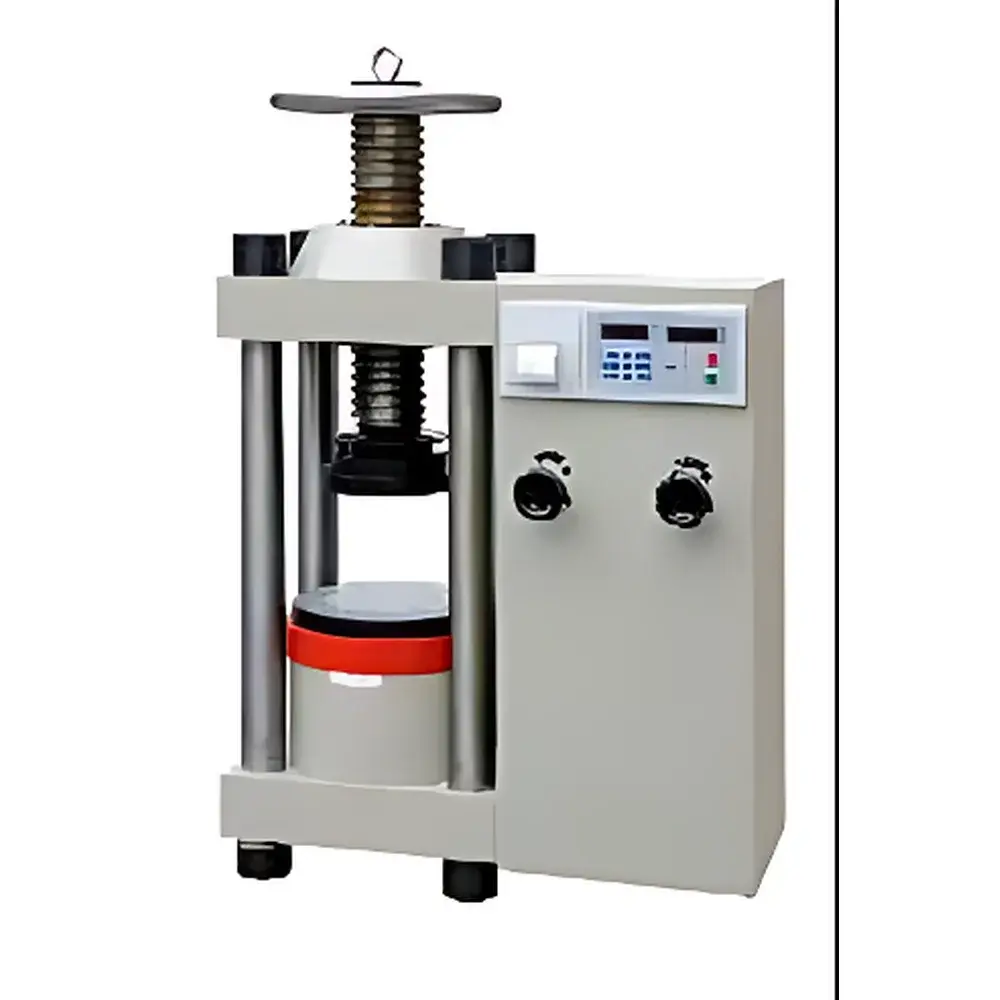
Jiubin Instruments JB/YES-2000 Electro-Hydraulic Compression Testing Machine
| Brand | Jiubin Instruments |
|---|---|
| Origin | Shanghai, China |
| Model | JB/YES-2000 |
| Max Test Load | 2000 kN |
| Load Range | 200–2000 kN |
| Load Indication Error | ≤ ±1% of reading |
| Load Resolution | 0.01 kN |
| Hydraulic Pump Rated Pressure | 40 MPa |
| Platen Diameter | φ225 mm / φ300 mm |
| Max Platen Spacing | 320 mm |
| Piston Diameter | φ250 mm |
| Piston Stroke | 30 mm |
| Motor Power | 0.75 kW (3-phase) |
| Dimensions (W×D×H) | 800 × 500 × 1200 mm |
| Weight | 750 kg |
Overview
The Jiubin Instruments JB/YES-2000 Electro-Hydraulic Compression Testing Machine is a statically rated, dual-platen compression testing system engineered for high-force mechanical characterization of construction materials under controlled quasi-static loading conditions. It operates on the principle of servo-controlled hydraulic actuation, where a precision-engineered piston—driven by a regulated oil circuit—applies axial compressive force to standardized specimens between parallel platens. The system conforms to fundamental mechanical testing paradigms defined in ASTM C39/C39M (concrete cylinders), ASTM C109/C109M (mortar cubes), ISO 7500-1 (static calibration of force-proving instruments), and GB/T 3159–2008 (Chinese national standard for universal testing machines). Designed for laboratory and quality control environments, the JB/YES-2000 delivers repeatable load application up to 2000 kN with traceable force measurement integrity, making it suitable for routine compliance verification and structural material qualification.
Key Features
- Robust electro-hydraulic architecture featuring a 40 MPa-rated gear pump, integrated filtration system, and pressure-regulated directional valve assembly for stable force ramping and dwell control.
- Dual interchangeable platens (φ225 mm and φ300 mm) mounted on rigid C-frame structure to accommodate diverse specimen geometries while maintaining parallelism within ±0.02 mm/m per ISO 7500-1 alignment requirements.
- Mechanically adjusted test space via calibrated handwheel mechanism—enabling precise pre-load positioning without motorized actuators, minimizing thermal drift and enhancing long-term repeatability.
- High-resolution load measurement using a factory-calibrated 2000 kN capacity load cell with 0.01 kN digital resolution and ≤ ±1% indication error across 10–100% of full scale.
- Integrated digital controller mounted directly on the frame, providing real-time load readout, peak hold, zero tracking, and manual load rate selection—fully independent of external PCs or software dependencies.
- Self-contained electrical cabinet with CE-compliant 3-phase 0.75 kW motor drive, thermal overload protection, and E-stop interlock circuitry meeting IEC 60204-1 safety standards.
Sample Compatibility & Compliance
The JB/YES-2000 accommodates standard civil engineering specimens including but not limited to: cylindrical concrete specimens (100 × 200 mm or 150 × 300 mm per ASTM C39), cubic mortar samples (70.7 × 70.7 × 70.7 mm per ASTM C109), fired clay bricks (240 × 115 × 53 mm per ASTM C67), and autoclaved aerated concrete (AAC) blocks. Its 320 mm maximum platen spacing and 30 mm piston stroke support both full-height compression tests and confined creep evaluations. All force measurements are traceable to national metrological standards; the load cell is certified to ISO/IEC 17025-accredited calibration protocols. The machine satisfies functional requirements for ISO 16750-2 (mechanical environmental testing), EN 12390-3 (concrete compressive strength), and GB/T 50081–2019 (standard test method for mechanical properties of ordinary concrete).
Software & Data Management
While the JB/YES-2000 operates as a standalone instrument with embedded digital controller, its analog output interface (0–10 V or 4–20 mA) enables seamless integration with third-party data acquisition systems compliant with IEEE 1451.2 transducer electronic data sheet (TEDS) protocols. Optional RS232/RS485 serial communication allows connection to LIMS platforms supporting ASTM E1382-compliant test data exchange formats. For regulated environments—including those governed by GLP or GMP—the system supports audit-trail-enabled data logging when paired with validated PC-based acquisition software (e.g., LabVIEW™ with NI DAQmx drivers). All raw load values meet FDA 21 CFR Part 11 requirements for electronic records when implemented with appropriate user access controls and electronic signatures.
Applications
- Compressive strength validation of Portland cement concrete, high-performance concrete (HPC), and fiber-reinforced concrete (FRC) per ACI 214R guidelines.
- Quality assurance testing of masonry units, refractory bricks, and lightweight aggregate blocks in precast manufacturing facilities.
- Research-grade evaluation of geopolymer binders, alkali-activated materials, and recycled aggregate concretes under sustained loading conditions.
- Calibration reference for field-portable rebound hammers and ultrasonic pulse velocity (UPV) devices through correlation studies.
- Teaching laboratories requiring robust, low-maintenance equipment for undergraduate mechanics of materials instruction.
FAQ
What is the recommended maintenance schedule for the hydraulic system?
Hydraulic oil should be replaced every 12 months or after 1,000 operating hours, whichever occurs first. The filter element must be inspected quarterly and replaced if clogging is observed. Annual recalibration of the load cell and verification of platen parallelism are advised.
Can the JB/YES-2000 perform flexural or tensile tests?
No. This is a dedicated compression-only machine. Flexural or splitting tensile tests require auxiliary fixtures (e.g., third-point loading beams or Brazilian disc holders), which are not included and are not structurally supported by the base configuration.
Is the digital controller compatible with Windows-based reporting software?
Yes—via optional analog-to-digital conversion modules or serial protocol adapters. Raw load signals can be streamed into Excel, MATLAB, or custom Python scripts using standard COM port configurations.
Does the machine meet CE marking requirements?
The electro-mechanical subsystem complies with the essential health and safety requirements of the EU Machinery Directive 2006/42/EC. CE documentation is available upon request for end-user self-declaration.
What is the typical lead time for factory calibration and commissioning?
Standard calibration and mechanical verification take 5 working days post-shipment. On-site commissioning with operator training is available as an optional service, subject to regional technician availability.
Related Products



