
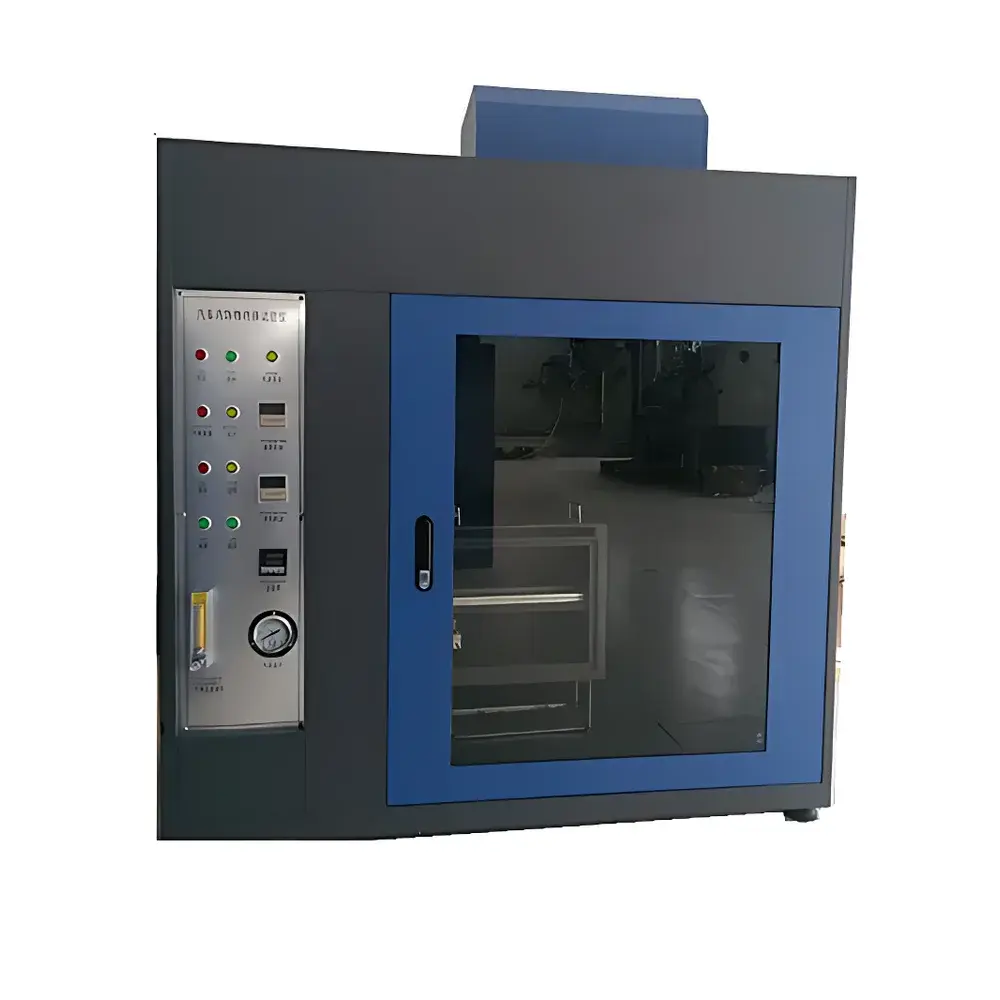
Jiubin Instruments FMVSS 302 Automotive Interior Materials Horizontal Burning Test Chamber
| Brand | Jiubin Instruments |
|---|---|
| Model | FMVSS 302 |
| Origin | Shanghai, China |
| Compliance | FMVSS 302, GB 8410-2006, PV3357 |
| Flame Height | 38 mm (adjustable per standard) |
| Ignition Time | 15 s ± 0.2 s |
| Sample Holder | U-shaped stainless steel fixture |
| Burner Nozzle ID | 9.5 mm |
| Nozzle-to-Sample Distance | 19 mm ± 1 mm |
| Gas Supply | Liquefied petroleum gas (LPG) or natural gas with calorific value 35–38 MJ/m³ |
| Comb Specifications | ≥110 mm length |
| Timer Accuracy | ±0.5 s |
| Temperature Range | ≥150 °C, ±1 °C |
| Ruler Accuracy | ±1 mm, 400 mm min scale |
| Chamber Dimensions (L×W×H) | 1300 × 800 × 1600 mm |
| Net Weight | ~120 kg |
| Sample Dimensions | 102 × 356 × t mm (t ≤ 13 mm) |
| Minimum Specimens | 5 per orientation |
Overview
The Jiubin Instruments FMVSS 302 Automotive Interior Materials Horizontal Burning Test Chamber is an engineered solution for evaluating the horizontal flame propagation behavior of interior materials used in motor vehicles. Designed in strict accordance with the U.S. Federal Motor Vehicle Safety Standard No. 302 (FMVSS 302), this test chamber implements the standardized horizontal burning test method to assess whether automotive interior components—such as seat fabrics, headliners, door trim panels, dashboards, sun visors, and energy-absorbing padding—meet mandated flame resistance thresholds. The test principle is based on controlled ignition of a horizontally oriented specimen using a calibrated Bunsen-type burner with a defined flame height (38 mm) and precise nozzle geometry. After 15 seconds of exposure, the apparatus records flame extinction time, burn distance, and burn rate—key metrics directly referenced in regulatory pass/fail criteria. Its robust architecture ensures repeatable positioning of the burner relative to the specimen (19 mm vertical offset), stable gas flow regulation, and thermal isolation of the combustion zone to minimize ambient interference.
Key Features
- Automated ignition sequence with programmable 15-second flame application and synchronized timing initiation at the 38 mm reference mark
- U-shaped stainless steel sample holder with micrometer-adjustable clamping force to ensure consistent specimen alignment and minimal thermal distortion during testing
- Calibrated gas delivery system compatible with LPG or natural gas (35–38 MJ/m³ calorific value), featuring pressure regulators and flow meters traceable to national standards
- Integrated digital timer with ±0.5 s accuracy and manual override capability for validation and troubleshooting
- Removable, corrosion-resistant combustion chamber liner with viewing window and ventilation interlock for operator safety and smoke management
- Compliance-ready mechanical design—no software-based control logic—to support auditability under GLP and ISO/IEC 17025 environments where deterministic hardware behavior is required
Sample Compatibility & Compliance
The chamber accommodates specimens measuring 102 mm × 356 mm × t mm, where thickness t reflects the material’s as-installed configuration in the vehicle, capped at 13 mm per FMVSS 302 Section 5.1. Materials exhibiting directional anisotropy (e.g., woven textiles, laminates) require sampling along both machine and cross directions, with a minimum of five replicates per orientation. Acceptable substrates include polyurethane foams, PVC-coated fabrics, nonwovens, thermoplastic elastomers, and composite laminates—provided they fall within the scope of “interior materials” as defined in FMVSS 302 §S3 and GB 8410-2006 Clause 3.1. The system is validated for conformance to FMVSS 302, China’s GB 8410-2006, and Volkswagen’s PV3357, supporting type-approval submissions to OEMs and regulatory bodies including NHTSA, CACC, and CNAS-accredited laboratories.
Software & Data Management
This is a fully mechanical, hardware-controlled test chamber with no embedded firmware or data logging software. All measurements—including burn distance (recorded via calibrated steel ruler, ±1 mm), burn time (via independent stopwatch), and visual observation of flame front progression—are manually documented by the operator in accordance with ASTM E1354 and ISO 5657 procedural guidelines. The absence of digital control eliminates validation overhead associated with FDA 21 CFR Part 11 or EU Annex 11 compliance, making it suitable for laboratories operating under paper-based GLP workflows or those requiring deterministic, non-algorithmic test execution. Raw data sheets are structured to align with internal QA templates and third-party accreditation checklists (e.g., ILAC-G8, CNAS-CL01).
Applications
The FMVSS 302 test chamber serves as a primary qualification tool across Tier 1–3 automotive suppliers, independent testing laboratories, and OEM R&D centers. Typical use cases include pre-compliance screening of seat coverings prior to full-system flammability validation, comparative evaluation of flame-retardant additives in polymer formulations, verification of coating durability after aging (per SAE J2527), and root-cause analysis of non-conforming batches during production audits. It is also employed in textile manufacturing facilities supplying automotive interiors to validate batch-to-batch consistency in char formation, afterflame time, and melt-dripping behavior—parameters critical to meeting both FMVSS 302 and supplementary OEM specifications such as Ford WSS-M99P1111-A or GMW15634.
FAQ
What standards does this chamber explicitly support?
FMVSS 302, GB 8410-2006, and PV3357. Calibration and operational procedures follow the test methods described in these documents without deviation.
Is the burner flame height adjustable?
Yes—the burner assembly includes fine-thread vertical adjustment to maintain a nominal 38 mm flame height above the burner tip, verified using a calibrated gauge prior to each test series.
Can this chamber be used for vertical burning tests?
No. This unit is purpose-built for horizontal orientation only, per FMVSS 302 requirements. Vertical flame tests (e.g., UL 94 V-0/V-2) require separate fixtures and burner configurations.
Does the system include gas supply or pressure regulators?
No—gas supply infrastructure (cylinders, regulators, hoses) must be provided externally and configured to deliver stable flow at specified calorific value and pressure per Section 4.2 of FMVSS 302.
How is measurement traceability ensured?
All metrological tools—ruler, thermometer, stopwatch—are supplied with calibration certificates traceable to national metrology institutes (e.g., SIMT, NIM), and calibration intervals are defined in the user manual per ISO/IEC 17025 Clause 6.5.



